
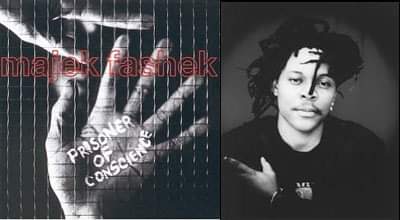
Cassock is no ordinary apparel. Neither are handcuffs choice ornament. So, when by mid 80s a fresh-faced minstrel from a cultural cauldron like Benin City spotting this unlikely fashion combo burst onto the big stage presented by Lagos, the nation was bound to take notice.
His modest academic background notwithstanding, Majekodunmi Fasheke (Majek Fashek) surely demonstrated sufficient cognitive sophistication early enough by adopting cassock and handcuffs as metaphor to break into national consciousness.


Indeed, as the “rainmaker” and author of the distinctive “kpangolo” sound drew his last breath in faraway New York on June 1 in sordid circumstances at great odds with the colossal promise he had presented more than three decades ago, there can be no debate about the monumentality of his talent and the profundity of his messages.


Apart from Fela and King Sunny Ade (KSA), Majek was arguably the nation’s next biggest cultural export and superstar that commanded global audience in the 90s and early this millennium. He belonged to the exclusive caste invested with multiple talents. In addition to a formidable stage presence in his prime accentuated by charming looks and facility to compose stirring songs delivered in rhapsodic voice, he also had more than an average command of the guitar, keyboard and trumpet.
Of course, Majek’s inaugural cassock and handcuffs constituted a haunting oxymoron themselves. One would sketch the halo of a mystic, the spiritual. The other evoked the secular shadow of the underworld.
So, the image we began to see in the horizon was not just of a singer, but also a preacher with biblical zest, invoking strong Old-Testament idioms.
Not surprising, he declared himself “prisoner of conscience”, dramatized powerfully with permanent manacle on the wrists, and chose to call his debut album by that politically-charged phrase.
Bob Marley had popularized Reggae as a genre in protest music in the 60s/70s, adopting dreadlock as totem, glamorizing weeds (marijuana), and romanticizing “Zion” while demonizing “Babylon”.
But by the time “Send Down The Rain” drenched the nation in 1988, Majek Fashek had managed to add cassock and handcuffs to the costume of reggae music. In retrospect, what should be added is that that improvisation certainly carried some profound cultural undertones which however seemed lost to most chroniclers of that age.
The flowing cassock Majek wore and the bell he rang ceaselessly from the outset were quite emblematic of his Aladura (Cherubim and Seraphim) spirituality. His public appearance or performance was always preceded with the ringing of his trademark bell and ritual chant of “Repent! For the kingdom of God is at hand”.
This, of course, was a sharp departure from pre-existing reggae orthodoxy which expressly idolizes Rastafari embodied by Haile Selassie (King of Ethiopia). While not denying Rastafari as angel of Jah, Majek was never shy to proclaim C & S’s Holy Michael and Jesus Christ, later sensationally revealing that he had embarked on a marathon dry fast for inspiration to compose the monster hit, “Send Down the Rain”.
That supreme confidence – if not independence of thought – is expressed in “Religion Na Politics”:
“Religion na politics, not all people know the tricks,
“Religion is politics, some of them is Pharisee
“Religion na politics, dem are hypocrites, fanatics…
“Some claim dem are Muslims, some claim they’re Christians,
“Some say they’re Rastafarians, some say they’re Juju-servers,
“But I & I is one…, we’re one before God, let’s unite and build the world!”
 Louis Odion