
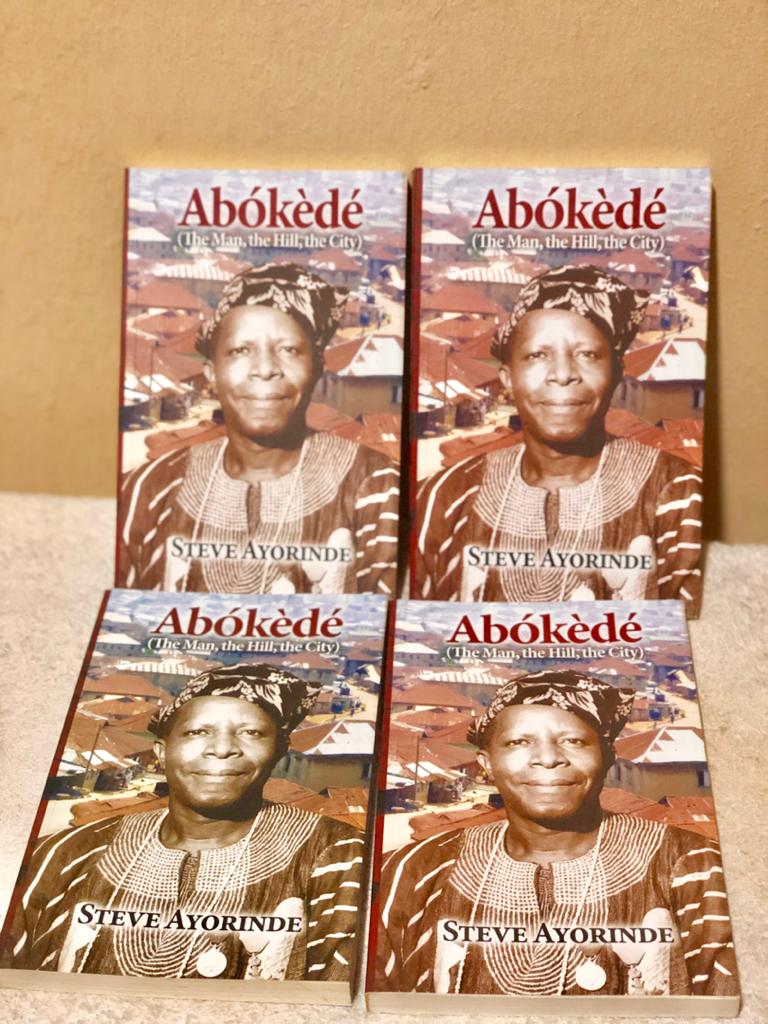
Title: Abokede: The man, the hill, the city
Pages: 180 + 48 pages of pictures)
Price: ₦5000.00
Author: Steve Ayorinde
Publishers: ArtPillar Books (In association with the Institute of African Studies, UI)
Year of publication: 2011
Reviewer: Kole Odutola
On the heels of an Uncle
“life stories are constructed from personal and cultural materials gathered during childhood, and that they are assembled for the first time during adolescence when we begin to form our identity as a person. These are stories about us that are designed to be told, both to ourselves and to others. Review of Dan McAdams’s The Redemptive Self by Nelson
Akin Adeṣọkan, a professor of comparative literature at Bloomington, Indiana, says in the preface of the book under review that there is a relationship between a subject and the author. He does not specify the nature of the relationship but from my reading of Abokede: The man, the hill, the city, I can go on a limb and say this is a relationship between a dexterous musician and his instrument. The fit is observable in the outcome during performance and not the efforts at rehearsals. Steve Ayorinde’s biography of his uncle belongs to that genre of an insider looking in. He is ‘in’ at various levels but also a generational outsider. There are ways in which a life story can be constructed, one is through an extensive interview process with the subject, and the other is a careful construction of coherent narratives pieced together from archival materials or artefacts. Outside of these two methods, it is possible to depend on an official resumé in the chronological presentation of the subject of interest. Steve Ayorinde, deployed all known methods to get to the lid of the subject matter. As in all works of art, so much still needs to be written about a self-made man like Pa Ayọrinde.
All books have stories behind the stories buried in the acknowledgement section. This book is not different. Steve tells the coming to life of the book through people and institutions that helped along the way. The list of those involved served dual purposes; it marked the professional trajectory of the author and presented a graphic constellation of relatives and members of the Ayorinde family. Here you can read off the weight of Steve’s social capital network and how this worked to his advantage from conception to execution. Though Yoruba people say Eniyan ni aṣọ mi (people provide me covering), readers will not fail to note that in Steve’s version Eniyan ni gègé mi (people are my scribal instrument).
For readers who maybe impatient with a review that takes its time, we can cut straight to the chase by starting upfront the nature of the man, Chief John Adeyemi Ayorinde. He is a man of nature and a mind steeped in culture. The High Chief of Ibadan cuts the image of a very cosmopolitan traditionalist who speaks the language of the colonizer with effortless ease. His ability in the spoken and written forms of his mother tongue earned him the accolade of someone who “writes figuratively,….[and] with a proverbial profundity that is integral to the language” (pg. ix). In his own words, he self identifies as a traditional oral poet and the craft has engaged his interest even before he was admitted into a secondary school.
This book was written to immortalize a “quintessential wordsmith, orator and exemplary defender of indigenous culture and tradition” (pg. xiii) who gained national eminence for his moral and cultural capital. In the course of re-presenting the man there is no way the history of his beloved geographical space will not be re-told. There is yet another Ibadan from the J.P Clarke’s “running splash of rot and Gold, like a broken China in the Sun.” The son of the soil through the tongues of good report brought another dimension to the fore. That dimension is not a needle in a haysack, readers can seek out chapters that throw light on “several Ibadan historical and ethnic values, which will no doubt provide many who had savored years of Ibadan festive pleasures on an annual basis, some nostalgic feelings” (pg. xvii). The main protagonist in this book was born during the Oke Ibadan festival thus the name Abokede. On that theme of birth and festival is another confluence of an arts writer bringing to life matters on arts and culture as it relates to his uncle. If like me you thought Okebadan festival was all about libidinous songs, this book helps set the records straight. You may have to deal with an uncommon relationship between lewd songs and sexual rejuvenation (pages 84-85).
Readers who are interested in details of the City of Ibadan’s history and customs will find ample materials in the seventh chapter. However the earlier chapters treat issues that are more philosophical especially the story that led to the “Gentleman Upstairs” (pages 25- 26). It is from this life of pain that the protagonist grew into a life of plenty and worked (or is it walked) his way into national and global reckoning. As you read the stories of the rise and rise of Pa Ayorinde, names of familiar faces and families accompany the narratives. You will not fail to notice that in 1967 Bola Ige was a Civil Commissioner in charge of the Ministry of Agriculture and Natural Resources. Chief Richard Akinjide also made a cameo appearance in one of the pages. The occasion that brought about his name is as dramatic as it is instructive. I say no more.
There are other names in the book, which appear to be minor characters but on further interrogation will surely lead to richer canisters of information. Names such as Leo Frobenius, is mentioned as the author of books on African arts, R. E Bennet, a foreign journalist who, as the cliché goes, put his foot in his mouth and in return got a piece of the tongue of Pa Ayorinde.
Text from textiles is a concept for an exhibition that has fascinated me in a long time. There are about eight pages (51-59) of the detailed processes and painstaking research on Nigerian costumes. This was planned and executed by a distinguished Ad Hoc committee of which Pa Ayorinde played a prominent role. The richness of this documentation will provide Art Historians leads that can open historiographic windows on what Nigerians wore and the history behind those attires. The sub-text of the documentation also throws some light on how FESTAC was organized. The short notice and the civil service bureaucracy that frustrated them are all commentaries on what has become known as a cultural jamboree to outsiders. In the words of Pa Ayorinde, he was glad to be a part of the “event which touched nearly every black person in an intimate and uniquely personal way” (page 59).
Conclusion
As it is said, there is so much in a Penny Newspaper, it takes wisdom to read and digest it all. The young Ayorinde by this book has only set the ball rolling for more books to be written in the nearest future. The need to locate lectures and papers presented by Pa Ayorinde is not only imperative but also a debt owed to the textual immortalization of a man, the Hill and the City that shaped him. As the epigram suggests, “life stories are constructed from personal and cultural materials gathered during childhood, and that they are assembled for the first time during adolescence when we begin to form our identity as a person.” It is my belief that most of the ingredients needed to prepare a fuller meal are within the reach of Steve Ayorinde.