

In the largest restitution of its kind, the Netherlands recently returned 119 Benin Bronzes to the Nigerian government—part of a growing international reckoning with the colonial-era looting of African cultural heritage. A week later, the Museum of Fine Arts, Boston, transferred two additional Benin works to the Oba of Benin.
It is notable that the MFA’s artifacts were not restituted to the state of Nigeria, like those from the Netherlands, but to the current monarch of the ancient Kingdom of Benin, whose great-great-grandfather Ovonramwen was the Oba at the time of the 1987 British raid that saw many of the treasured artworks taken.


The best of Artnet News in your inbox.



Oba Ewuare II, the non-sovereign monarch and custodian of Benin culture, described the return of the Netherlands’ artifacts at a ceremony held in Lagos, Nigeria as a “divine intervention,” adding that the restitution is a testament to the power of prayer and determination. The Nigerian government will now decide how and where the works will be displayed, according to a statement from Dutch officials.
Meanwhile, at Nigeria House in New York City, Matthew Teitelbaum, the MFA’s director, said he was “pleased” to deliver the museum’s two works—a terracotta and iron commemorative head dating to between the 16th and 17th centuries and a bronze relief plaque showing two officials with raised swords from the 16th century—to Prince Aghatise Erediuwa, who received them on behalf of His Royal Majesty.

The Museum of Fine Arts, Boston, returned two Benin Bronzes to His Royal Majesty Omo N’Oba Ewuare II, Oba of Benin, in a ceremony at the Nigeria House in New York City attended by His Royal Highness Prince Aghatise Erediauwa and H.E. Ambassador Samson Itegboje of the Embassy of Nigeria. Courtesy of the MFA, Boston.
“As custodians of these exceptional objects for the past 12 years, it is deeply gratifying to see them returned to their rightful owner,” Teitelbaum said in a statement.
These recent handovers underscore a widening shift in museum ethics and restitution policy and mark an important chapter in the long journey of the Benin Bronzes. There are still thousands of artifacts that the British plundered from the palace that remain in foreign hands and, as these two repatriations underscore, questions linger about who should rightfully receive them—the state or the Oba—as well as what restitution looks like in practice as pressure mounts for Western institutions to return looted objects.

The two Benin artifacts restituted by the Museum of Fine Arts, Boston. Relief Plaque Showing Two Officials with Raised Swords (16th century). Commemorative Head (16th or 17th century). Courtesy of MFA, Boston.
How Did the Benin Bronzes End Up in Western Museums?
Believed to have been founded in the 1200s, the Kingdom of Benin was a rich and powerful city state with an advanced artistic culture. It established its wealth through trading, including with Europe—its famed bronzes, including a large number of plaques, were made in part from brass bracelets from Portugal, beginning around the 1500s.
But during the so-called “Scramble for Africa,” as European countries vied to take control of the continent, British forces increasingly came into conflict with the Beninese, who did not want to annexed into the British Empire. Things came to ahead in January 1897, the Oba warned a British party looking to negotiate more favorable trading terms not to enter the kingdom during a festival. When the party continued to advance, Beninese forces ambushed them, killing six British men and almost 200 African porters. The retaliatory attack by the British the next month left Benin City in ruins, and the palace burned and looted.
Oba Ovonramwen was sent into exile, and the treasures of the palace became “spoils of war.” The U.K. donated a large number to the British Museum, and sold the rest to private dealers and museums in the U.K. and Germany.
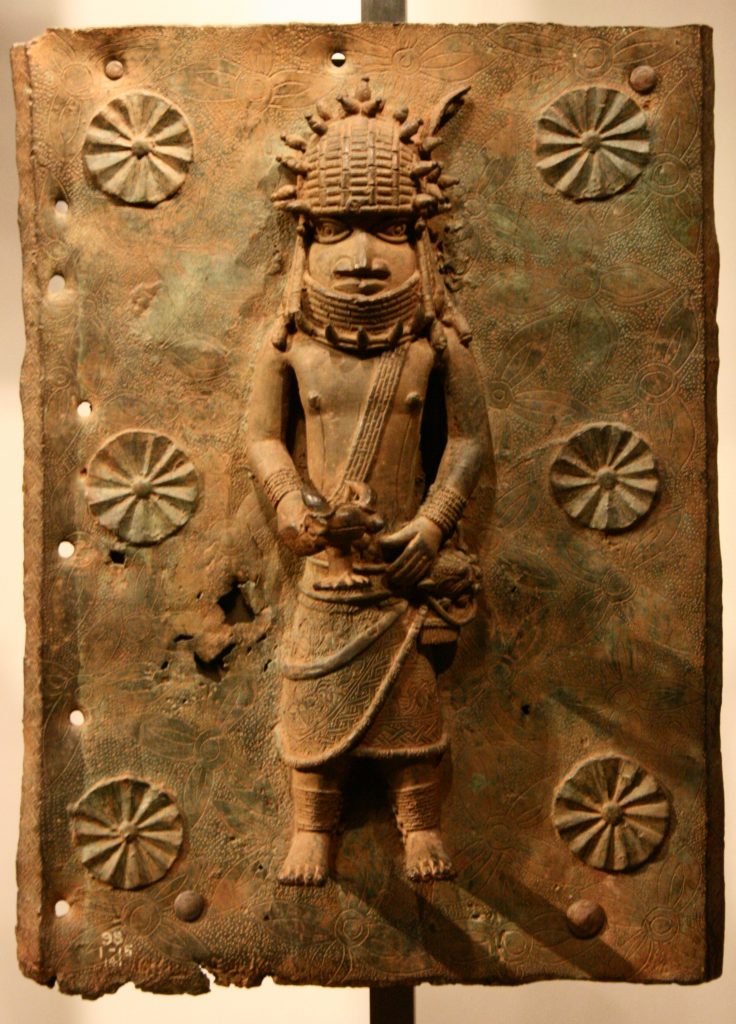
A Benin Bronze plaque in the British Museum’s collection. Photo: Michel Wal, GNU Free Documentation License.
Who’s Driving the Push to Return the Benin Bronzes?
“In the context of cultural heritage, it is typically national governments that are fighting for the return of their objects,” Lawrence Kaye, an art lawyer at New York firm Freedman Normand Friedland, said. The Benin Bronzes present an “interesting exception,” he explained, as they were taken from the Oba, or king, of Benin. The Benin Kingdom was under British rule from 1897 until 1960, when it became part of the independent state of Nigeria. Edo, a state created in 1991 by the Nigerian government, is the modern political entity that includes Benin City and surrounding areas.
In 2023, the Nigerian government officially recognized the Oba’s rights to the Benin Bronzes, clearing the way for a more streamlined restitution process after some disputes between the Oba and the Edo state government. Last year, the Stanley Museum of Art at the University of Iowa became the first institution to directly return artworks to the royal family.
This decision has created some controversy, Kaye said. “For example, it raises questions about whether and how the repatriated objects will be publicly displayed.”
Some of the restituted art is destined for the new Edo Museum of West African Art in Benin City. Designed by architect David Adjaye of Adjaye Associates, it is expected to open next year. It is meant to restore the former glory of the Benin Bronzes, and the royal palace ransacked so long ago. That could be works that have been restituted, if the Oba agrees, or long-term loans from Western institutions. High-tech copies could also be involved, either in Benin City, or at the museums in other countries that have turned over their collections to the Oba.
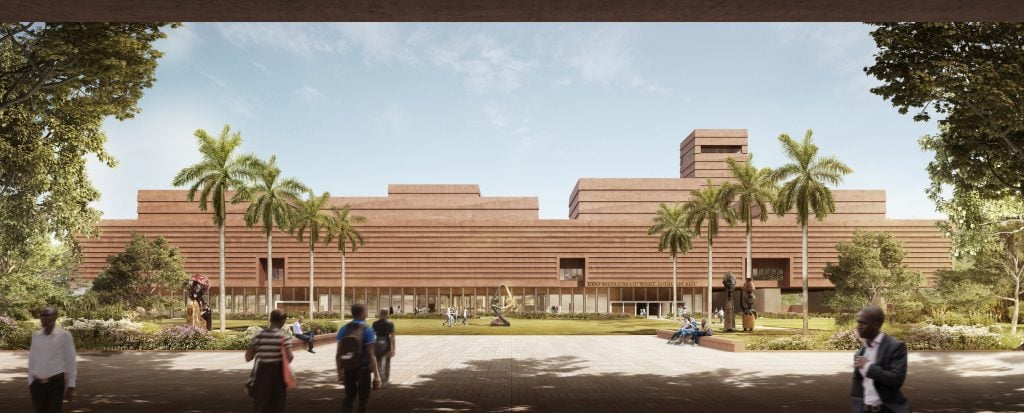
Rendering of main entrance and courtyard garden of the Edo Museum of West African Art (EMOWAA) in Benin City, Nigeria. © Adjaye Associates.
How Have Institutions Responded to Restitution Requests?
Returning the Benin Bronzes seemed like a radical idea as recently as a decade ago. But in 2014, a British medical consultant who had inherited two Benin Bronzes from his grandfather returned them to Uku Akpolokpolo Erediauwa I, the current Oba’s father, igniting Nigerian hopes for a widespread restitution.
The next major development came in March 2016, when students at Cambridge University’s Jesus College successfully lobbied for the removal of a looted Benin rooster sculpture in the college’s dining hall. Later that year, Nigeria made its first formal call for restitution of Benin Bronzes in French museums.

Master of Jesus College Sonita Alleyne with director general of Nigeria’s National Commission for Museums and Monuments professor Abba Isa Tijani ahead of a ceremony at Jesus College, Cambridge, where the looted bronze cockerel, known as the Okukur, will be returned to Nigeria. Photo by Joe Giddens/PA Images via Getty Images.
French President Emmanuel Macron responded with a speech promising to prioritize the return of African heritage, and commissioning an expert report to assess the situation. The report—which was not without its detractors—recommended restitution. Within days of the groundbreaking document’s 2018 release, 26 Benin Bronzes were on their way back to Africa.
Progress remained slow—even with the 2018 Marvel movie Black Panther voicing support for the cause—but steady. Nations around the world were being forced to reevaluate their own stances on the Benin Bronzes.
In 2021, Germany—which had already adopted a code of ethics pertaining to colonial-era artifacts—unveiled plans to return the nation’s Benin Bronzes. And Cambridge became one of the first institutions to restitute a Benin Bronze, returning the rooster that had helped spark a spate of returns to Nigeria. Two months later, the National Gallery of Art in Washington, D.C., did the same. And New York’s Metropolitan Museum of Art also decided to send back a trio of Benin Bronze works (although it still owns many others).

Employees open a glass case containing some of the 113 Benin Bronzes that are being returned to Nigeria after British troops looted them in the late 19th century, during a handing over ceremony at the Wereldmuseum (World Museum) in Leiden on February 19, 2025. Photo: Freek van den Bergh/ANP/AFP via Getty Images.
In 2022, the U.S.’s Smithsonian Institution drafted its first restitution policy, and announced that it would return its Benin Bronzes. Then Scotland’s Glasgow City Council voted to return the 17 Benin Bronzes in the Glasgow Museums collection. And before year’s end, London’s Horniman Museum and Gardens had become the first public U.K. institution to restitute its collection of Benin bronzes.
The Netherlands’ return of 119 Benin Bronzes, first announced in February, has provided additional momentum to broader restitution causes, extending its initiative to return stolen artifacts to all of its former colonies.

A National Museum exhibition officer adjusts returned artifacts from the “Benin Bronzes” collection during the signing ceremony and handover of the 119 Benin bronzes returned from the Netherlands to Nigeria at the National museum Onikan in Lagos on June 21, 2025. Photo: by Toyin Adedokun/AFP.
What Does the Future Hold for the Benin Bronzes—and Restitution More Broadly?
The future of the Benin Bronzes remains a big question, especially as more and more museums finally agree to return theirs. Despite considerable progress, the British Museum in London remains a holdout—and it has the world’s largest collection of Benin Bronzes, with 928 works in total. The institution has cited the British Museum Act 1963, which prevents the museum from deaccessioning objects from its collection—although U.K. laws governing other institutions have recently been loosened. But as more nations and institutions decide in favor of repatriation, the pressure will presumably mount for the British Museum to follow suit.
“We have seen a shift in the discourse surrounding repatriation of cultural property—with increased public acceptance of the return of objects that were taken during colonial times,” Kaye said. “This has had a positive impact on the willingness of institutions and governments to return colonial art, even when there is not a strict legal obligation to do so.”
In some instances, there are laws and treaties that guide restitution principles, such as UNESCO’s 1970 Convention, which outlaws looting and smuggling antiquities, and the 1998 Washington Conference Principles on Nazi-Looted Art. But there has not been the same international consensus as to how to address the issue of native artifacts taken by colonizers.
“In the absence of special laws enacted to address repatriation of colonial art, timeliness limitations will often have barred ownership claims (among other legal obstacles). But even in those cases, museums and governments may feel morally obligated to return the objects,” Kaye added. “At the end of the day, if an object was looted as a result of war, conflict, or other acts of colonialism, those objects should be returned to their rightful place.”
Credit: news.artnet