
I. The Man Who Ate Himself
In 2016, 24 year old Nicholas Perry wanted to be big online. He started uploading videos to his YouTube channel in which he pursued his passion—playing the violin—and extolled the virtues of veganism. He went largely unnoticed.
A year later, he abandoned veganism, citing health concerns. Now free to eat whatever he wanted, he began uploading mukbang videos of himself consuming various dishes while talking to the camera, as if having dinner with a friend.


These new videos quickly found a sizable audience, but as the audience grew, so did their demands. The comments sections of the videos soon became filled with people challenging Perry to eat as much as he physically could. Eager to please, he began to set himself torturous eating challenges, each bigger than the last. His audience applauded, but always demanded more. Soon, he was filming himself eating entire menus of fast food restaurants in one sitting.


In some respects, all his eating paid off; Nikocado Avocado, as Perry is now better known, has amassed over six million subscribers across six channels on YouTube. By satisfying the escalating demands of his audience, he got his wish of blowing up and being big online. But the cost was that he blew up and became big in ways he hadn’t anticipated.

Nikocado, moulded by his audience’s desires into a cartoonish extreme, is now a wholly different character from Nicholas Perry, the vegan violinist who first started making videos. Where Perry was mild-mannered and health conscious, Nikocado is loud, abrasive, and spectacularly grotesque. Where Perry was a picky eater, Nikocado devoured everything he could, including finally Perry himself. The rampant appetite for attention caused the person to be subsumed by the persona.
We often talk of “captive audiences,” regarding the performer as hypnotizing their viewers. But just as often, it’s the viewers hypnotizing the performer. This disease, of which Perry is but one victim of many, is known as audience capture, and it’s essential to understanding influencers in particular and the online ecosystem in general.
II. Lost in the Looking Glass
Audience capture is an irresistible force in the world of influencing, because it’s not just a conscious process but also an unconscious one. While it may ostensibly appear to be a simple case of influencers making a business decision to create more of the content they believe audiences want, and then being incentivized by engagement numbers to remain in this niche forever, it’s actually deeper than that. It involves the gradual and unwitting replacement of a person’s identity with one custom-made for the audience.
To understand how, we must consider how people come to define themselves. A person’s identity is being constantly refined, so it needs constant feedback. That feedback typically comes from other people, not so much by what they say they see as by what we think they see. We develop our personalities by imagining ourselves through others’ eyes, using their borrowed gazes like mirrors to dress ourselves.
Just as lacking a mirror to dress ourselves leaves us disheveled, so lacking other people’s eyes to refine our personalities leaves us uncouth. This is why those raised in isolation, like poor Genie, become feral humans, adopting the character of beasts.
Put simply, in order to be someone, we need someone to be someone for. Our personalities develop as a role we perform for other people, fulfilling the expectations we think they have of us. The American sociologist Charles Cooley dubbed this phenomenon “the looking glass self.” Evidence for it is diverse, and includes the everyday experience of seeing ourselves through imagined eyes in social situations (the spotlight effect), the tendency for people to alter their behavior when in the presence of pictures of eyes (the watching-eye effect), and the tendency for people in virtual spaces to adopt the traits of their avatars in an attempt to fulfill expectations (the Proteus effect).
When we lived in small tight-knit communities, the looking glass self helped us to become the people our loved ones needed us to be. The “Michelangelo phenomenon” is the name given to the semi-conscious cycle of refinement and feedback whereby lovers who genuinely care what each other think gradually grow closer to their partner’s original ideal of them.
The problem is, we no longer live solely among those we know well. We’re now forced to refine our personalities by the countless eyes of strangers. And this has begun to affect the process by which we develop our identities.
Gradually we’re all gaining online audiences, and we don’t really know these people. We can only gauge who they are by what some of them post online, and what people post online is not indicative of who they really are. As such, the people we’re increasingly becoming someone for are an abstract illusion.
When influencers are analyzing audience feedback, they often find that their more outlandish behavior receives the most attention and approval, which leads them to recalibrate their personalities according to far more extreme social cues than those they’d receive in real life. In doing this they exaggerate the more idiosyncratic facets of their personalities, becoming crude caricatures of themselves.
The caricature quickly becomes the influencer’s distinct brand, and all subsequent attempts by the influencer to remain on-brand and fulfill audience expectations require them to act like the caricature. As the caricature becomes more familiar than the person, both to the audience and to the influencer, it comes to be regarded by both as the only honest expression of the influencer, so that any deviation from it soon looks and feels inauthentic. At that point the persona has eclipsed the person, and the audience has captured the influencer.
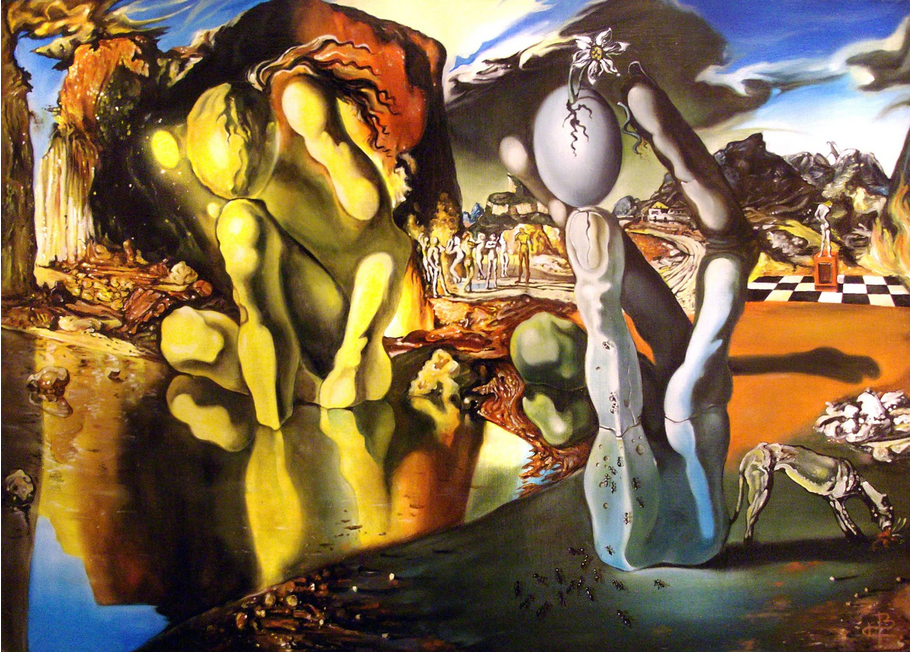
The old Greek legends tell of Narcissus, a youth so handsome he became besotted by his own reflection. Unable to look away from his image in the surface of the waters, he fell still forever, and was transformed by the gods into a flower. Similarly, as influencers glimpse their idealized online personas reflected back at them on screens, they too are in danger of becoming eternally besotted by how they appear, and in so doing, forgetting who they were, or could be.
III. The Prostitution of the Intellect
Audience capture is a particular problem in politics, due to both phenomena being driven by popular approval. On Twitter I’ve watched many political influencers gradually become radicalized by their audiences, starting off moderate but following their increasingly extreme followers toward the fringes.
One example is Louise Mensch, a once-respectable journalist and former Conservative politician who in 2016 published a story about Trump’s alleged ties to Russia, which went viral. She subsequently gained a huge audience of #NotMyPresident #Resist types, and, encouraged by her new, indignant audience to uncover more evidence of Trump’s corruption, she appears to have begun to view herself as the one who’d prove Russiagate and bring down the Donald. The immense responsibility she felt to her audience seems to have motivated her to see dramatic patterns in pure noise, and to concoct increasingly speculative conspiracy theories about Trump and Russia, such as the claim that Vladimir Putin assassinated Andrew Breitbart, the founder of Breitbart News, so his job would go to Trump ally Steve Bannon. When her former allies, such as the hacker known as “the Jester,” expressed concern over her new trajectory toward fringe theories, she doubled down, accusing all her critics of being Trump shills or Putin shills.
Another, more recent victim of audience capture is Maajid Nawaz. I’ve always liked Maajid, and as someone who once worked with the organization he founded, the counter terrorism think-tank Quilliam, I’m aware of how careful and considered he can be. Unfortunately, since the pandemic, he’s been different. His descent began with him posting a few vague theories about the virus being a fraud perpetrated on an unsuspecting public, and after his posts went viral he found himself being inundated with new “Covid-skeptic” followers, who showered him with new leads to chase.
In January, after he lost his position at the radio show LBC due to his increasingly careless theories about a secretive New World Order, he implied his firing was part of the conspiracy to silence the truth, and urged his loyal followers to subscribe to his Substack, as this was now his family’s only source of income. His new audience proved to be generous with both money and attention, and his need to meet their expectations seems to have spurred him, consciously or unconsciously, to double down on his more extreme views. Now almost everything he writes about, from Covid to Ukraine, he somehow ties to the shadowy New World Order.
Motivated by his audience to continually uncover new truths about the conspiracy, Maajid has been forced to scrape the barrel of claims. His recent work is his wildest yet, combining common tropes like resurrected Nazi eugenics programs, satanic rituals, and the Bilderberg meeting. Among the fields he now relies on for his evidence are… numerology.
Maajid أبو عمّار @MaajidNawazBritish MPs have begun voting on a motion of ‘no confidence’ in the UK Parliament against Prime Minister Johnson. The vote commenced at: 6pm, on the 6th day, of the 6th month. No joke. آل عمران:[54] وَمَكَرُوا وَمَكَرَ اللَّهُ وَاللَّهُ خَيْرُ الْمَاكِرِينَ Maajid أبو عمّار @MaajidNawaz3 of our British MPs were at this dodgy af global Bilderberg meeting: Michael Gove (con) Tom Tugendhat (con) David Lammy (lab) Their attendance alone must be remembered if they ever seek leadership of their respective political parties and hence try to become PM of Britain https://t.co/EKohVzfaiNJune 6th 2022287 Retweets957 Likes
There is obvious value in investigating the corruption that pervades the misty pinnacles of power, but by defining himself by his audience’s view of him as the uncoverer of a global conspiracy, Maajid has ensured he’ll see evidence of the conspiracy in all things—even in evidence against it—and if he does one day realize his pattern-matching is a product of biases such as the clustering illusion and the Baader-Meinhof effect, it’ll be all but impossible for him to admit it.
IV. Muddying the Waters to Obscure the Reflection
Maajid, Mensch, and Perry are far from the only victims of audience capture. Given how fundamental the looking glass self is to the development of our personalities, every influencer has likely been affected by it to some degree. And that includes me.
I’m no authority on the degree to which my mind has been captured by you, my audience. But I do suspect that audience capture affects me far less than most influencers because I’ve taken specific steps to avoid it. I was aware of the pitfall long before I became an influencer. I wanted an audience, but I also knew that having the wrong audience would be worse than having no audience, because they’d constrain me with their expectations, forcing me to focus on one tiny niche of my worldview at the expense of everything else, until I became a parody of myself.
It was clear to me that the only way to resist becoming what other people wanted me to be was to have a strong sense of who I wanted to be. And who I wanted to be was someone immune to audience capture, someone who thinks his own thoughts, decides his own destiny, and above all, never stops growing.
I knew there were limits to my desired independence, because, whether we like it or not, we all become like the people we surround ourselves with. So I surrounded myself with the people I wanted to be like. On Twitter I cultivated a reasonable, open-minded audience by posting reasonable, open-minded tweets. The biggest jumps in my follower count came from my megathreads of mental models, which cover so many topics from so many perspectives that the people who appreciated them enough to follow me would need to be willing to consider new perspectives. Naturally these people came to view me as, and expected me to be, an independent thinker as open to learning and growing as themselves.
In this way I ensured that my brand image—the person that my audience expects me to be—was in alignment with my ideal image—the person I want to be. So even though audience capture likely does affect me in some way, it only makes me more like the person I want to be. I hacked the system.
My brand image is, admittedly, diffuse and weak. My Twitter bio is “saboteur of narratives,” and few people can say for sure what I’m about, other than vague things like “thinker” or “dumb fuck.” And that’s how I like it. My vagueness makes me hard to pigeonhole, predict, and capture.
For this same reason, I’m suspicious of those with strong, sharply delineated brands. Human beings are capricious and largely formless storms of idiosyncrasies, so a human only develops a clear and distinct identity through the artifice of performance.
Nikocado has a clear and distinct identity, but its clarity and distinctness make it hard to escape. He may be a millionaire with legions of fans, but his videos, filled with complaints-disguised-as-jokes about his poor health, hardly make him seem happy.
Unfortunately, salvation seems out of reach for him because his audience, or at least the audience he imagines, demands he be the same as he was yesterday. And even if he were to find the strength to break character and be himself again, he’s been acting for so long that stopping would only make him feel like an imposter.
This is the ultimate trapdoor in the hall of fame; to become a prisoner of one’s own persona. The desire for recognition in an increasingly atomized world lures us to be who strangers wish us to be. And with personal development so arduous and lonely, there is ease and comfort in crowdsourcing your identity. But amid such temptations, it’s worth remembering that when you become who your audience expects at the expense of who you are, the affection you receive is not intended for you but for the character you’re playing, a character you’ll eventually tire of. And so be warned: being someone often means being fake, and if you chase the approval of others, you may, in the end, lose the approval of yourself.
Source: gurwinder.substack.com