
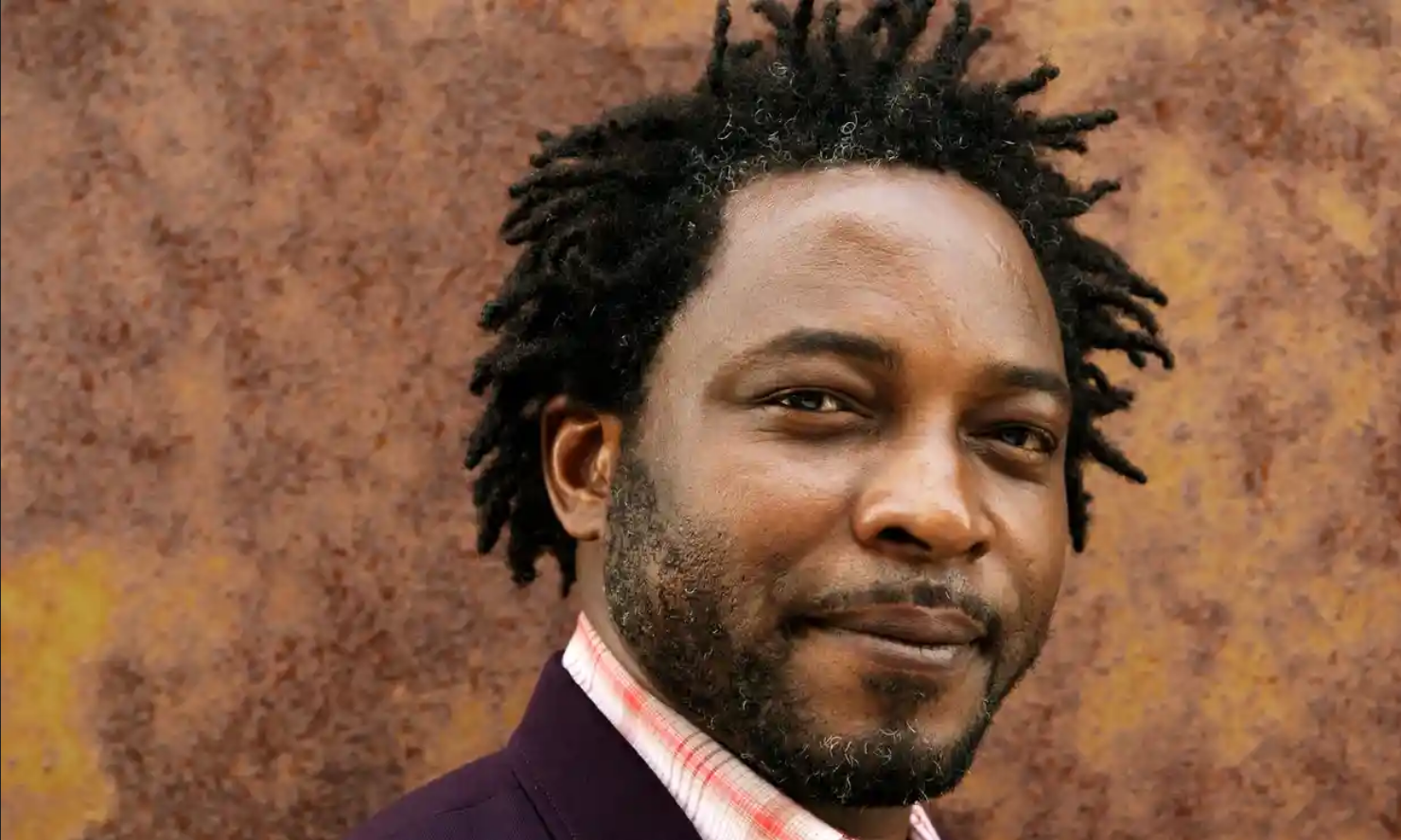
Poet, novelist, playwright, screenwriter, producer, director, film-maker, documentary photographer – many labels might attach to Biyi Bandele, who has died unexpectedly aged 54.
His directorial feature film debut, Half of a Yellow Sun (2013), based on the 2006 novel by Chimamanda Ngozi Adichie, was shot in Nigeria, produced by Andrea Calderwood and starred Chiwetel Ejiofor and Thandiwe Newton. Seven years in the making, it required Biyi to confront unforeseen battles; among many challenges, members of the cast and crew were afflicted by typhoid and malaria during the shoot. It was no mean achievement that the film went on to critical and commercial success.


In 2015 came another feature film, Fifty. In 2020, his BBC Arena documentary Fela Kuti: Father of Afrobeat aired to more acclaim, and he recently co-directed the Netflix four-part thriller Blood Sisters (2022). His final feature, Elesin Oba, The King’s Horseman, adapted from Wole Soyinka’s 1975 play Death and the King’s Horseman, premiered at the Toronto international film festival in September and is due to be released on Netflix this autumn.


“The more he achieved, the further he aimed,” wrote Soyinka last month. “Biyi was a unique, all-responsive talent … He was versatile – no sooner [had he] invaded one genre than he commenced exploration of another, with the former still hovering over his creative horizon as unfinished business.” Biyi himself asserted: “I consider myself to be a storyteller. I use all sorts of media, but I am first and foremost a writer.”
His debut novel, The Man Who Came in From the Back of Beyond, was published in 1991.
An Observer review noted how Biyi revelled in the sheer joy of words: “No English or American novelist since Henry James has dared use words such as ‘mitigated’ and ‘mandatory’ without irony.” Biyi wrote “like fury”, noted another reviewer, when his novel The Sympathetic Undertaker: And Other Dreams was published later that year (“the humour is wild and rather funnier than most political satire”).
In 1992, I was on a panel at the Arts Council – when Alastair Niven was literature director – that happily gave Biyi a writer’s bursary, enabling him to devote further time to writing. But he was making his mark in other British cultural circles, too, working zealously in both fringe and mainstream theatre – for the Royal Court, the Royal Shakespeare Company and the Talawa Theatre Company – as well as in radio and television.
Advertisement
His 1992 TV screenplay Not Even God Is Wise Enough was directed by Danny Boyle; in 1993 came his first published play, Marching for Fausa, staged at the Royal Court by the English Stage Company; then other plays in 1994, Resurrections in the Season of the Longest Drought (staged by Talawa at the Cochrane theatre) and Two Horsemen (the Gate); and in 1995 publication of Death Catches the Hunter/Me and the Boys.
He was resident dramatist with the National Theatre Studio in 1996, and that year added Bad Boy Blues on BBC Two to his TV credits. His play Happy Birthday, Mister Deka D premiered at the Edinburgh festival in 1999, and he found fresh resonance in fearless adaptations of literary classics: Chinua Achebe’s 1958 book Things Fall Apart, Aphra Behn’s 1688 Oroonoko, and Samuel Johnson’s 1759 Rasselas.
Biyi brought his own novel The Street (1999) to the stage as Brixton Stories in 2001, the same year as he adapted Lorca’s Yerma and dramatised for Radio 4 Colin MacInnes’s City of Spades. Meanwhile, he was Judith E Wilson fellow at Churchill College, Cambridge (2000-02), and Royal Literary Fund resident playwright at the Bush theatre (2002-03).
His next big step was to become a film director, a role he hoped would allow him more creative control over how his scripts were interpreted. During almost a decade of what he saw as an apprenticeship, he watched up to four films a day, also writing screenplays for others, until he felt ready to take on directing.
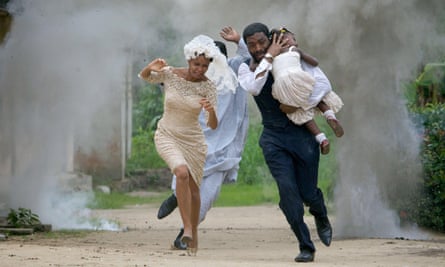
Thandiwe Newton and Chiwetel Ejiofor in Half of a Yellow Sun, 2013, directed by Biyi Bandele. Photograph: Maximum Film/Alamy
Born in Kafanchan, a railway town in northern Nigeria, to Yoruba parents from Abeokuta in the south-west, Biyi was affected by the experiences of his father, Solomon Bamidele Thomas, an engineer with the Nigerian Railway Corporation and veteran of the second world war Burma campaign who had returned home a broken man, and whose conversation was seeded with tales of strife. “That was probably one of the things that turned me into a writer,” Biyi said.
His father, between spells of volatile behaviour, introduced Biyi to the local library, where he immersed himself in the worlds that books offered. He started putting pen to paper, influenced, too, by his mother, Taiye.
A natural storyteller, she was a trader who had a kiosk selling food at the train station, and Biyi spent much time there, later recounting: “I knew from a very early age who the thieves and pickpockets were …”
He wrote about what he knew, and a story for a regional newspaper became his first paid piece, at the age of 14. While continuing his schooling in Kafanchan, Biyi left his parents’ house, earned his living doing odd jobs, and began his first novel at 16.
In 1987, Biyi went to Lagos, staying with a cousin, and gained a place to study drama at Obafemi Awolowo University, Ile-Ife. That year he entered a BBC playwriting competition, and the following year the BBC Arts and Africa Poetry Award competition, a poem of his being chosen from 4,500 submissions for inclusion in the anthology The Fate of Vultures.
In 1989, his unpublished play Rain won the International Student Playscript Competition sponsored by the British Council (judged by Alan Ayckbourn), and his poetry collection, Waiting for Others, won the British Council Lagos award. Rewarded with a year’s scholarship, in 1990 Biyi flew to the UK, bearing the manuscripts of his first two novels. Within weeks he had a publisher and a job offer on the arts desk of a Nigerian weekly paper in London, and decided to remain in the capital.
He wrote movingly about the price his whole family had paid as a result of the war-trauma suffered by his father, who died in 1984. It was in 2002, at the funeral of his mother, who had “heroically endured [her husband’s] seismic mood swings for much longer than was fair on any one human being”, that Biyi resolved finally to write what he had wanted to since he was 18: a novel about Burma – “this war that had so shaped my father, and in turn my own childhood and subsequent life”.
Burma Boy (2007), now translated into several languages, is a riveting story with unforgettable characters, drawing on his father’s experiences as a young soldier in the British army, compounded by months of archival research in the Imperial War Museum.
Passionately committed to every venture, Biyi displayed great urgency in all his productivity. He was a beguiling mix of daring and reticence, self-confidence and humility, with bravely ambitious dreams.
He had been eagerly working on a new novel. Yorùbá Boy Running – which is due to be published next year – began to take shape while Biyi was on a Fulbright research fellowship at New York University’s Tisch School of the Arts, as a “fictionalised history” of Samuel Àjàyí Crowther, the first African bishop in the Anglican church.
Biyi regarded Crowther’s story as personal: it mirrored that of his great-great-grandfather – who had also been abducted and sold into enslavement, eventually finding his way back to Yorubaland.
He is survived by Temitayo, his daughter with Andrea Calderwood.
Biyi Bandele, writer and film director, born 13 October 1967; died 7 August 2022
Source: www.theguardian.com