

In India’s scorching summer heat, the ancient practice of chilling water in terracotta pots is inspiring new trends – from cooling towers to screens for buildings.
Nandita Iyer hates chilled water. And yet, when temperatures soared in India this May, with even her home-city of Bengaluru hitting a record high, the cookbook author and food blogger knew she had to do something to stay hydrated. And so she turned to a favourite childhood fixture: the matka – a terracotta pot composed of two different types of clay and designed to act as domestic water cooler in the home.


“I have sensitive teeth, so drinking refrigerated water feels like a shock to my system; the matka keeps water just cool enough that it’s comforting to sip on,” she says, recalling how a wet muslin cloth on top of the pot helped lower the water temperature further still. “I remembered how nice this naturally chilled water would feel in the hot Mumbai summers growing up, so when Bengaluru weather started behaving like Mumbai, I decided to get a similar pot.”


The matka has ancient roots. When water fills a terracotta pot, it sinks into every pore and crevice. As the water trapped inside these pores evaporates, the process slowly draws out the latent heat from the water within. The pot cools down after losing its heat to evaporation and so the remaining water inside it cools down too. For centuries, therefore, India’s rural areas have turned to earthen pots for their cooling needs – with the earliest known records dating back to the Harappan civilisation, more than 3,000 years ago.
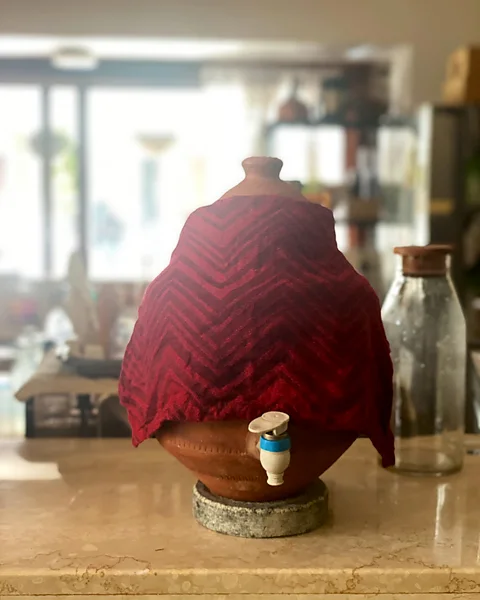
As someone who cooks a lot, and the author of Everyday Superfoods, Iyer says there’s hardly any room in her fridge to chill several bottles of water, so her matka ends up saving precious space as well.
But in recent years, as India contends with extreme heat, the need for cool is growing more urgent. India’s heatwaves this summer have been relentless, with a weather station in Delhi tentatively recording temperatures as high as 52.3C (126.1F), which would be a record if confirmed. From 2019 to 2023, the need for air conditioning on really hot days saw the nation’s average hourly demand for power on rise 28%.
With cooling solutions now vital to survival, terracotta’s ancient application is finding new use far beyond domestic kitchens.
An ancient technology finds new life
Terracotta is Italian for “baked earth” and featured prominently in the ancient world, from Chinese and Greek pottery to Egyptian art. But in 2014, Monish Siripurapu, founder and principal architect of CoolAnt, part of Ant Studios near New Delhi, found himself turning to this ancient material with fresh eyes.
One of his clients, an electronics manufacturer, had a problem. A diesel generator on their premises was spewing so much hot air in the space between two buildings that the heat was unbearable for employees, causing headaches and nausea. Siripurapu wanted to see if terracotta, combined with new techniques, could help: “Keeping nature as the central focus in all my work, I wanted to explore emerging technologies”.
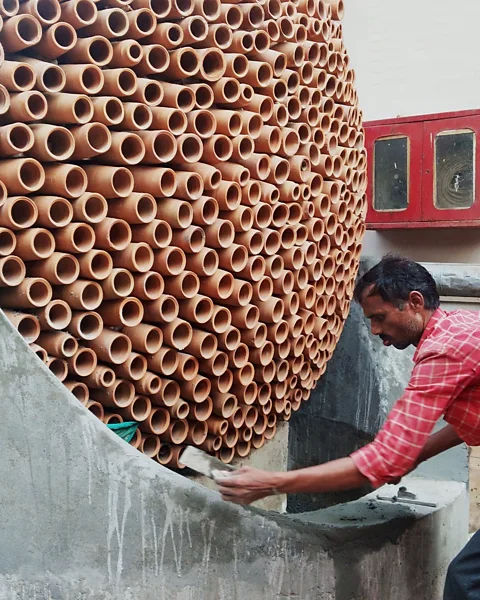
The thought of the matka crossed Siripurapu’s mind. “The water in the mud pot is naturally cool because when it evaporates, it sucks the heat from the pot. But what if I reversed that process? It struck me that we could cool the air around the terracotta in the same way,” he says. In Siripurapu’s design, recycled water is pumped over the terracotta. As the water evaporates from inside the terracotta’s pores, it cools the air around it.
Called the Beehive, around 800-900 terracotta cones were handcrafted and arranged by CoolAnt in a honeycomb design fitted around a stainless steel framework. “Stacking the cones like a beehive improves the surface area needed for effective cooling,” says Siripurapu.
Since their first beehive installation, the company has created 35 such cooling towers in schools, public spaces, airports and commercial buildings across the country, from Pune to Jaipur. In addition to the beehive design, they’ve also experimented with designs that stack the terracotta in different shapes, and even with one that uses no water at all.
Researchers have also experimented with terracotta cooling prototypes. Mechanical engineering students from Maharashtra, India, built a terracotta air conditioner, that used a fan to suck in air and expel it over wet terracotta. This resulted in a 1.5C (2.7F) drop in ambient temperature, they reported.
Architectural firms in India say their terracotta installations have produced far more significant drops in temperature – over 6C (10.8F), and can cool outdoor spaces and entire buildings more naturally.
Through videos sent by clients and site visits, CoolAnt says it has recorded a drop of up to 15C (27F), using designs like their Beehive. “It did much better than we anticipated,” Siripurapu says. However, that drop in temperature depends on an area’s wet bulb temperatures (a measure of both heat and humidity in the atmosphere). If it’s already very humid, then there can’t be such a steep drop, because the potential for evaporation is less, he notes. (Think of the sky over a city like a wet sponge – if there’s already too much water, it can’t absorb more.) And yet even a few degrees drop in temperature can make a crucial difference.
Buildings that breathe
Ant Studio are also far from the only architectural company deploying terracotta as a cooling solution. “In the last 100 years, modern technologies have revolutionised our air cooling. However, they have impacted our environment adversely,” says Avinash Ankalge, architect and one of the co-founders of A Threshold, an architectural firm based in Bengaluru that has been experimenting with recycled terracotta to build passive cooling systems for buildings.
“We are turning to terracotta for many of our recent projects,” says Ankalge. “We use it in many ways.” For instance, reclaimed roof ridge tiles from a nearby factory were used to create terracotta screens. The designs are inspired by nature and they wrap around buildings like a protective skin, he says.
In a commercial building in southern Bengaluru, one of A Threshold’s designs for a terracotta shade is fitted into the southern side of the building, to keep the Sun at bay.
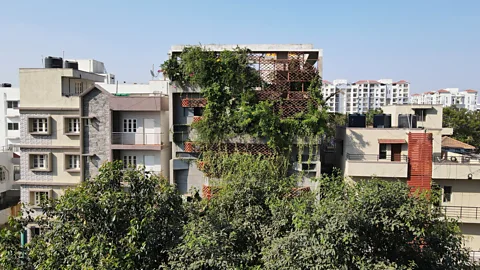
“Around 12-3pm, when the Sun is at its most intense, the shadow of the top tile is cast over the bottom, ensuring that the glare doesn’t enter the building,” says Ankalge. “We call it the mutual shading principle. This was used in many older Indian cities in Rajasthan – especially in Jaipur and Jaisalmer. It was used in homes, palaces, everywhere – nearly 400 to 500 years ago.”
In modern designs that use this principle, the main building begins 3 to 4ft (91 to 121cm) behind the terracotta screen structure. The tiles are arranged like a bird’s open beak, the top one casting deep shadows and an overhead sprinkler system, set to go off during the hottest part of the day, ensures evaporative cooling.
“Terracotta, being a natural material, is always taken over by vegetation which has a further cooling effect. It supports life and a healthy biodiversity. You still have plenty of light streaming indoors, just not heat,” says Ankalge. “We’re creating a micro-climate within a home – and moderating the extreme heat outside. It’s an acoustic screen as well, because it cuts the noise from outside and provides privacy for occupants.”
In a farmyard 25 miles (40km) from Bengaluru, A Threshold has experimented with terracotta bricks as an alternative to regular bricks for cooling. They’re cheaper and better for the environment, says Ankalge. Terracotta bricks bake at between 600 and 700C (1,112 to 1,292 F), half the temperatures required to bake regular bricks, and they’ve observed a temperature drop of 5-8C (9-14.4F) inside the resulting buildings.
Artisanal insights
In their mission to cool spaces, architectural firms are also enlisting the help of India’s indigenous terracotta artisans.
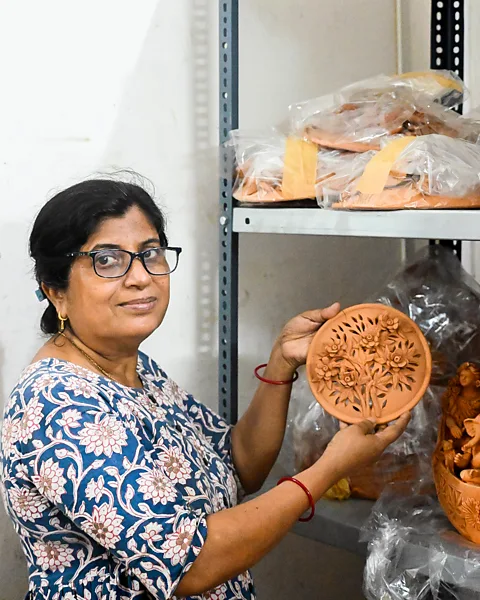
One of them is Dolan Kundu Mondal, who is based in Kolkata and whose terracotta artwork has won a national award. As a child, Mondal spent her days collecting clay from the riverbank to shape into tiny dolls, animals, birds and huts. Her own home was also built with clay, but without any waterproofing, so after every monsoon, the house would be completely destroyed. “My grandmother, elder sister and I would chop bits of straw to mix in the clay and rebuild the house for us to live.”
Mondal says she always dreamed of sculpting something new with clay, and recently had an offer to work on a terracotta screen for a home. “From a very early age, I’ve always lived in the embrace of clay and clay in my embrace,” says Mondal.
Soumen Maity, vice president of development alternatives, a think tank based in Gurugram in northern India, says it’s heartening that terracotta constructions are providing rural artisans with a livelihood – but there are some drawbacks. The additional terracotta structures on buildings – such as screens and panels – can take up a lot of space in already cramped cities. Plus the cooling efficiency can decrease over time: micro pores in the terracotta can become clogged by mineral deposits, making cleaning and meticulous maintenance essential.
If terracotta is used more widely as a building material and manufactured to scale in factories, then there could also be another hidden cost: more energy required for transportation, points out Niyati Gupta, a senior associate in New Delhi with the climate programme at the think tank the World Resources Institute.
“Terracotta tiles manufactured in a factory environment tend to be heavier than the conventional clay bricks that artisans craft by hand, and will consume fertile soil [that could otherwise be used for agriculture]” Gupta says. Locally crafted and on-site baked terracotta tiles offer a more climate friendly solution, but as cooling needs grow, factory production may be inevitable.