
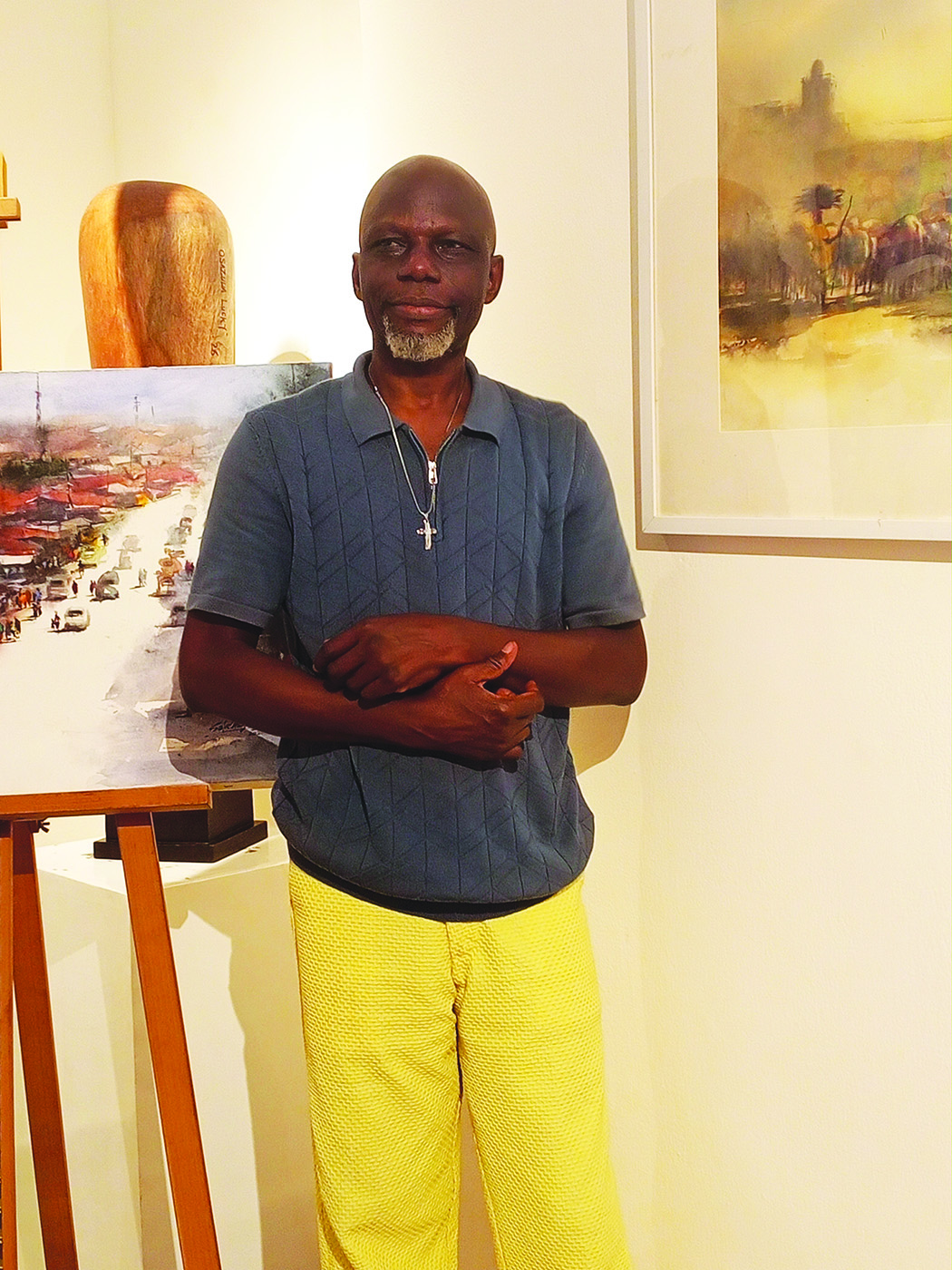
A wet morning preceded the press preview of the watercolour paintings that now cover the freshly painted walls of Mydrim Gallery, South-West Ikoyi. The exhibition, Echoes of the Commute, opens on October 10. At a meeting with a handful of art writers on September 23, painter Olumuyiwa Afolabi Olusola, widely known as Sola Olumuyiwa, spoke about his growing interest in storytelling and the journey that has taken his practice from a corporate career to a succession of gallery exhibitions. ShopPaint Sets
His third solo exhibition marks an ambitious expansion of the possibilities of watercolour on the Lagos art scene. Traditionally associated with delicate sketches and small studies, the medium takes on a considerably larger scale in Echoes of the Commute.
The exhibition brings together large watercolour paintings that look at the daily commute as a shared Lagos experience — its movement, congestion, colour and occasional moments of stillness.
Watercolour is an unforgiving medium. Unlike oil or acrylic, which allow the painter to build up layers, scrape away pigment or make corrections, it leaves little room for retreat once the brush touches the surface. It demands speed, precision and planning. These demands are evident in Olumuyiwa’s handling of the medium.
Whether depicting a sunset over Makoko or floating rafts on the Lagos Lagoon, he uses washes and controlled brushwork to suggest both the physical character of the scene and the changing quality of its light. BuyMaps
In Echoes of the Commute, he pushes the medium beyond its conventional scale. His larger works combine carefully observed structures with the fluidity that watercolour permits. Wet-on-wet washes dissolve some forms while sharper details bring others into focus, creating the sense of movement associated with Lagos traffic.
Light is central to the paintings. Instead of covering the surface with opaque white, Olumuyiwa allows the paper to provide much of the luminosity, building transparent layers of indigo, ochre and warm amber around it.
At the centre of the exhibition are works such as “Urban Dilemma” and “Home Coming”. Here, familiar Lagos fixtures, particularly the ubiquitous yellow Danfo buses, become more than symbols of traffic. They appear as collective vessels carrying people through a city in constant motion.
Olumuyiwa is less interested in photographic exactitude than in mood and memory. Groups of commuters waiting at bus stops, traders moving through busy crossroads and solitary figures heading towards the horizon dissolve at the edges into washes of colour. The effect suggests how, during the daily commute, individual identities can momentarily disappear into the larger experience of moving through the city. BrowseArt Prints
The exhibition follows “First Insight” and “A Few Minutes After”, earlier presentations in which Olumuyiwa used watercolour to explore quiet resistance, social commentary and waterfront communities such as Makoko. With Echoes of the Commute, his attention shifts towards the broader rhythm of urban movement, while retaining an interest in the histories and environments that shape Nigerian life, including the familiar brown roofs of Ibadan.
According to the assistant curator, Idowu Bankole, the gallery readily embraced Olumuyiwa’s proposal, confident in the artist’s vision and his ability to expand expectations of what watercolour can achieve. In an art market where oil and mixed-media works dominate, the decision to devote an exhibition to large-scale watercolour is itself a statement.
Echoes of the Commute invites viewers to slow down and look more closely at scenes that are usually experienced in passing: the waiting commuter, the crowded bus stop, the movement of traffic and the fleeting light across the city. In Olumuyiwa’s hands, watercolour becomes a means of holding these everyday moments still.
Credit: This Day