
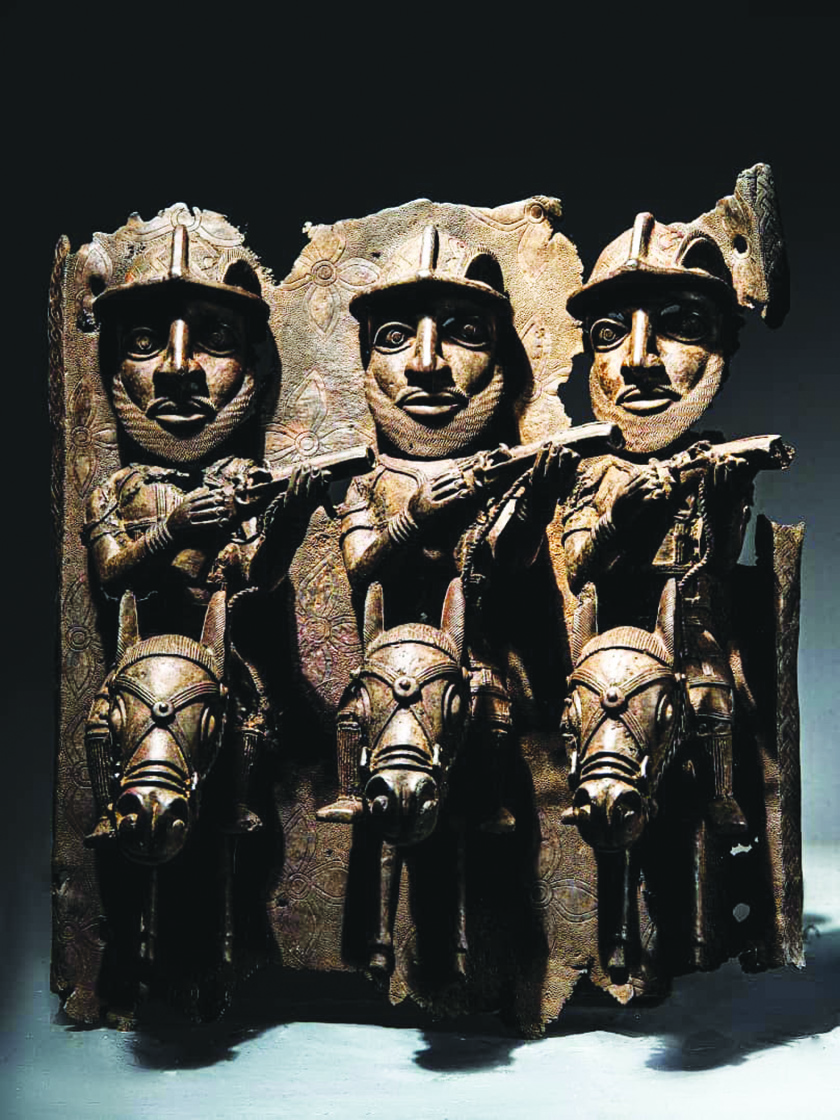
Long before the tragic looting of 1897 defined its image in the West, the Benin Kingdom negotiated with Europe from a position of absolute strength. A new exhibition at Lisbon’s Ndikama Museum rewinds the clock to this earlier era, showcasing a sophisticated African superpower meeting Portuguese explorers on its own terms.
For her refreshing exhibition, Benin-Portugal: Encounters, Art & Cultural Exchange, in Lisbon, Portugal, which offers another narrative of the Benin Kingdom, Eyamba Dafinone, director of the Ndikama Museum, deserves plaudits. Hitherto, no exhibition of that ancient kingdom’s bronzes in recent memory has transcended the tale of the 1897 British invasion, which led to the destruction of the palace and the removal of thousands of objects, many of which are scattered across museums and private collections outside Nigeria.
Indeed, the one-week exhibition mounted for Nigeria’s Independence anniversary takes the viewers, who include ambassadors , government officials, and Nigerian business representatives in Portugal, to a time when Nigeria did not yet exist as a country. The symbolism of its opening at the Nigerian Embassy, tucked away in the Restelo neighbourhood among the diplomatic residences of western Lisbon, on Avenida D. Vasco da Gama should not be lost on the cognoscenti. For while Ambassador Erelu Angela Adebayo received guests with the flags of Nigeria and Portugal fluttering in the background, the bronzes were there too, carrying the story much further back.
There is something about standing before these bronzes, depicting leopards, elephants and aquatic creatures, that brings home the sophistication of the Ancient Benin workshops. A closer look reveals the leopard associated with the Oba, or Benin king; the elephant possibly suggesting power; and aquatic imagery pointing towards Olokun, the water deity, and the wealth of the sea. Then there are the figures of the Portuguese soldiers, their unfamiliar dress and weapons giving Benin artists something else to look at, and to work with.
Isn’t it ironic that these bronzes made during the Benin-Portuguese encounters have once again crossed the water and arrived in Lisbon? That coincidence could easily be glossed over, but it leaves nagging questions about the world that made the objects. How did the workshops function? Who trained the artists? Who paid them? What happened to that knowledge when the system that sustained it was broken?
The exhibition, on until October 8, does not attempt to answer them. Rather, it highlights the bronzes, which attest to the fact that the Portuguese did not step into some cultural wilderness when they arrived on the West African coast towards the end of the 15th century. When they eventually made contact with the Kingdom of Benin, they found a well-organised society with its court, its army, its trading networks and, most conspicuously for anyone standing before these objects, its artists.
Under Oba Esigie, the relationship with the Portuguese became particularly significant. Brass and copper goods, coral and firearms found their way into Benin in exchange for ivory, pepper, textiles and other goods. Portuguese soldiers even fought alongside Benin forces, as some of the bronzes depict. There are also Portuguese figures among the courtly figures, and they are not difficult for viewers to recognise because their clothes give them away. So do the weapons, some of which bear the unmistakable hallmarks of European military equipment. Portuguese figures also appear on bangles and knives and in hunting scenes.
Yet the Oba has not been displaced from the centre merely because these strange-looking visitors have arrived. The established hierarchy remains intact. The foreigner may have been given a place in the composition, but not the whole composition. Indeed, the Benin artist did not have to become a European artist in order to depict a European. He simply added the newcomer to a visual world that already had rules of its own.
It is also known that the interaction with the Portuguese rubbed off on the Benin kingdom through Christianity, which found its way to the royal court. Then there was the language, which, somewhere along the line, inveigled its way into Nigerian Pidgin. Thus, the Portuguese saber, meaning “to know”, became “sabi”.
Of course, the usual account of Benin’s encounters with Europeans was not just a male affair: Oba, Portuguese visitor, soldier, trader. Queen Idia was also in the picture. She was a powerful political figure and warrior and was honoured by Esigie as the first Iyoba, or Queen Mother.
This is where the exhibition becomes more than an illustrated history lesson. It not only takes its audience back to the earlier encounter, before British conquest, when the Benin court was dealing with Europeans as visitors to its world; it also allows Benin to appear in the story with rather more agency than the old colonial accounts usually permitted.
While exhibitions about Benin that begin with 1897 and end with restitution remain important, what happened before the looting, the dispersal and the arguments over where the objects now belong is even more important. Aficionados need to be reminded of the meeting, on equal terms, between a European maritime power and an African kingdom. The bronzes, among the surviving witnesses, attest to this. And in them, the Portuguese can still be seen, standing where the Benin artists placed them.
Credit: This Day