

The origin of Elephantine Island’s name remains murky. Some spy the mammal in its hulking granite rocks, or conjure the specter of some long-extinct herd. Others point to the lucrative ivory trade it once supported.
It’s a sliver of rock at the Nile’s southern extreme, a mile long and half that across, but the size belies its importance.


It began as a garrison town, a first line of defense against Nubian raiders, but it was commerce that saw the island flourish on-and-off for roughly 4,000 years, with a population that exhibited an array of languages, cultures, and religions.


This cultural diversity struck the pith-helmeted Europeans who began excavating the island at the turn of the 20th century. In addition to well-preserved sites such as a step pyramid and a structure that measured the Nile’s fluctuations, archaeologists uncovered a litany of writings, not only in hieroglyphics, but hieratic, demotic, Aramaic, Greek, Coptic, and Arabic.
Today, these innumerate Elephantine texts are scattered across 60 collections in two dozen countries. The primary holders are the Egyptian Museum in Berlin, the Louvre in Paris, and the Brooklyn Museum. A monumental project led by Berlin’s Verena Lepper, however, is unifying the texts by archiving, digitizing, and translating them.
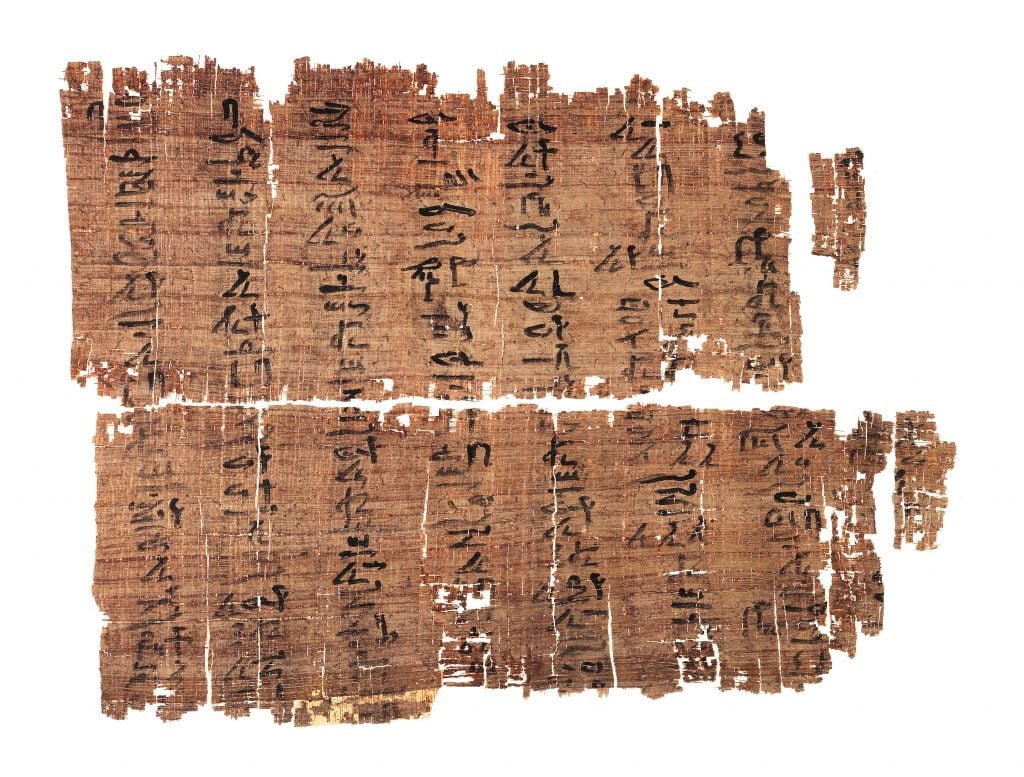
Hieratic document about legal disputes regarding property and inheritance. Photo: Berlin State Museums / Sandra Steiß.
Work began seven years ago when Lepper received a European Research Council grant to gather a team that could translate the manuscripts and shed light on Elephantine’s multiculturalism, societal structure, and religious development.
The public-facing output of this painstaking research is an exhibition held at two sites on Berlin’s very own island of culture, Museumsinsel. At the James-Simon-Galerie, the focus is on time, while at the Neues Museum, it’s on space—big questions for a site that has provoked great imaginings.
“Elephantine Island of the Millennia” brings together newly translated texts, artifacts, and interactive “activity stations” to tell the story of a place unlike any other in ancient Egypt. The Egyptian Ministry of Tourism and Antiquities is involved and the island’s spirit of multilingualism is reflected in an exhibition (through October 10) that uses Arabic, German, and English.
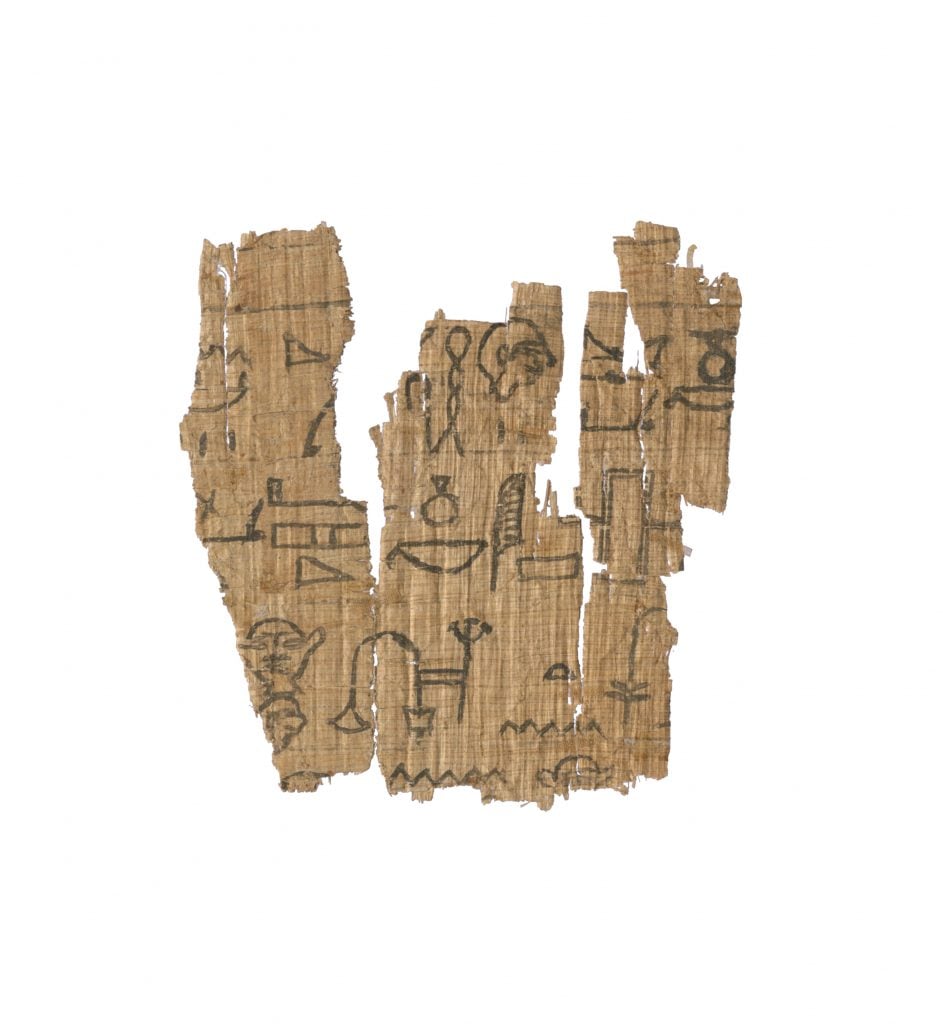
Hieroglyphic magical papyrus fragment from Elephantine. Photo: Berlin State Museums/ Sandra Steiß.
Written texts on Elephantine were primarily recorded on two materials: papyri and shards of clay known as ostraca. Clay was the cheap, everyday writing substance of choice. Pieces were used for making notes, calculations, and receipts—the substance’s resilience has made deciphering them relatively easy.
Papyrus, on the other hand, was expensive and reserved for recording the likes of official business, religious texts, and magical incantations. The material is extremely brittle, however, and when researchers began opening archival boxes that hadn’t been opened in a century they found piles of thousands of pieces. A system was devised to clean, flatten, sort, and digitize the fragments, one replicated in Berlin, Paris, and Brooklyn, rendering the papyri accessible to Egyptologists around the world.
In total, 10,745 were documents indexed and uploaded onto a database. These letters, contracts, wills, receipts, and notes give a view into the society developed on Elephantine from the third century B.C.E through the Arab conquest in 642 C.E.
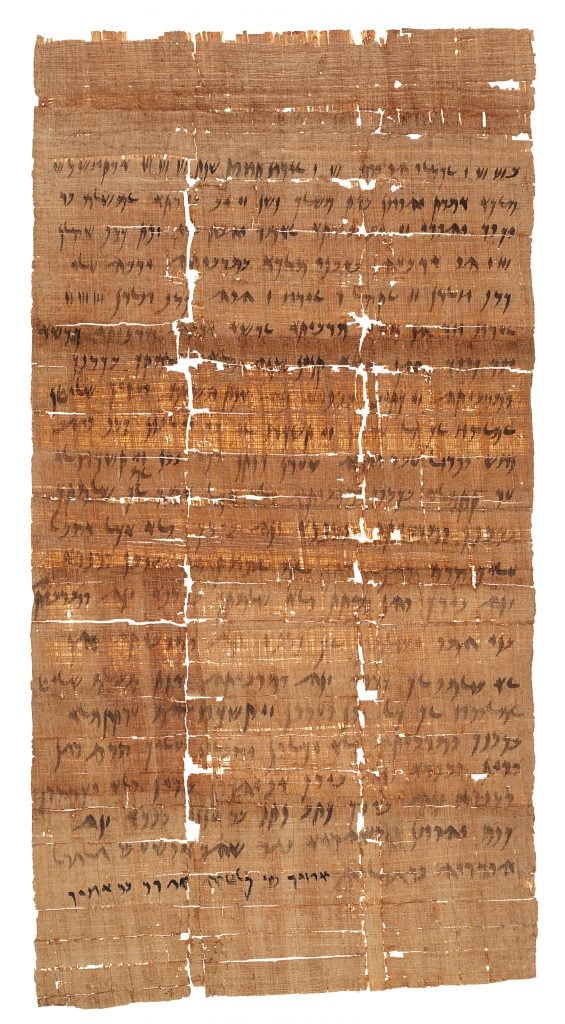
Aramaic contract for a large silver loan. Photo: Berlin State Museums/ Sandra Steiß.
The picture painted is of a place built on codified laws and customs. There’s a papyri for a large loan of silver and the record of a civil trial for a property dispute in the 3rd millennium B.C.E.—the exhibition suggests it might be Egypt’s oldest legal document. Elsewhere, there’s an Aramaic marriage contract from the first century B.C.E. that stipulates the amount owed to the woman in the event of divorce. Nearby, there’s a parallel document from nearly a thousand years later, written in Arabic and witnessed by 77 people.
Elephantine may have been at the far fringe of Egyptian society, but it remained very much connected to the broader world, through trade as well as its culture. The Story of Ahikar, for example, is the tale of a wise chancellor to Assyrian kings in the seventh century B.C.E. On show in Berlin there’s the earliest surviving record of the story, from the fifth century B.C.E. and written in Imperial Aramaic, thus pointing to Jewish mercenaries stationed on the island.
So, a Mesopotamian story written in the Imperial language of Persia for Jews living in Egypt. This, perhaps, is what Lepper is gesturing towards when she said that the “knowledge of Elephantine is global.”