
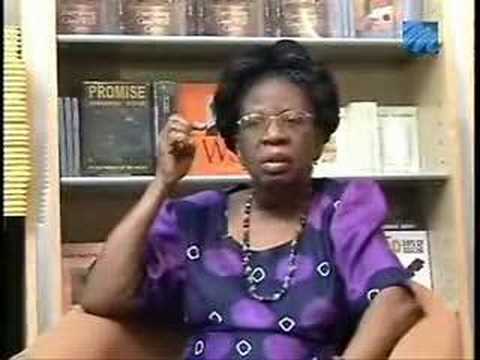
On Tuesday, February 18, writer, broadcaster, sportswoman, educationist and rightful owner of the titles, ‘matriarch of children’s literature’, and ‘matron of culture’, Mabel Segun, clocked 90.
In a country where the average life expectancy for women is 53 years, God has been good to the outlier, daughter of a clergyman who passed when she was only eight years old. But aside God, she has also taken good care of herself with her preference for sports and healthy diet.


It has been a productive, eventful life filled with laurels for Mama, a scion of the Aig-Imoukuede family of Sabon-Gida Ora, Edo State. Hers is a life that many would love to live or have. The setback of her father’s early demise didn’t hold the young child back. After elementary and secondary education at schools including St Peter’s School, Edunabon, Akoko Jubilee Central School, Ikare, St Paul’s School, Ikole and St David’s School, Akure, and CMS Girls’ School, Lagos, she gained admission into the University College, Ibadan (UCI) in 1949, a year after its founding.


She graduated with a Bachelor of Arts Degree in English, Latin and History in 1953 and it was here that she first started displaying her competencies as a writer and sportswoman. At Nigeria’s premier university with titans like the late Professor Chinua Achebe (who she shares a birth year with), late Professor Chukwuemeka Ike, the late Bola Ige, Professor Grace Alele Williams, Professor Akin Mabogunje and later Professor Wole Soyinka, Mama held her own. She shone like a star.
At the UCI, she was close with Professor Achebe, her classmate. While he was Editor of the pioneer students magazine, ‘University Herald’, she was Deputy Editor/ Advertisement Manager.
“Achebe was a very self-respecting person who respected other people,” she began about the close association between the duo in an interview with Ademola Adegbamigbe of TheNews in 2013. “I know of men who went to the point of trying to rape women 20 years older than them. But Achebe composed himself well. He was a perfect gentleman. We would do the editing and all the work together alone in the room. Of course, people wrote all sorts of things in their stupid magazine – a weekly bug – insinuating many funny things. They even corrupted our names to read Nuachi (instead of Chinua) and Lemba (instead of Mabel). But we just ignored them and went on with our work,” she added.
Apart from co-editing, the then young lady, whose brother, Frank Aig-Imoukhede, is also a writer, contributed poems, short stories and articles to the magazine. Her ‘The Surrender’, which she wrote in her final year, won the maiden Nigerian Festival of the Arts Literature Prize in 1954.
But it wasn’t only in her academics and creative writing that she excelled. The then ‘Tomboy’ of sorts, holds the record of being the first woman to play table tennis at the UCI. She became an honorary male by entering for Men’s Singles tournaments and was awarded the University’s Table Tennis Half Colour. She proceeded to win more laurels on the national scene. She would later chronicle her experiences in ‘Ping Pong: Twenty-five Years of Table Tennis’ (1989).
Humorous and friendly, the then Miss Mabel Dorothy Aig-Imoukhede was fearless and always spoke her mind. She didn’t suffer fools gladly and told people off when they got on her wrong side. “His brain must be leaking,” she said of Professor Wole Soyinka’s account of an incident that happened back in Ibadan and which she disputed, in an interview with this writer published in the rested NEXT Newspaper.
Soyinka’s friend, Bola Ige also felt her ire while they were on the UCI campus. “Bola Ige had a big mouth and could say anything! He attacked me too. It was later we made up, and he started calling me the Matriarch of Literature,” she revealed in the 2013 TheNews interview.
That unwillingness to tolerate fools and thoroughness has served her in good stead in an illustrious career that spanned teaching, broadcasting, writing, publishing and foreign service.
She is the author of the famous autobiography, ‘My Father’s Daughter’ (1965) and its sequel, ‘My Mother’s Daughter’ (1986). Her other works include ‘Youth Day Parade’, ‘Olu and the Broken Statue’, ‘Sorry, No Vacancy’, ‘Conflict and Other Poems’, ‘The First Corn’, ‘The Twins and the Tree Spirits’, ‘The Surrender and Other Stories’, ‘Readers’ Theatre: Twelve Plays for Young People’ and ‘Rhapsody: A Celebration of Nigerian Cooking and Food Culture.’
Her stories and poems have been published in over 30 anthologies in Nigeria and abroad. They have been translated into German, Danish, Norwegian, Greek and Serbo Croat.
In 2007, Mama Segun’s ‘Readers’ Theatre: Twelve Plays for Young People’ jointly won the highly coveted The Nigeria Prize for Literature sponsored by Nigeria LNG with Professor Akachi Ezeigbo’s ‘My Cousin Sammy’.
In 2009, her illustrious literary was recognised with the conferment of the Nigerian National Order of Merit for academic excellence in the humanities.
Outside writing, she was Hansard Editor to the Western Nigeria Legislature; Overseas Publicity and Features Officer, Western Region Information Service; Head of Information, Publications and Broadcasting, Federal Ministry of Education; Pioneer secretary to the Nigerian Book Development Council; Deputy Permanent Delegate and Acting Permanent Delegate of Nigeria to UNESCO, Paris; Chief Federal Inspector of Education; Senior Research Fellow, Institute of African Studies, University of Ibadan and editor African Notes and other Institute publications.
Though she retired from the University of Ibadan in 1989, Mama remained active. She established the Children’s Literature Documentation and Research Centre in Ibadan facilitated workshops for writers and also read for children in schools.
Now frail, Mama’s mind remains analytical and bright as ever. Last November, she delivered a speech entitled ‘Books for Understanding Self and Others’ at the Lagos Book & Art Festival. She reiterated the importance of reading to children in modern society who don’t have the extended family to provide guidance.
“On the contrary, in modern society, the child growing up does not have the advantages of the extended family to provide the much-needed guidance that would help him or her to cope with the challenges of life. There is, therefore, need for books for the understanding of self and others – books about the emotional needs of people and their reasons for behaving as they do; books about growing up; books about family relationships; books about people who have special problems; books about the expectations of society and acceptable behaviour patterns,” she said.
On Tuesday when she joined the nonagenarian club, her children, including the writer Omowumi Segun, grandchildren, relatives and people of goodwill converged on her home to wish her a happy birthday. We at TCN wish her the same. May she continue to enjoy good health and reap the bountiful fruits of her labour.