
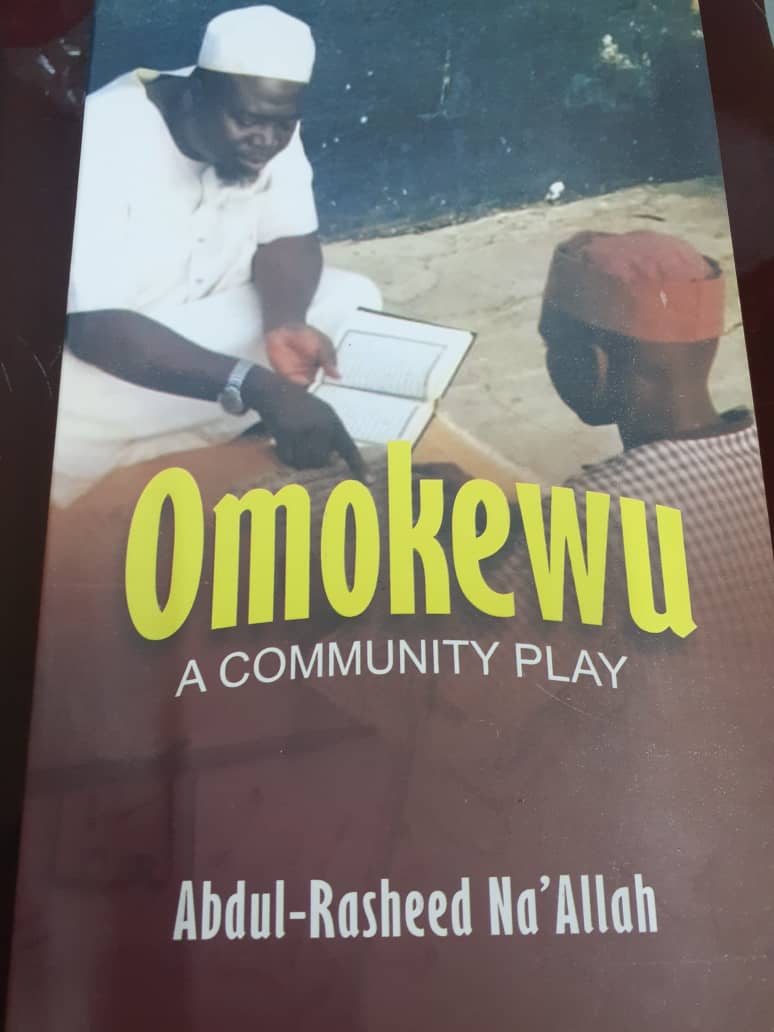
Baba Omokewu is a community drama text riddled with variations of different languages that inadvertently contribute to different layers of meaning. On the surface level, the play is about an aged grandmother who cries about how she has been neglected and how she places much importance on the living together of the extended and nuclear family as it has its importance to communal living.
However, on the metaphorical level of interpretation, Na’Allah is essentially preaching, upholding, and subverting the idea of family ties, bonding, and communal living and how they speak to his community, country, and the African continent. The major acts in the play, which are the dramatic actions of older characters who do not put priority on family bond, as opposed to the young ones who all work and roam the street together for the same purpose without disputes, is commendable.


Overall, the playwright projects that through love and communal living, there would always be a shared identity holding the home, nation, and community together, and if these are largely ignored, it might be a source of disunity that could lead to the dissolution and tearing apart of families and multiethnic nations in Africa. Hence, through different dramatic elements and techniques, Na’Allah has further joined other modern African and Nigerian playwrights to examine and present different ways nations can live together.


It is important to note that there is a formidable nexus between language and its propagated meaning. Most writers skillfully carry this out as they help to make the subject matter in a text more decipherable and readable to the readers and audiences. Through various language nodes, Na’Allah has effectively explored this in his play which he called a community play. The most important is how he starts the actions in the play with kids and children meandering the community. From the play, it is evident that the language through which the children dialogue is love, cooperation, and mutual respect. Throughout the play, as the children go about, basking in the festive spirit, they do not fight, even when they share the money they have received. Also, they are instrumental to the union of the families as their actions brought delight to the grandmother, who eventually sings the song and panegyrics of the Akaje lineage centred on “Opomulero.”
In addition, Na’Allah embellishes the play with Yoruba proverbs, songs, and praise poetry. These elements are common techniques employed by the playwright in most of his drama, which helps to identify the socio-cultural realities of his immediate community. In Baba Omokewu, the songs, proverbs, and praise poems used are signifiers of love, unity, and mutual respect, which helps and contributes to the rising action and resolution of the play in great detail. Na’Allah, therefore, explains the relationship between language and Yoruba oral elements, showing how orality amongst Africans, especially in the family system, is used to pass down customs and traditions. As a result, the playwright demonstrates the importance of African families maintaining their history, customs, and traditions.
Besides passing down Yoruba history and customs, Na’Allah also attempts to incorporate Islamic values in the play. It is essential to note that the whole play revolves around the actions and inactions of adult and children characters to voice out societal issues and proffer solutions to them. The book starts with accounts of children’s innocence in working together productively and how they are learning and assimilating the processes of the family system, which is an important division of the society, as well as the teaching of Islamic duties like reading the Qur’an and observing prayers at the appropriate times. Ironically, however, the adults do not put these into practice as they do things differently during cooking and celebrations. Also, the narrator drifts into the praises of the girl child in the play, which is notable of Na’Allah’s works as he seems to elevate the female child positively in a typical Muslim community. This is evidenced in the play as the character of Afusa, a young girl who read the Qur’an more accurately than her male counterparts during the festivity and is cheered and respected even among the boys. Invariably, this shows the amount of love, sense of unity, and appreciation children have before they are re-orientated into hateful signifiers.
The family is the microcosm of society. Therefore, the state of the family mirrors the state of society at large. One of the features of the Third World societies is the disintegration of the family unit. When the family is a functional, stable unit, then the society would be orderly. However, the breakdown of the family unit could lead to instability and anarchy in society. In Baba Omokewu, Na’Allah extols and reminds the readers that Africans are essentially communitarian or communalistic. In contrast to the Western way of life, the African culture is designed towards communitarian principles. Most people in the African continent believe that an individual cannot carry out their responsibilities alone. They are entirely or partially helped by the community where they live, which means existence generally depends on others in the community.
In the play, Mama Hakeem and Mama Kulu deviate from the communal way, and Saratu, the grandmother, highlights, points out and proves that the idea of community and togetherness cannot be removed from communitarianism. Saratu emphasizes and frowns against how the women have neglected the traditional community life where the whole house cooks and eats together in a pot. Also, the neglect of allowing the children to visit members of the extended family is frowned at in the play as it is not the African way, according to Na’Allah. Hence, communitarianism preaches the goal of the whole rather than the part, as against the western ideology that focuses on the principles of individualism. To put it right, Na’Allah emphasizes that the foundation of African societies is laid on the idea of togetherness, unity, and a common destiny. Rather than the “I” in the West, it is a theme of “we” in Africa. Africans move from realizing that they exist to the realization that their existence is tied to others’ existence, which is aptly carried out in Baba Omokewu by the actions of the children and the character of Saratu, the grandmother.
At the metaphorical level, Na’Allah presents in the play, communal life – the act of helping strangers rather than the only family, working with friends, and also the idea of home as a dynamic one. Most people in Africa believe in the idea of communalism rather than the individualism common in the West. This idea of community affiliation has a tie with the idea of humanism, whereby the next person is as important as you, and you are not thinking about filial relations alone but, rather, affiliations in general. It is an acculturation and enculturation process, as well as a basic idea that helps in the absorption of multiple cultures, which should be the epitome of multiethnic nations in Africa. Na’Allah tilts towards embracing the community, and through the character of Omokewu and his friends, he shows how long-lasting relationships can be built. Therefore, it is not surprising that the play Baba Omokewu was performed at the convocation ceremony in Kwara State University to an audience of multiple ethnicities. This is a colossal step towards the essence of humanism, which is to live a fulfilled life.