
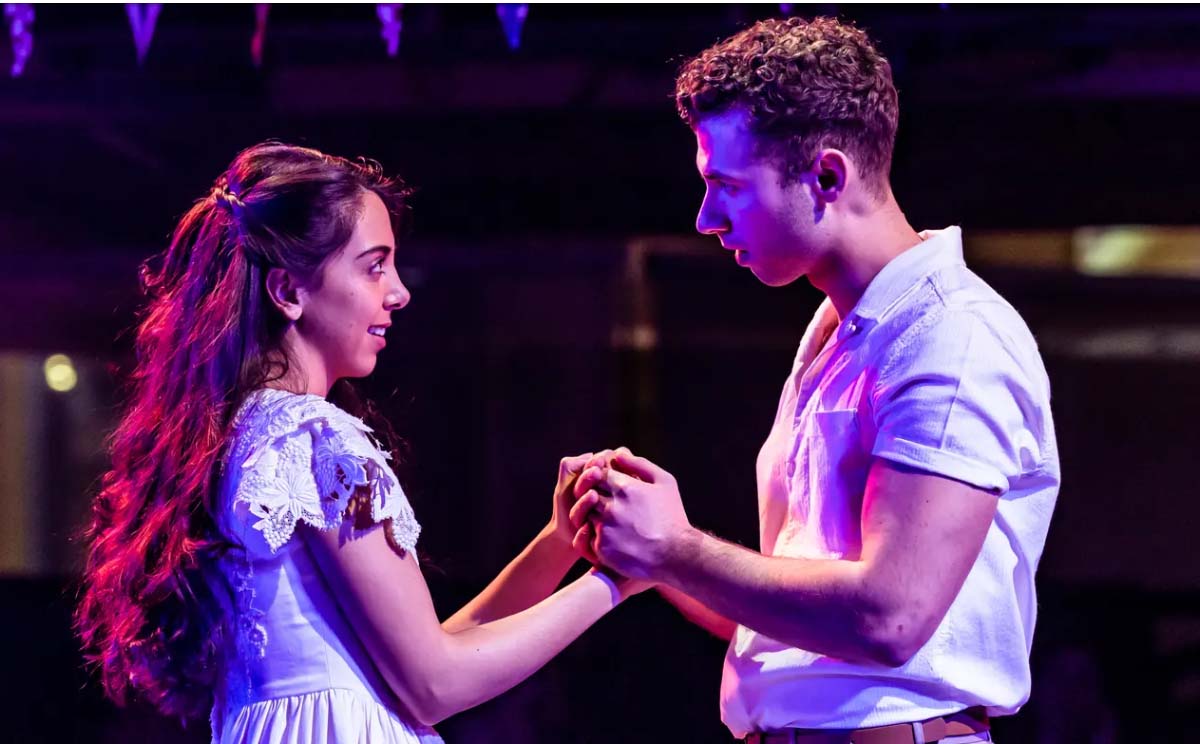
‘It felt weird taking the train”, remembers Gabriela García. She was on the way to Manchester to play Maria in West Side Story at the Royal Exchange. One week earlier, Broadway theatres had been closed by the pandemic. García knew it was only a matter of time before the UK followed suit. On 16 March, her first day of rehearsals, prime minister Boris Johnson warned the public to avoid theatres. The next day, West Side Story was cancelled. “The amount we were able to get done in just two days was incredible,” she says. “It was such a nice gift to have.”
The Royal Exchange could now make 65% of staff redundant. Across the UK, theatres are losing employees, facing permanent closure and crowdfunding for their future as the coronavirus job retention scheme is set to expire. As an actor who also earns a living as a casual worker at a theatre, I, like thousands of others, am waiting for my P45.


After months of monotone condolences and a vague “five-step roadmap” from culture secretary Oliver Dowden, the British government Beyoncéd the arts community on 5 July by announcing a surprise £1.57bn emergency support package. Dowden said he would begin by bailing out the “crown jewels of our national life – you know, the Royal Albert Halls and so on”. It should come as no surprise that this government is prioritising bedazzled institutions. The “crown jewels” of theatre, however, are not the brick-and-mortar, however fine, of London landmarks, but the creative workforce that set the stage alight – 70% of whom are freelancers.


For Stella Kanu, executive director at London International Festival of Theatre, who has reservations about the colonial undertones of the phrase “crown jewels”, the gem that sparkles is community engagement. “The majority of people will come into contact with theatre through school, or some kind of community performance,” she said. “The awe and wonder that often comes with nine- and 10-year olds who see theatre for the first time – that’s the stuff that has a lasting impact.”
Freelance director Omar Elerian has a perplexed expression when I ask what he makes of the arts rescue package, and says: “I’d love to have an opinion, but nobody’s published the details.” There has been no mention of how much of this money will go to commercial producers, and the announcement has raised questions. “Are they the crown jewels?” he asks. “Who makes the parameters? How long will it last? How will it trickle down to the rest of the industry?” How the money is shared could cause division, he warns. “The differences will become more acute.”
We do know is that the Treasury hasn’t addressed the thousands of freelancers who have slipped through the cracks of its support schemes. “Even though I’ve paid my taxes and started working as self-employed, I have received zero support,” says Elerian. “And because I had a bit of money aside to pay my taxes, I wasn’t even eligible to get Universal Credit.” Even the most visible freelancers – actors – have been hung out to dry. “Right now, actors are getting nothing,” said García. “If you don’t come from a family that can support you, you just won’t make it … we’re going to lose a lot of talent.”

Stella Kanu, who created the redundancy care campaign #AllOfUs to support communities disproportionately affected by Covid-19. Photograph: Sharron Wallace
A recent report revealed that one-third of freelancers are considering leaving the industry. It’s predicted that 287,000 freelance roles in the creative industries will be cut before the end of this year. Theatre freelancers comprise 86% of all people of colour employed by national portfolio organisations (NPOs); in contrast, 82% of the permanent workforce identify as white. Redundancy care campaigns such as Kanu’s #AllOfUs are being set up to support the black and Asian communities disproportionately affected by Covid-19. The pandemic happened when we were “just about starting to make very minute progress” in diversity, says Elerian.
“Covid-19 has shone a light on the overreliance on a [freelance] sector we don’t show enough value to,” says Kanu. “Crown jewel” theatres rely heavily on a completely demoralised and unprotected workforce, currently encouraged to go back to work and earn. “My fear,” says Elerian, “is that this will lower the welfare standards even more.” Says García: “It feels like everybody is worried about the audience’s safety when coming back to theatre but not many people are talking about actors’ safety.”
Over the past decade, the theatre sector has been resilient when it comes to adapting its business model to austerity cuts. “But while the output kept coming out, we were accumulating a problem,” says Elerian. Is now the time that the industry can start to redress its labour and welfare system? Reopening theatres is fine but what if all the freelancers didn’t turn up? “The artists and creatives should have power,” he says, “because they are the ones that make the work.”
Art evokes our common humanity, and it has been essential for our mental health during the Covid-19 crisis. The arts industry makes a lot of money – yet continues to struggle. Why can’t the arts be a stable and viable career? It will only survive if it does away with elitism and democratises – creating a self-sustaining ecosystem in which each faction is supported by the other.
Arinzé Kene in Misty, directed by Omar Elerian, who says, ‘Artists and creatives should have power.’ Photograph: Tristram Kenton/The Guardian
The industry bolsters a culture of competition, further deviating from solidarity, “therefore you’re not incentivised to see yourself as part of a whole”, says Elerian. Freelance task force initiatives are a good step but are set up by organisations – potential bosses – so criticising them may pose a conflict of interest. “There need to be spaces [facilitated by NPOs, the Department for Digital, Culture, Media and Sport, and public funding bodies] where freelancers can debate ideas and understand what the focus is now. Now is the time to formalise a whole sector of the creative industry by acknowledging that these people cannot go back to working without any sort of protection.”
The UK could start by adopting working models from other parts of the world. In France, if artists work 507 hours over 10 months, or roughly 13 hours a week, the state will match what they earn and pay them during periods of unemployment. “Which allows actors not to have to jump from one job to another and have down moments in between jobs, do better jobs, and have families and other things normal workers do – holidays!” Elerian says. Intermittent workers also benefit from continuous education; workshops are paid for. “You’re not penalised for taking time off to improve your craft, you’re incentivised.”
If this can be achieved, it would start helping other issues to be solved such as the underrepresentation of female directors, the need for far more diversity on every level of employment, endemic issues around access for deaf and disabled artists, and the difficulties of parenthood as a theatre worker. “This is a time for everybody to be at the table – so many of us have the answers and want to still be in the room when the solutions are found,” says Kanu.
Source: www.theguardian.com