
“There is no room for tourists in a world of ‘displaced persons,’” the author Evelyn Waugh declared sulkily. The year was 1946, and the world was still reeling from the depredation and devastation of World War II. Waugh was right to be sorry; here was the beginning of the end of colonialism in its explicit forms, the end of the age of the white man as explorer-traveler heading off to the most remote corners of the world. The shrinking of empire felt like it meant the white man could no longer go anywhere and everywhere. Waugh need not have worried too much, however; people continued to be tourists after World War II, undeterred by any moral travesty involved in voraciously gawking at the world while others searched for mere shelter and survival.
Until March 2020, the white and Western traveler still inhabited a world bubbling over with opportunities for stomping through foreign grounds. Despite the indications of the adverse effects this was having on the world—trashed beaches, dying coral reefs, crumbling frescoes—no one was interested in staying put, in not seeing what their officemates or their neighbor or mother-in-law had already seen. Cities like Venice were rendered almost entirely performative—places where no one but tourists could afford to live and where the fantasy of Italian romance was created precisely for tourist consumption. The fact that tourism was destroying the city was of no concern to those who would be gone next week.


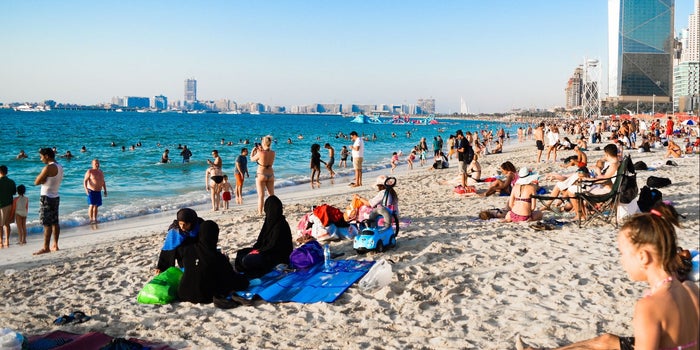
In 2015, five years before the world would stop, a little boy’s body washed up on the shores of the Mediterranean. Meanwhile, on other Mediterranean beaches, white bodies lay splayed out, cooking, browning, bronzing before they moved to the next attraction, the next adventure. There was a momentary moral outrage, but the world in 2015 was still too steeped in its hedonistic ways to nurse the concerns of black and brown others for very long. Ships full of migrants continued their treacherous crossings, refugees kept dying, and tourists kept soaking their skin in the sun, looking the other way.


The persistence of tourism was due at least in part to moral justifications for it. The millennial generation defined itself against Baby Boomer proclivities for material consumption by embracing a different kind of consumption, one that in the view of many was somehow less culpable. Hence the insatiable hunger among younger people for “experiences” over material items; according to a 2016 survey, 72 percent of millennials would rather spend money on going places and doing things. Travel began to mean wild (if pre-arranged) adventures, the more unique the more salable, all of it ennobled by its inchoate immateriality. Some Western women, now no longer dependent on having a man to purchase or participate in their adventures, defined their feminism with adventures sans men.
This is where things were in March 2020 before the world paused. The dead canary was a cruise ship called the Diamond Princess; its sequestered passengers, who had been having a carefree romp while terribly underpaid others waited on them, suddenly became symbols of contagion. Stranded passengers, sitting amid the detritus of their vacations, took to Twitter. One man used his social media account to post food reviews of the fare that was served to stranded guests. He described every meal with a dystopic relish—and without mentioning the fact that the virus that kept passengers sequestered in their state rooms could also sicken the still-working crew of the ship.
Tourism, fueled as it was by cheap air travel, package tours crammed with “sights,” and sweaty Americans loudly occupying sidewalks, should never come back.
It took a pandemic to stop the gluttonous consumption of other places, trips that relied centrally on the have-nots—armies of hotel workers, cleaners, food preparers, bartenders, pool attendants—to provide the lavish experience sought. The argument in favor of this juxtaposition was that tourists, however noxious, were propping up the GDP of places like Macau (51 percent), Maldives (32.5 percent), Spain (14.6 percent), and Italy (13.2 percent). It was, as neoliberal economics go, a top-down model, mere cents going to the worst-off at the bottom.
Figures like these are routinely tossed about as a kind of imperative for the continuation of an industry that has an exploitative and extractive effect on local economies. While some find it convenient to believe that local economies flourish when beautiful places are monetized, studies of “leakage” show that a large amount of money spent locally by tourists leaves those economies. Furthermore, the “jobs” created are largely low-skilled, wage-earner jobs or even limited gigs that do not deliver people out of the economic precariousness that Americans lament pervades their own society.
Tourism, fueled as it was by cheap air travel, package tours crammed with “sights,” sweaty Americans loudly occupying sidewalks in their marches through Amsterdam or Dubrovnik (beleaguered since it was discovered as one of the shooting locations of Game of Thrones) or anywhere, should never come back. A better system, one that actually delivers the assistance to local economies that has been touted for so long, is going to be a more expensive system. Sustainable tourism requires a different and non-tourist-centric analysis of whether local people are able to earn a living wage, the extent to which natural resources are being depleted, the impact on historical monuments and other famous sites, and other similar considerations.
Finally, some of the biggest inequities of tourism involve non-reciprocal arrangements, where those from rich countries can go anywhere and the residents of the poor but beautiful countries are bound to their borders. A humane and ethical tourism would ensure that this is not the case, that the great fun of the moment is not a product of the steep power difference between the server and the served, the guide and the tourist.
The pause delivered by the pandemic can and should induce a moral reckoning with why tourism has existed, and the desperation imposed on poor but popular countries that must rely on obnoxious strangers in search of experiences that can be visibly and publicly disseminated through social media platforms. Indeed, if pre-Covid Instagram is any indication, the amount of “learning” travelers do—the degree of local or global understanding that is the product of their cavorting—doesn’t seem to be particularly significant. In general, tourists, however far they may have traveled, are there for short moments in which they remain by and large in the same psychological space they inhabited back home. Then there is the added inauthenticity of performing enjoyment for the production of content. Everyone who had money was gorging on it.
Tourism should never be resuscitated in the form in which it existed. Those who love travel must be forced to consider how their gluttony for it has affected others. The power difference between tourists and locals must be recalibrated so that it is interdependence, rather than servitude, that defines the relationship. This might mean fewer “experiences” but more understanding. Fewer people will be able to go and fewer places will be seen, but travel will also be less injurious, less rapacious in its unthinking imposition of injustices and inconveniences on so many. The question is longer when can I be a tourist again, but what kind of tourist do I want to be?
Source: thebaffler.com