
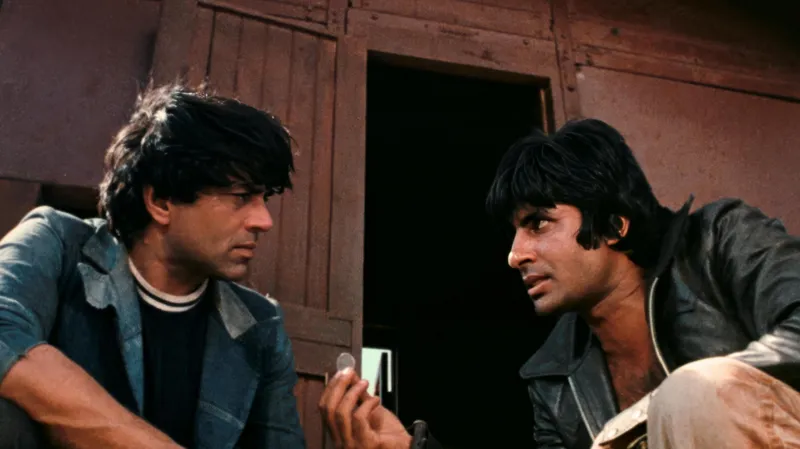
Fifty years after it first exploded on Indian screens, Sholay (Embers) – arguably the most iconic Hindi film ever made – is making a spectacular return.
In a landmark event for film lovers, the fully restored, uncut version of Ramesh Sippy’s 1975 magnum opus will have its world premiere at Il Cinema Ritrovato Festival in Bologna, Italy, on Friday. This version includes the film’s original ending – changed due to objection from the censors – and deleted scenes.


The screening will take place on the festival’s legendary open-air screen in Piazza Maggiore – one of the largest in Europe – offering a majestic setting for this long-awaited cinematic resurrection.


Crafted by writer duo Salim-Javed and featuring an all-star cast led by Amitabh Bachchan, Dharmendra, Hema Malini, Jaya Bhaduri, Sanjeev Kumar and the unforgettable Amjad Khan as Gabbar Singh, Sholay draws cinematic inspiration from Western and samurai classics. Yet, it remains uniquely Indian.
The 204-minute film is a classic good-versus-evil tale set in the fictional village of Ramgarh, where two petty criminals, Jai and Veeru (Bachchan and Dharmendra), are hired by a former jailer, Thakur Baldev Singh, to take down the ruthless bandit Gabbar Singh – one of Indian cinema’s most iconic villains.
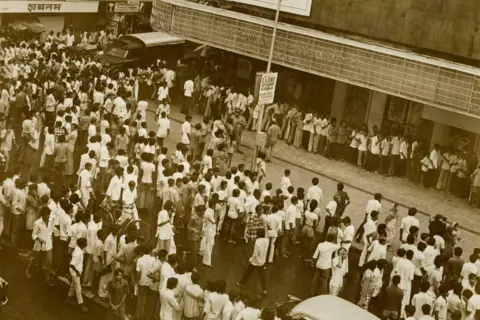
When it first released, Sholay ran for five uninterrupted years at Mumbai’s 1,500-seater Minerva theatre. It was later voted “Film of the Millennium” in a BBC India online poll and named the greatest Indian film in a British Film Institute poll. Half a million records and cassettes of RD Burman’s score and the film’s instantly recognisable dialogues were sold.
ADVERTISEMENT
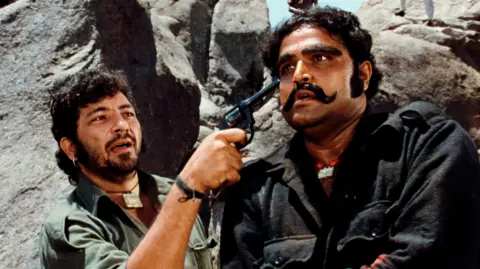
The film is also a cultural phenomenon: dialogues are quoted at weddings, referenced in political speeches and spoofed in adverts.
“Sholay is the eighth wonder of the world,” Dharmendra, who plays a small-town crook and is paired up with Bachchan in the film, said in a recent statement.
Shooting the film was an “unforgettable experience,” Bachchan said, “though I had no idea at the time that it would become a watershed moment in Indian cinema.”
This new restoration is the most faithful version of Sholay, complete with the original ending and never-before-seen deleted scenes, according to Shivendra Singh Dungarpur of the Film Heritage Foundation.
In the original version, Gabbar Singh dies – killed by Thakur, who crushes him with spiked shoes.
But the censors objected. They balked at the idea of a former police officer taking the law into his own hands. They also found the film’s stylised violence too excessive. The film faced unusually tough censors because it hit the theatres during the Emergency, when the ruling Congress government suspended civil liberties.
After failed attempts to reason with them, Sippy was forced to reshoot the ending. The cast and crew were rushed back to the rugged hills of Ramanagaram in southern India – transformed into the fictional village of Ramgarh. With the new, softened finale – where Gabbar Singh is captured, not killed – in place, the film finally cleared the censors.
The road to the three-year-long restoration of the epic was far from easy. The original 70mm prints had not survived, and the camera negatives were in a severely deteriorated condition.
But in 2022, Shehzad Sippy, son of Ramesh Sippy, approached the Mumbai-based Film Heritage Foundation with a proposal to restore the film.
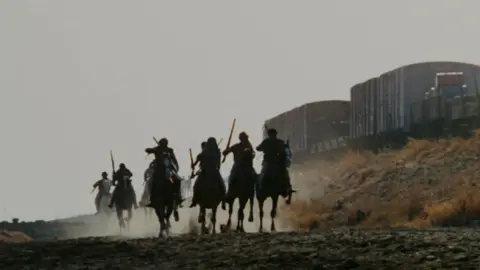
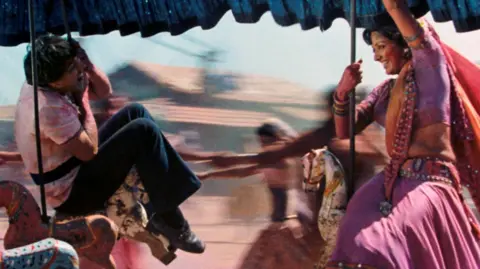
He revealed that several film elements were being stored in a warehouse in Mumbai. What seemed like a gamble turned out to be a miracle: inside the unlabelled cans were the original 35mm camera and sound negatives.
The excitement didn’t end there.
Sippy Films also informed the Foundation about additional reels stored in the UK. With the support of the British Film Institute, the team gained access to archival materials. These were carefully shipped to L’Immagine Ritrovata in Bologna, one of the world’s premier film restoration facilities.
Despite the loss of the original 70mm prints and severely damaged negatives, archivists sourced elements from Mumbai and the UK, collaborating with the British Film Institute and Italy’s L’Immagine Ritrovata to painstakingly piece the film back together. The effort even uncovered the original camera used for shooting the film.
Interestingly, Sholay had a rocky start when it first hit the screens. Early reviews were harsh, the box office was shaky, and the 70mm print was delayed at customs.
India Today magazine called the film a “dead ember”. Filmfare’s Bikram Singh wrote that the major problem with the film was the “unsuccessful transplantation it attempts, grafting a western on the Indian milieu”.
“The film remains imitation western – neither here nor there”.
In initial screenings, audiences sat in silence – no laughter, no tears, no applause. “Just silence,” writes film writer Anupama Chopra in her book, Sholay: The Making of a Classic. By the weekend, theatres were full but the response remained uncertain – and panic had set in.
Over the next few weeks, audiences warmed up to the film, and word of mouth spread: “The visuals were epic, and the sound was a miracle…By the third week, the audience was repeating dialogues. It meant that at least some were coming in to see the film for the second time,” writes Chopra.
A month after Sholay hit screens, Polydor released a 48-minute dialogue record – and the tide had turned. The film’s characters became iconic, and Gabbar Singh – the “genuinely frightening, but widely popular” villain – emerged as a cultural phenomenon. Foreign critics called it India’s first “curry western”.
Sholay ran for over five years – three in regular shows and two as matinees at Mumbai’s Minerva. Even in its 240th week, shows were full. Sholay hit Pakistani screens on April 2015, and despite being 40 years old, it outperformed most Indian films over a decade old – including the 2002 hit Devdas starring Shah Rukh Khan.
As film distributor Shyam Shroff told Chopra: “As they used to say about the British Empire, the sun never sets on Sholay.”
Why does Sholay still resonate with audiences, half a century later? Amitabh Bachchan offers a simple yet profound answer: “The victory of good over evil and… most importantly, poetic justice in three hours! You and I shall not get it in a lifetime,” he told an interviewer.
Credit: BBC