
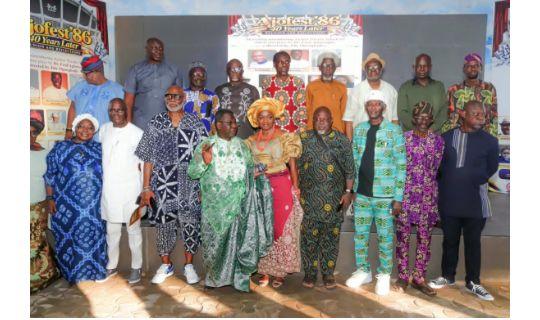
INTRODUCTION: BEFORE AJOFEST
A hazy harmattan evening it was in March, 1983. I needed a rest, but the rap on the door did not let me.
‘Who’s that?’ I enquired calmly.
‘Papa Ben’O’, a voice on the other side responded like a song while a couple of others murmured below it.
‘Crosh, Papa Judah’, I hailed, knowing that the lead voice at the door was my bosom friend Nicholas Jide Ogungbade.
I opened the door, welcomed Jide, Albert Odulate and one Sola that I was meeting for the first time.
That was the evening when Jide introduced Ajo Productions to me, of which he was the Artistic Director. He mentioned Lawyer Fred Agbeyegbe as the brain behind the project and that he needed my support in the directorial as well as the media areas. A
long pause, but eventually I acquiesced on the grounds of the artistic solidarity that we had both enjoyed since our university days and, of course, the vision of a project brilliantly relayed to me. The portraiture of the Lawyer-playwright, Fred Agbeyegbe, and his plans for the theatre profession, judging by the not so complimentary experience so far in the Nigerian theatre, was, to me, out of this world. It did not take much time for me to appreciate the visionary and humanist attribute of Lawyer Fred Agbeyegbe whom one later realised was also a businessman, politician, poet, public affairs analyst and civil rights internationalist.
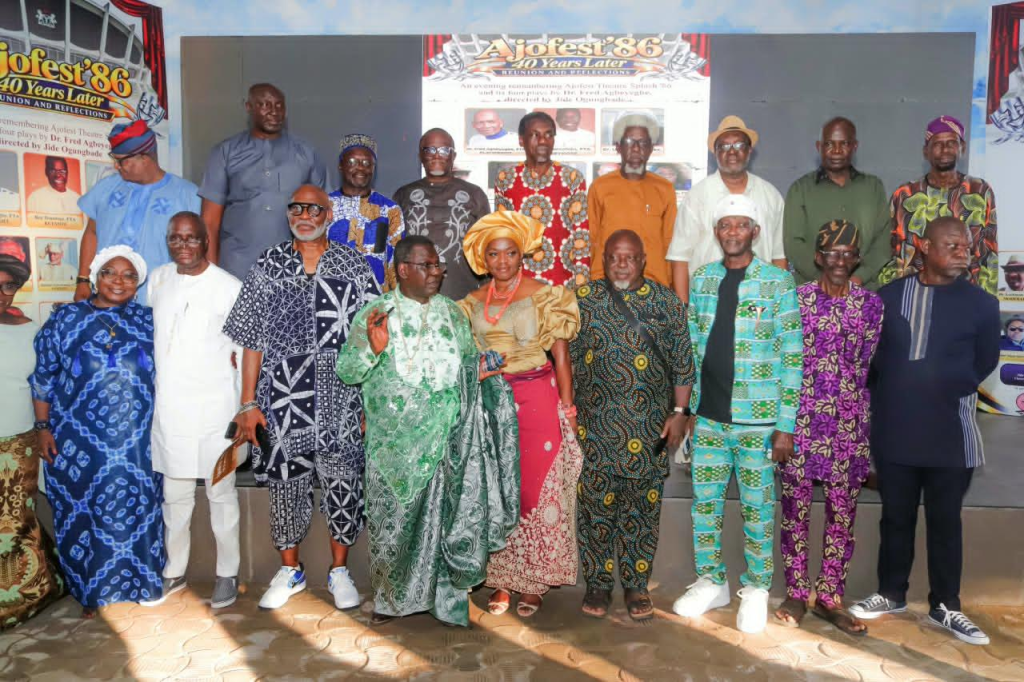
In 1983, the Executive Producer, whom we now fondly referred to as Uncle Fred, constructed a big, prefabricated camp at the beachside Odidi Resort, a few kilometres to Seme Border along the Lagos-Badagry expressway.There the rehearsals of THE KING MUST DANCE NAKED was held for approximately eight weeks, after which it was premiered at the National Theatre, Iganmu, Lagos with resounding success. The theatre show featured some of the brightest professional theatre artistes in Nigeria. One cannot really list all members of the cast and crew right now due to lack of full documentation. But that first course in the theatrical menu of the Ajo Production series was star-studded, a reputation that was maintained throughout the four years, leading up to the Ajo Festival of 1986, which stakeholders have deemed fit to commemorate its 40th Anniversary, this year.

The foundational elements of very serious, professional theatre organisation manifested firmly in 1983. Firstly, artistes welfare was made a priority. Secondly, artistes were accommodated in what could be referred to as a conducive creative habitat, a beautiful beach side resort for lodging and rehearsals. Thirdly, artistes were paid professional fees comparatively outclassing what obtained in the theatre sub-sector at the time. Fourthly, a Peogeot 504 was made available for the production’s use as and when necessary. By this and other considerations, a standard was set for subsequent Ajo Productions plays, which we described as an annual production series.
The series came in unbroken turns every year. THE KING MUST DANCE NAKED (1983) was followed by WOE UNTO DEATH in 1984, by which time the camp and rehearsal venue had shifted to Uncle Fred’s private property near Ilogbo, also along Lagos -Badagry Expressway.
By this time, the production company’s activities had become known nationwide with higher dividends in terms of scope of participation of artistes. WOE UNTO DEATH was taken on a tour to Ibadan where it was presented at the Arts Theatre of the University of Ibadan. Also more artistes joined the production from Ibadan, Ife and Benin. Rehearsal of THE LAST OMEN in 1985, was moved to a twin bungalow in Ijesa. Thereafter, for BUDISO, the last play in the series right onto the festival year, some artistes were lodged in Mapol Guest House, off Apapa Road, Iganmu, Lagos because of its proximity to the National Theatre where Ajo Productions plays were usually staged. In addition, as Ajofest 86 drew near and with a very large cast in view, closeness to the National Theatre would certainly ease the commuting of artistes in a situation where they could not be accommodated in the Guest House. The fourth play in the series, which had its own special place in the dramaturgy of Fred Agbeyegbe, is BUDISO. Much will be said later about this scathingly satirical, hilarious political drama with all its farcical elements which unveils another side of Fred Agbeyegbe.


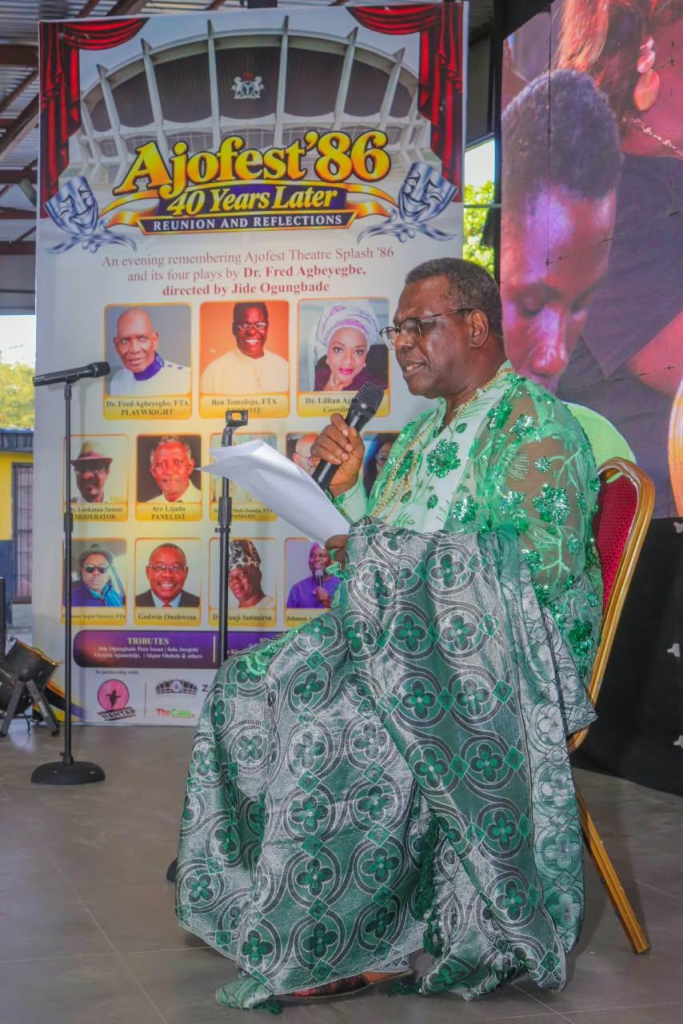

THEMATIC THRUSTS
The thematic thrusts of the four plays of the pre-Ajofest year are somehow varied. But it is also interesting to know that the playwright, Fred Agbeyegbe maintains some form of consistency throughout the four plays in terms his attribute as a social visionary.
Looking at each of the plays, particularly THE KING MUST DANCE NAKED, culture and tradition is amply celebrated. The profusion of dance and other fascinating spectacles and hair-raising polyphonic songs of the Itsekiri are quite edifying, soulful and inspirational. But there is an under-current of thematic antithesis in the same play where some characters – even major ones like Queen Odosun – deliberately subvert the very culture that is being celebrated. King Omajuwa the 9th’s illicit affair with Bagiwa, the palace maid who later metamorphoses into Queen Odosun is a thematic concern where the prestige of the royalty and tradition are undermined. The theme of cultural subversion is also accentuated by Ololo, the drunkard’s, demystification of tradition by feasting on the sacrifices meant for the gods.
In WOE UNTO DEATH the domestic and political shenanigans of members of the royal family are copiously exposed. This arises from the King, Asamaigon falling into a state of coma for several years. He has not been pronounced dead. He is merely in a state of coma. As such, beneficiaries of the royal bounties and booties, like Queen Egwuaruna would rather keep death at bay to maintain the status quo. On another side ambitious princes or their sympathisers and sponsors pray that the death of Asamaigon is hastened one way or another so that the ascendancy of new political potentates will take effect. This is just another way of pursuing their selfish desire, through various appeals to allegorical and death-bringing forces like Common Cold, Old Age and Death itself.

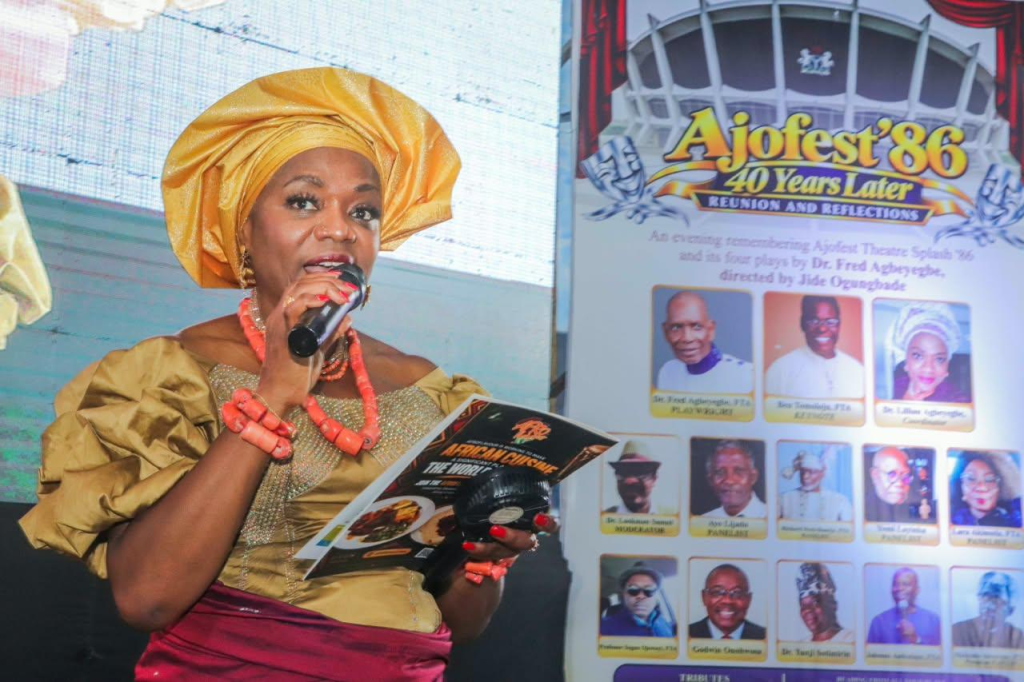

THE LAST OMEN, staged in 1985 as the third Ajo Production play, portrays a debilitating monarchy which has not been able to install a King for several years. It is only being governed by an ad-hoc Regency Council with all its centrifugal forces at play. Involved in the endemic political crisis is Demeyin, the modern day philosopher, who is perceived as being antithetical to the prevailing traditional leadership and their obsession with superstition.
The fourth play in the series, BUDISO, makes a mockery of military rule in Nigeria and its reckless assault on constitutionalism and civil liberty in a modern state. In fact, BUDISO is the most contemporaneously and radically political among Agbeyegbe’s dramatic offerings within the context of Ajo productions of 1983 to 1986.
DRAMATURGICAL CONSIDERATIONS
In terms of dramaturgy, there is quite a buxom harvest in the plays of Agbeyegbe as they unfold yearly in the pre-Ajofest years.
We take a look at THE KING MUST DANCE NAKED, for instance. It’s Brechtian dramatic mode is quite obvious. Although the play is about the nobility, the plot subverts the same social order predominated by its noble and aristocratic characters. Generally in the form of the non-Aristotelian epic theatre of Bertolt Brecht, and with a dose of proximate inspiration from Femi Osofisan, the play’s technical antecedents are clearly identifiable as a basis for further analysis of the playwright’s status as a dramatist and social visionary. Agbeyegbe seems to show in his works a predilection to demystifying the establishment. Despite the fact that he came from an aristocratic background, as one could read from his biography, he tends to demonstrate in his writings the attributes of a rebel in the house. This tendency could be traced back to his younger days in the United Kingdom both in Students Unionism and Civil Liberty Movements.
Uncle Fred does not confess to being a leftist. Indeed, his closest political associates that one could identify at close range, are either moderates or conservatives. Yet the spirit that drives his works has a socialist motivation.
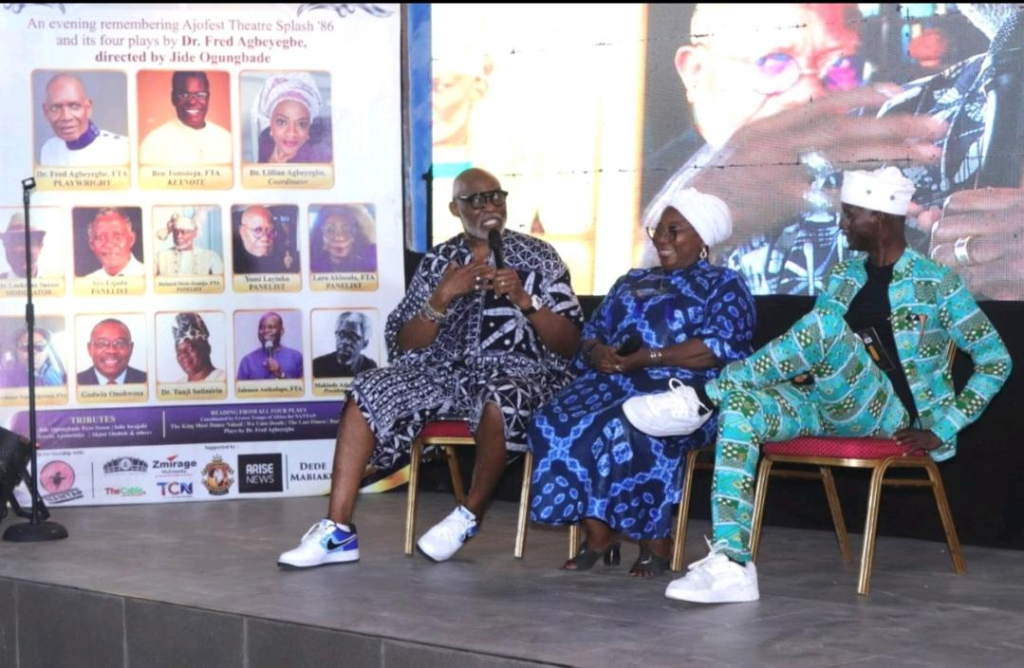
Moving to the second play in the series, that is, WOE UNTO DEATH, we have fresh offerings. Perhaps, the only character that reminds us of the Brechtian mode is Ewo, a palace attendant and lower chief. Otherwise, the play is a parabolic mix of the physical and metaphysical. It brings humans like the King Asamaigon, his two Queens, Irohro and the scheming Egwuaruna, his Princess Ogbodu and his two princes from two different women Eyitwoyo and Eyinmode into a contest of will, with allegorical characters like Old Age, Common Cold and Death. It is not a contest in the real sense of a challenge, but – like I said – a contest of one individual will to self-justification against another. Let me quickly add here that WOE UNTO DEATH may be considered prophetic in this 39th year of its existence, given the currency of socio-political reality in this country of its creation. The contest that one had elaborated upon, leads to virtually the demise all the members of the royal family and, ultimately, the decimation of a whole dynasty. Only Princess Ogbodu is left to contend with the massive bereavement in the palace. She is left with the absurdist option of placing the crown on her own head, a taboo that leaves the palace chiefs in consternation and perplexity.
One cannot but be left curious about Fred Agbeyegbe’s line of thought, especially in this matter that one refers to as subversion of the established traditional order. Recall that Odosun in THE KING MUST DANCE NAKED schemes her daughter to become a King. In WOE UNTO DEATH, another princess, Ogbodu places the crown on her own head, with everyone knowing the full implication of the action as an abomination.
THE LAST OMEN, which was the third leg of the tripod of Agbeyegbe’s plays presented by Ajo Productions between 1983 and 1985, explores the theme of conflict between tradition and modernity. This theme has re-occured over time in African Literature. Examples are Achebe’s THINGS FALL APART, Soyinka’s THE LION AND THE JEWEL, James Ene Henshaw’s THIS IS OUR CHANCE, Ama Ata Aidoo’s THE DILEMMA OF A GHOST and Gabriel Okara’s poem “Piano and Drums”. The question now is: What is different about Agbeyegbe’s culture conflict play? It is the absurdism of antipodal perception of the dynamics of society, with one driving to the left and the other driving to the right on the same issue.
A community is currently being headed by a Regent. According to the custom of the land, a Regent does not qualify to be made a King. Yet the issue of enthroning a new King is an exigency tied to to an ominous deadline and monstrous and superstitious traditional prescriptions.
The last King who ruled the land, though alive, is said to be missing. And the situation is so desperate that there is no apparent heir to the throne. Worse still, the Queen is the only pregnant woman in the Kingdom. It is not even certain that if she is delivered of a baby it will be a boy. If a boy, it still gets complicated because, according to tradition, the King to be enthroned must have four legs. The bane is the state of confusion that the Recency Council finds itself amidst tragic deadline and looming interregnum, probably reminiscent of a certain experience in Itsekiri between 1848 and 1936 when traditional structures of Itsekiri Kingdom were disrupted for 88 years. Echoes of this historical experience are subtly alluded to in THE LAST OMEN.
But the very factor who answers to question “What’s different about THE LAST OMEN” , is Demeyin, a member of the Regency Council described as “a modern day philosopher estranged from his kith and kin by foreign education.” To break the deadlock, Demeyin proposes the transmutation of the Old Kingdom to a Republican Government. The Council found the proposal distasteful. Hence the rigmarole of searching for a four-legged heir to the throne continues. Meanwhile, Demeyin is branded by other members of the Council as a “bird of passage”, a non-conformist. A verdict is passed on him. The punishment is death. Stoically, Demeyin accepts the verdict, but surreptitiously, plans to outwit the Council and have his way. He proposes delaying tactics which give him enough time to carry out his plans.
In the process, he approaches the Queen, Iye, who actually has been deceiving the people with a fake pregnancy all along. Demeyin in disguise as Hooded Being and a fake oracular agency hoodwinks the Queen and discloses to her that he is aware she is only faking pregnancy. The Queen admit. Demeyin now has the upper hand to effect his contrivances. He convinces the Queen to join his plot. They steal a baby-boy and deceive the Council that it is begotten by Queen Iye after eighteen months of pregnancy. With his Machiavellian strategy, Demeyin hoodwinks other members of the Council into believing that Queen Iye’s “baby-boy” is the annointed heir to the throne. He insists that although the baby has two legs and not four, his own Oracle has decreed that this baby is the annointed successor to the throne. Thus, illusion crashes before reality and superstition surrenders to science and the force of reason.
Amazingly, the regent, Itsejuwa, recognises that history sometimes repeats itself; for he, too, was stolen as a baby, and destiny was so kind to him that he was installed later in life as a Regent. In a sober and ear-splitting recall, the Regent confesses:
” Without remorse, I have lived a life not my choice. I was born of royalty, but was never to sit on my father’s throne. I was stolen from the palace of your King, at the same age as that poor baby, to come and serve the same purpose for which he was brought today. History has repeated itself; our destinies belong to forces far beyond our imagination. My ancestors call me – I must answer.”
After the valediction, Itsejuwa breathes his last and dies.
And since the populace at end of the play have eventually voted for a Republican Order which Demeyin has been agitating for all along, he celebrates his victory inside a coffin meant for his internment. According to the script, ‘The philosopher emerges slowly from the coffin without leaving it and declares;
” I won!” ‘
The question here is: Are Demeyin’s last words here indicative of resurrection, resignation or a teasing literary device in magical realism? This leaves us with many rivers to cross, imaginatively.
Against the backdrop of these three plays, the Directorial Corps of Ajo Productions in 1985 posed a question; whether or not these three plays can be referred to as a trilogy. Viewed against the background of conventional precepts, especially from the perspective of the Athenian antecedents, Agbeyegbe’s plays may not appropriately fall in the line of a trilogy. Yet the corps of literary and dramatic intellectuals both from the academia and the profession raised an issue thus:
“Should a trilogy necessarily be defined only by a linear continuity of the stories of legends and other characters in three parts or also by other considerations such as moral and ideological consistency and their overall statement in the story?
For instance, in the three plays, women play major roles in the subversion of the established order of the royalty. Queen Odosun, Princess Ogbodu and Queen Iye fall into this category. They influence in no small measure the progression of the plot to arrive at a definite conclusion in terms of breaking the illusion of conservatism in the royalty. Another trilogic feature in these three plays of Fred Agbeyegbe is the fact that at the end of each play, it is the traditionally unqualified candidate that grabs the reins of power. These are Omajuwa the 10th in THE KING MUST DANCE NAKED, Ogbodu in WOE UNTO DEATH and the stolen baby in THE LAST OMEN.
This informed us, as a think-tank to consider BUDISO as the fourth play that rounds off the entries of the Athenian playwrights, let’s say, for convenience, in a Dionysiac Festival.
One is saying “for convenience” to emphatically imply that the Old Athenian experience is not altogether a model of the intention of Agbeyegbe as a playwright, but a mere academic exercise coming up in the process of dramaturgical appraisal of a production.
The foregoing submission informed the confidence of the the Directorial Corps to also consider BUDISO, a comedy and not a satyr, as akin to the fourth play that rounds off an entry into City Dionysia. Again, that was just a pendantic supposition.
BUDISO was the fourth play produced and presented by Ajo Productions before Ajofest 1986.
In December 1983, there was a change in the government of Nigeria through a military coup. In summary, the coup was such a rape on constitutional governance in Nigeria that it provoked the satirical angst of the dramatist. The principal members of new regime heading the Executive are General Bu, General Di and their Judiciary collaborator, a pawn known by the title of the Chief Justice of the Federal, is Chief Justice So. Their utterances are burlesqued and actions portrayed in garbs of the ludicrous. They unleash arbitrary laws known as budicrees on the people and translate modern statehood into a Hobbesian state of nature where life is brutal, nasty and rude. In this state of military dictatorship, the activism in Fred Agbeyegbe is storming, be it as a lawyer or as civil rights advocate. In biting satire, farcical imagery and outright battery of the atrocious system, BUDISO exposes the backside of Nigeria’s politics as a paradox of civilisation. Lawyers are either haunted or morally ostracized. Journalists are either gagged or incarcerated. Public life is like an expanded prison yard under the symbol jackboot of BUDISIC.
While BUDISO was being rehearsed or staged, Agbeyegbe’s long-term dream of embarking on an Ajo Production Festival of Plays was already filtering its way into the consciousness of members of the cast and crew.
(At this point in this address on Ajo Production and Ajo Festival 86, it is necessary to pause and rise in a moment of silence and reverence to the spirit of the late Artistic Director of Ajo Productions,
NICKOLAS JIDE OGUNGBADE and, by extension
PERO SOSAN,
ENEBELI ELEBUWA,
SOLAMIPE AWOJOBI,
AKPOR OTEBELE, Lara Sobowale and
VICTORIA AJOMEYINJE….
May their souls rest in perfect peace. Amen.
AJO THEATRE FESTIVAL 1986
Posterity can only be fair to Jide Ogungbade for his dogged pursuit of actualising the Ajo dream from the inception in 1983 to 1986. I saw practical testimonies among artistes whose main drive in their participation was being a part of an epoch-making history in the development of Nigerian theatre. And I heard some culture administrators cooing from the corners of their lips, “This is what we should be doing”, after experiencing what a gigantic project Ajofest 86 was.
Yet it was not as simple as it sounds. After BUDISO, there was a little break and Ajo Productions pooled one of the largest number of cast and crew for a production at the National Theatre, Iganmu, Lagos. Numerically, I think this figure only ranks after the Nigerian contingent at FESTAC 77 and the annual NIGERIAN UNIVERSITIES THEATRE ARTS FESTIVAL (NUTAF). In terms of qualitative personnel engagement, AJOFEST 86 brought together seasoned artistes in the theatre business, graduates and highly gifted students of the theatre departments across Nigeria. It also involved some folk artistes and groups where necessary.
As if to affirm that the past three years – 1983 to 1985 – was a process of distillery to bring forth the finest brew, the gathering of artistes at the call-up for Ajofest were
formidably commited.
To be presented in the festival were the four plays that had featured from 1983. But it was not and could not have been an easy going affair. In a creative process, ideas and innovations consistently appeal and appear to the creative imagination. They can be adopted and adapted. Where a member of cast or crew has left the production, a new one is hired and his or her aptitude is bound to be re-aligned with the general interpretation of the play. More of such reviews were done to ensure that rehearsals flowed without setbacks from the incongruities in characterisation and techniques of presentation.
What was particularly impressive about the work spirit of the Ajofest 86 cast and crew was that the rehearsals were very riotous and extensive. With that of BUDISO early in 1986 to the staging of the festival in August the same year, artistes went through uninterrupted all-night rehearsals for eight months at the main bowl of the National Theatre, sleeping, waking, going to work by day, returning to the same rehearsal schedule every night. For eight months! I could have mentioned their names; heroes and heroines of Nigerian theatre, all of them. But this address is not designed for such a long list. It will be overburdening.
In a bid to underscore the national cultural significance of Ajofest 86, traditional rulers and other patrons from across Nigeria were made to feel the pulse and enjoy the beauty of the festival. The presence of these patrons also added colour and pageantry to the festival not only by the entertaining entourage of some of the dignitaries but also the supplementary troupes hired by the management of AJOFEST 86 to boost the festive air.
CONCLUSION
Without doubt, the implementation of AJOFEST 86 did so much to raise awareness about theatre culture in Nigeria. From one’s personal interaction with practitioners of the profession, the impact was not only felt in the theatre of English expression, but also among the folk artistes.
Government cultural agencies were also put on their toes. With the shrewd management that went into hosting an elaborate, month-long festival, culture administrators had no excuse to lay claims all the time to financial incapacitation when faced with the challenge of hosting a major theatre event. In addition, the festival provided added value to the Nigerian theatre subsector in terms of the empowerment of individual talents and creating new perspectives in the exploration of the theatre market.
At the end of it all, we search the past forty years and find out that no individual has done for the Nigerian theatre of English expression what Chief Fred Agbeyegbe has done. This is why in all true conscience, I submit that in the annals of Nigerian theatre history, posterity will forever be grateful to him.
**Tomoloju, a playwright, musician and former Deputy Editor (Arts) of The Guardian, delivered this keynote address at the AJOfest reunion event on Sunday November 1, 2026 at the National Theatre, Lagos.