
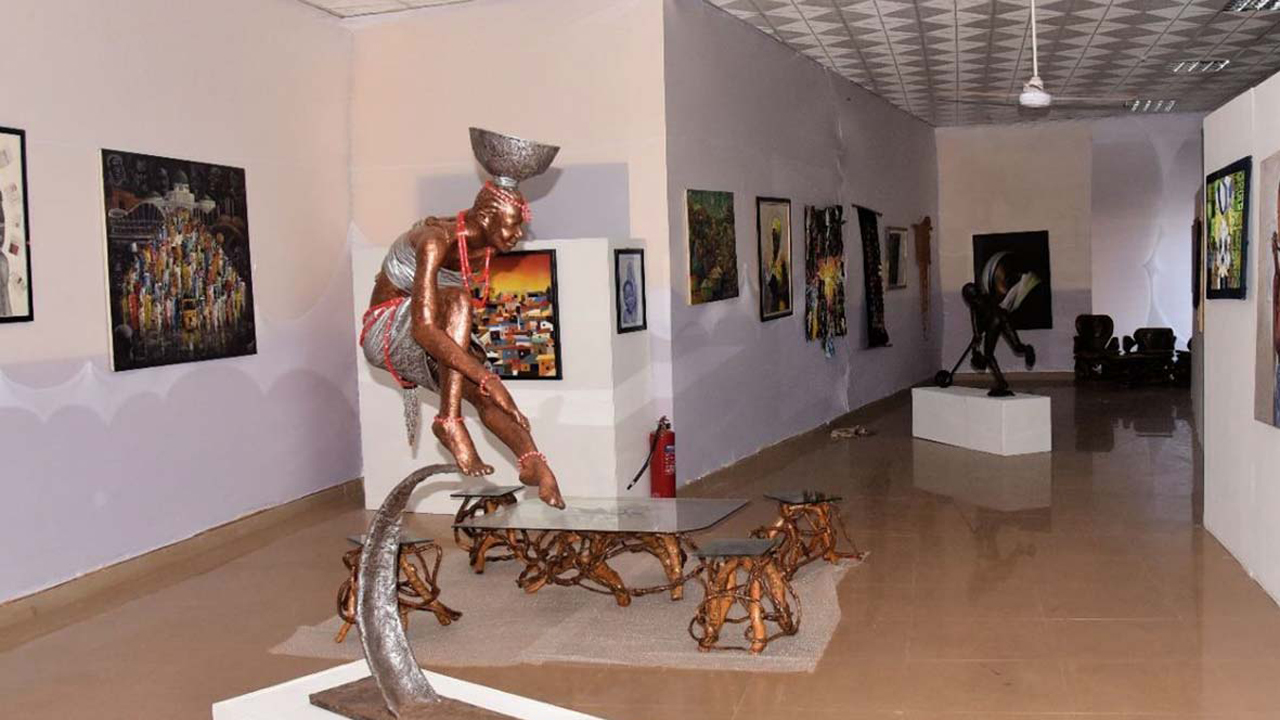
Young artists from across Nigeria including Jalingo, Enugu and Abuja/Jos showcased their works at the 2026 Life in My City Art Festival (LIMCAF) organised by the Life in My City Art Foundation. Through their works, these young artists articulated their thought-provoking concerns and experiences about Nigeria and beyond.Nigerian sports news
There were 100 finalists from 17 regional centres, and they all gathered at the International Conference Centre, Institute of Management and Technology, Enugu for the grand finale of the festival, which was held on October 31. The works of art, which were displayed at the two-storey lobby of the conference center’s auditorium, included photography, digital art, installation, textiles, ceramics, drawings, sculptures and paintings.
This year’s festival, themed “Open Letter,” allowed artists to raise their voices to different issues using their favourite medium of expression. Some artists decided to tackle the social and political conditions of their environments, while others chose to speak about their personal feelings and cultural experiences, and also tackle the issues of environmental decay, burdens of the day to day existence, and so on.
The festival has proven to be the best platform for upcoming artists in Nigeria to be discovered and appreciated.Nigerian sports news
One of the works that attracted the most attention was Bilikisu Oyiza Shuaibu’s “Mai Kisto: A Million Tales,” which won the festival’s Grand Prize, the Elder K.U. Kalu Prize for Young Artist of the Year, worth $2,000. With strings linked beads, Shuaibu generated an image of women having their hair done at a beauty salon. The originality and excellence with which Shuaibu used her materials made her work stand out from the rest of the exhibit.
It was an appropriate award for an entry that exemplified how an artist could make a strong visual statement in a compelling way using different materials. The jury’s report, in fact, acknowledged this year’s finalists’ broader interest in working with different materials, including used and discarded textiles, metal and aluminum scraps, mesh and waste paper.
The judges acknowledged the use of different materials as an exciting development in the field of art and appreciated the energy and creativity that artists of Shuaibu’s age exhibited. For the judges, the energy and willingness to innovate and experiment raised hopes for the field of art, because it meant that the constraints and limitations of the environment would prove beneficial in stimulating and expanding artists’ imagination and ideas.
The six-person jury, chaired by Chike Chinazom Obeagu, was Talatu Adiwu Onkala, Frank Ugiomo, Ugochukwu-Smooth Nzewi, Bella Anne C. Ndubuisi and Dotun Popoola. In the assessment of the entries, the jury considered the interpretation of the theme, the originality of visual expression, the quality of finish and presentation, and the creative use of materials.
The jury appreciated the intellectual level of the entries and noted potential areas of improvement. Some artists had ideas and concepts that were quite interesting and original, but ended up losing impact as a result of poor execution. The jury was particularly disturbed to find instances of imitation of works similar in nature and style to those of previous LIMCAF winners. The jury recommended to the Regional Coordinators to strongly advise the deselection of imitations and replicas and encourage artists to cultivate their own individual visual voices.
Presentation guidelines should be strictly enforced, and the judges recommended that these be defined in detail at each stage of the competition.
Awards were also presented to Success Emeka, the recipient of the Chinelo Chime Prize for Photography for “The Tomorrow We Might Never See”. Kayode Oluwapelumi won the Capt. Everest Nnaji Prize for Best Painting for “Open World: Where Everything Grows”. Obeka Simon Edoh was awarded the Tayo Adenaike Prize for Best Watercolour for “Breaking Chains, Not Spirits”.
Gushi Clinton Data won the Chief Alexander Orji Prize for the Best Sculpture/Installation for “How I Play My Part”, while Chimmuanya Onuzulike won the Best Ceramics award for “Extraction”. “Many Good Heads” by John Ojo won the Best Drawing award and “Life” by Jacob Onyebuchi Onu won in the Graphics, Digital Art and Video category.
Other awards went to Victoria Oluwadamilola Adewole, for the Best Textile Art/Fashion Art for “To The Wounds That Refuse to Heal”; Praise Edward won the Most Creative Female Artist award for “Between The Lines of Inertia”; and Taiwo Iyamu Shileola won the Artists Living with Disability award for “Open Letter to the Mind”.
Godwin Ejike Ugwuagbo won the Justice Aniagolu Prize for Originality for “The People’s Manifesto”. Ruth Ben won the Mfom Usoro Prize for Best Entry from Uyo Centre for “The Rat Race”, and Louis Ifeanyi Igwegbe won the Vin Martin Ilo Prize for Best Entry from Enugu for “Every Feeling Leaves A Mark”. Hosea Timothy Dakas won the Chike Obeagu Prize for Best Collage for “A Letter Unread”, and Augustine Martin Ebuka won the Stephen Bezalel Prize for “Green-White-Green Like Babel”.
“Que Sera, Sera” won the Agoreyo Armstrong Prize for Best Entry with Wastepaper, and Daniel Ogbodo won the Kanyeyachukwu Tagbo-Okeke Prize for Best Entry by a Special Need Artist for “Residue of Time”. “Prime” by Hannah Success Egba won the Pius Okigbo Prize for Technical Proficiency. Egba hails from Auchi.
A host of others including Shuaibu, Oluwapelumi, Data, Adewole, Edward and Shileola were selected for the El Anatsui sponsored all-expenses-paid two week trip to Dakar, Senegal. Other Entries were awarded consolation prizes.
Of course, awards and recognition play a major role in validation for artists. But LIMCAF provides a different kind of platform for the recognition of artists. It provides a space to bring artists together from across the country, and showcase their work alongside their contemporaries. For many participants, it is a much needed opportunity for recognition; for others, it is an opportunity to assess and appraise their ideas and artistic development in relation to the field.
The members of the jury, however, mentioned that the next stage of development would demand more than the right choice of materials and high level of skill.
Artists need to, on their own, find a way of making their personal experiences concrete and visible to the audience. To expand on this point, the theme for the next edition of the festival is the Emerging Frontiers. This year’s exhibition provides a lot of insights on how young artists are interpreting and representing the world around them, and may also give us a lead into what frontiers they are exploring.
Vanguard