
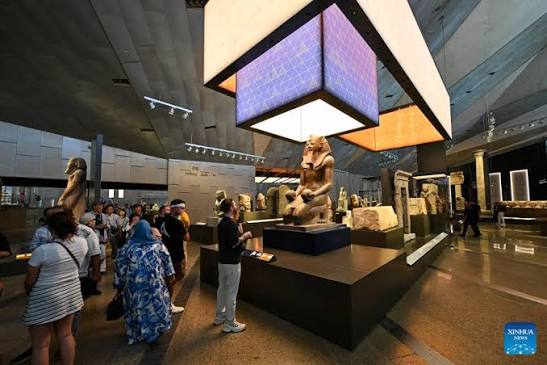
The Cultural Office of the Egyptian Embassy in Kuwait, in cooperation with the National Council for Culture, Arts and Letters (NCCAL), held an event on Sunday to mark one year since the opening of the Grand Egyptian Museum in Cairo in early November last year. The event was titled ‘The Grand Egyptian Museum: A Civilization Told, a Future Revealed’.
Egypt’s Ambassador to Kuwait Mohammed Abu Al-Wafa described the museum, which lies near Remaya Square and the Giza pyramids, as “a unique cultural landmark that embodies Egypt’s renewed message to humanity”. He said the museum, which covers 490,000 square meters and displays around 57,000 artifacts, is among the world’s largest archaeological museums dedicated to a single civilization.
“Our celebration of this occasion in Kuwait carries special significance, as Egyptian-Kuwaiti relations have never been merely political and economic. Culture, science, education and the arts have remained among their most important pillars,” Abu Al-Wafa said.
NCCAL Assistant Secretary-General for Cultural Affairs Aisha Al-Mahmoud said the event showed that museums are not just spaces that house antiquities but living cultural institutions that help preserve human memory. She said the accompanying exhibition brings together work by Kuwaiti and Egyptian students and gives young people a chance to engage with heritage.
Professor of ancient history and archaeology at Kuwait University’s College of Arts Dr Sayed Mahfouz presented some of the museum’s key pieces. They include the hanging obelisk of King Ramses II, made of pink granite and weighing 110 tons, and the colossal statue of Ramses II, who ruled Egypt for 66 years from 1279 to 1212 BC. He also showed 10 statues of King Senusret I and the museum’s Grand Staircase, which holds 59 royal statues.
Kuwait University history professor Dr Reem Al-Rudaini moderated a panel discussion on the museum and understanding ancient Egyptian civilization, with Dr Sultan Al-Duwaish, Dr Ahmed Saeed and Dr Hasan Ashkanani.
The museum’s design was inspired by the pyramids. Its collection includes the treasures of Tutankhamun, displayed in full for the first time since his tomb was discovered in November 1922.
Credit: kuwaittimes