
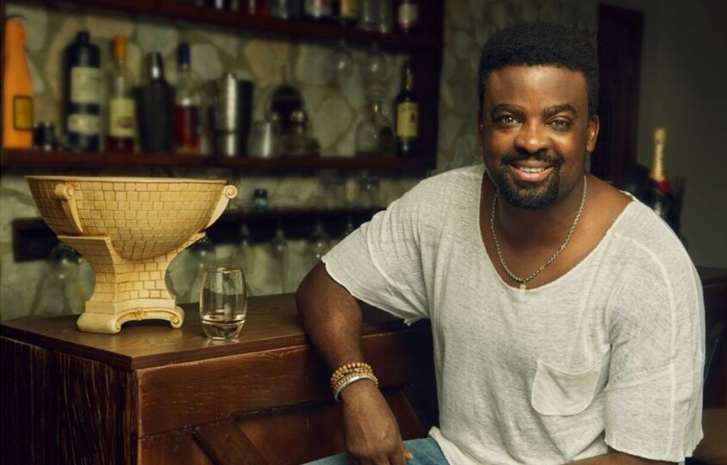
“AT THE AGE of 12 or 13, I began travelling beyond the borders of Nigeria with my father: Benin, Togo, Ivory Coast,” recalls Kunle Afolayan. It was the 1980s, and his father, Adeyemi Afolayan, a celebrated director and actor, would personally distribute his films. They were often stories about ordinary people—taxi drivers, perhaps, or farmers—overcoming difficulties. “We would go from one town to another by bus, carrying 16mm projectors,” Mr Afolayan says. It was a labour of love.
Mr Afolayan initially resisted a career in film despite this early exposure to the industry, studying business administration at Lagos State Polytechnic before taking a job at a bank. He soon had an idea for a movie and, finding that he did not have the time for both the corporate world and his project, in 2005 he quit his job and enrolled on a course in digital film-making at the New York Film Academy’s outpost in London. On his return to Nigeria, he set up his own production company, Golden Effects Pictures, and began developing his first feature-length film.


The industry in his native country was booming, earning the moniker “Nollywood”. Film-makers no longer had to trundle across the region to distribute their work: movies were burned onto CDs in their hundreds and sold in shops and markets. Film-makers started producing “tens of low-quality films a year,” Mr Afolayan says, with around 50 new movies released to the market each month, but they were of low technical quality and the storylines were tired. “It was not what I grew up seeing, and I really couldn’t relate to it.”

He wanted to create bold, sophisticated films across a range of genres. Films should take advantage of cheap new technologies, he reckoned, but not at the expense of rich characterisation, engaging narratives or attention to detail. As a result Mr Afolayan is seen as leading a “New Wave” of Nigerian cinema. “Kunle Afolayan’s sheer talent and ambition as a director and actor made him the standard bearer for ‘New Nollywood’,” says Jonathan Haynes, a professor at Long Island University who specialises in African film, video and literature.
Mr Afolayan believes that audiences are looking for storytelling that feels modern while evoking Nigeria’s history. “Irapada” (2006) and “The Figurine” (2009) were supernatural thrillers which drew on Yoruba folktales and ancient rituals; both won awards at the Africa Movie Academy Awards (AMAA). Toyin Falola, a professor of African Studies at the University of Texas, says that Mr Afolayan’s films are “modernising traditions, and traditionalising modernity”.

Mr Afolayan changed tack for “October 1” (2014), a tense historical drama set on the eve of Nigerian independence in 1960, and “The CEO” (2016), a whodunnit featuring jet-setting executives competing for the top job. His new film, “Citation”, about the “sex for grades” scandal at Nigerian and Ghanian universities which came to light in 2018, began filming on January 10th. Mr Afolayan matter-of-factly predicts that it will “beat records”.
Yet box-office receipts are not Mr Afolayan’s main concern. “Nigerian films that are driven by commercial interests alone make a lot of one-off noise, but people don’t remember them in six months’ time,” he says. “That isn’t the kind of legacy I want to leave.” Most of his films have been financed through a combination of his own earnings, bank loans and individual investors, though he has now attracted funding from further afield, receiving a Ford Foundation grant to make “Citation”. In September Netflix licensed six of Mr Afolayan’s films as part of their bid to attract more subscribers in the region.
While other film-makers produce work in English, the official language of Nigeria, in order to reach international audiences more easily, Mr Afolayan has always opted for multilingual scripts that feel more authentic. To intimate differences in tribes, education and regions, the dialogue in “Irapada” was delivered in a mix of English, Hausa, Igbo and Yoruba. In “The CEO” characters speak English, French, Swahili, Yoruba, Arabic and Chinese to reflect how, and with whom, the African world does business. “Citation”, the new film, will feature English, French and Portuguese. “We just don’t speak straight up English,” he laughs. “That’s not us.”
These efforts have inspired a new generation of film-makers in the country. Mr Afolayan’s movies are “benchmarks in the evolution of the visual aesthetic of Nigerian films,” says Abba Makama, who co-wrote and directed “The Lost Okoroshi”, a standout film at the Toronto International Film Festival in 2019. Mr Afolayan is supporting his successors directly, too, with a film hub in Lagos due to open later this year. It will host a school, a cinema and production facilities; it’s a “one-stop shop for aspiring film-makers to come and get things done,” he says. It is a more modern version of the education Mr Afolayan received as a youngster: “I have merged what I have learnt from my father with what is possible today”.
Source: economist.com