
At the ancient Assyrian city of Nimrud in northern Iraq, a temple razed by fire around 612 BCE, has remarkably preserved shrines that were recovered by the Penn Museum and Iraqi archaeologists on a site excavation this year as part of the Penn Nimrud Project, one of several cultural heritage preservation and protection initiatives of Penn’s Iraq Heritage Stabilization Program (IHSP). These recent discoveries enhance our understanding of one of the world’s first empires while also highlighting archaeology’s integral role in cultural heritage restoration.
This book traces the history of cuneiform from its beginnings in the fourth millennium BC to its eventual demise in the face of the ever expanding use of alphabetic Aramaic in the first millennium BC.
Penn Nimrud Project expands 19th-century excavations
Known as Kalhu by Assyrians and Calah in the Bible, Nimrud’s vast archaeological mounds first excavated in the 19th century, provide evidence confirming how ancient Mesopotamia contributed to human advancement. Assyria also represents a crucial part of Iraq’s cultural identity, which the so-called Islamic State of Iraq and Syria (ISIS) attempted to erase by destroying major Mesopotamian monuments between 2014 and 2017. Two of these sites at Nimrud were the Ninurta Temple and its Ziggurat (stepped temple tower) and the famed Northwest Palace built by King Ashurnasirpal II (883-859 BCE) who reigned over Nimrud, the newly appointed capital of the Neo-Assyrian state.
Despite previous excavations led by the English archaeologist Sir Austen Henry Layard and then by British archaeologist Sir Max Mallowan, husband of renowned mystery author Agatha Christie, the temple remained poorly documented and predominantly unexplored until now.
Penn IHSP safeguards at-risk cultural heritage sites in Iraq and Syria. By working collaboratively with government authorities, international experts, and local stakeholders, the Penn Nimrud Project, a part of IHSP, seeks to repair recent damage, reopen the site to tourism, and refine our understanding of Nimrud’s temples and Assyrian religious practices. All artifacts recovered from excavations remain in Iraq.
Findings at the temple
In its third season, project excavations unearthed two new shrines within the sprawling Ninurta Temple. Inside the larger shrine, the team found a monumental stone dais (a low platform for the statue of a god or goddess worshipped in the temple (measuring about 12 ft. by 9.5 ft.) with a cuneiform inscription, presumably of King Ashurnasirpal II. The smaller shrine contained a dais severely damaged in antiquity. These artifacts provide valuable clues regarding Assyrian religious practices and the deities worshipped there for centuries.
Other noteworthy finds in the shrines were possible parts of statues of unknown deities, which would have once stood on the daises. Yet only fragments of these types of statues and their accouterments were found after invaders from Babylonia (southern and central Iraq) and Media (ancient western Iran) pillaged and burned the temple around 614-12 BCE, overthrowing the Assyrian Empire. Through careful examination, excavators hope to develop a detailed picture of the religious practices surrounding the state god Ninurta, the war god of the mighty Assyrians, and closely associated deities as the kingdom emerged as one of the world’s first empires. Despite the looting and destruction of the temple in antiquity, the discoveries reveal Ninurta’s central role in the state religion and the incredible wealth held by the temple.
“The burning and sudden collapse of the Ninurta Temple left it in a remarkable state of preservation. The team located preserved cedar wood brought to Nimrud from the Lebanon Mountains for the temple’s construction—exactly as it was recorded in the inscriptions by King Ashurnasirpal II, in which he describes building the temple precinct,” says Dr. Michael Danti, Program Director of the IHSP. “The condition and distribution of artifacts strongly suggest that the shrines and associated treasures were looted and intentionally damaged by the Babylonians and Medes before being set ablaze.”
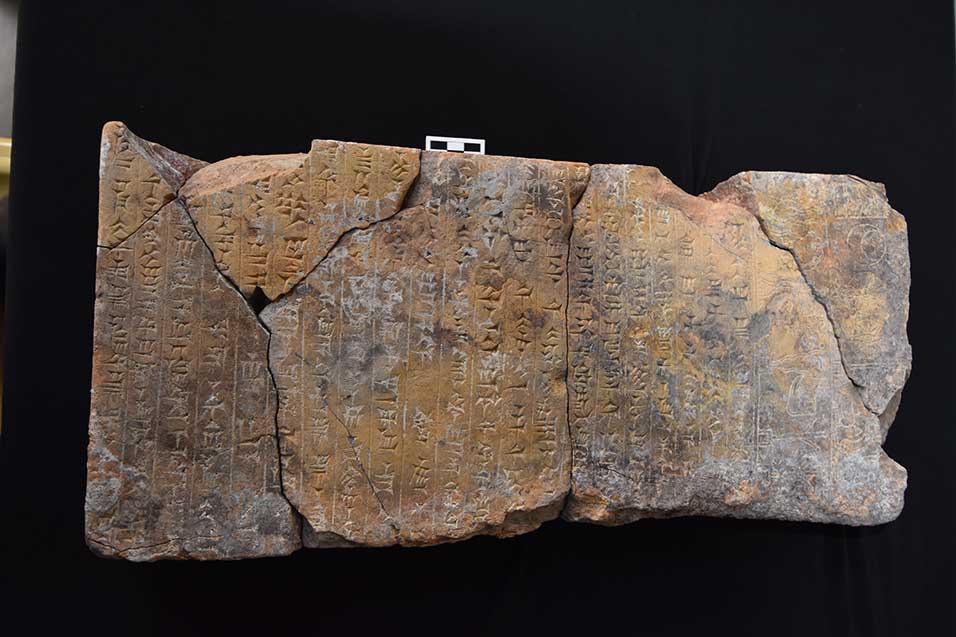
According to Dr. Danti, the most intriguing find was a kudurru, a cuneiform-inscribed stone monument in the temple, which dates to 797 BCE and features symbols of important deities. It documents a royal decree granting the governorship of Hindanu, an area located on the Euphrates River at the Syria-Iraq border.
“The Assyrian king Adad-Nerari III (811-783 BCE) assigned this strategic region to a governor named Nergal-Eresh of Rasappa (located west of the Tigris and northwest from Nimrud in the Khabur River region),” Dr. Danti explains. “It strongly emphasizes that no one may refute NergalEresh’s claim to his new territory. It closes with a long list of curses for anyone who breaks the agreement, damages the stela, or removes it from the temple.”
Researchers also found well-preserved clay tablets with cuneiform inscriptions written in Assyrian (a dialect of Akkadian) that reveal details about the temple’s economic activities, such as silver loans and lists of assets, along with a note written in Aramaic—a language and script widely used during the later Assyrian Empire. Other objects recovered during the excavations include a stone bowl set into the brick floor of the shrine, likely used for pouring libations during religious ceremonies, the sculpted head of a griffon, fragments of glazed pottery and stone tablets, carved ivories, and jewelry. The wide range of object types, materials, and artistic styles reflect the burgeoning wealth of the Assyrian Empire and its vast military conquests and trade connections.