
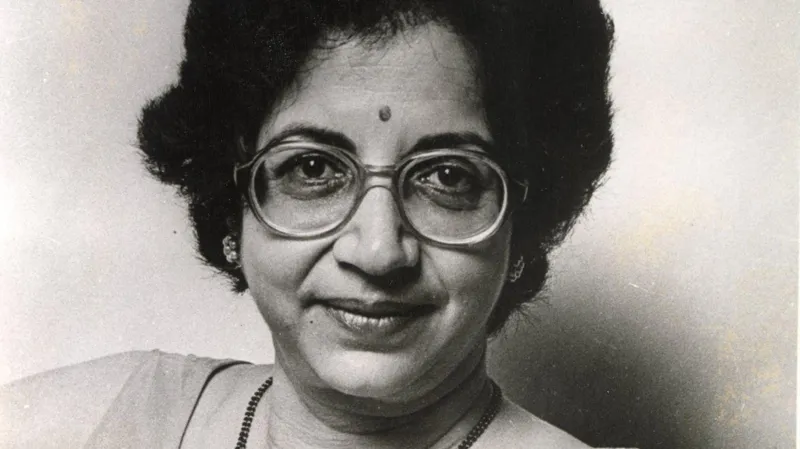
Vijaya Mehta who died last week, aged 92, was known for her trailblazing plays that transformed the landscape of Indian theatre.
Mehta, who was widely credited with modernising Marathi-language theatre (performed mainly in Maharashtra state) in the 1960s and 1970s, was one of the most influential figures in the world of performing arts.
She was best known for directing and acting in experimental plays and films, and was a mentor to many budding as well as popular Bollywood actors like Nana Patekar and Anupam Kher.
Mehta received several awards during her lifetime, including National Film Awards for her acting and direction and a Padma Shri (an Indian government civilian award) for her contribution to modern Indian theatre.
Although widely associated with Marathi theatre, Mehta was born in Vadodara in present-day Gujarat state in 1934. She came from a family of actors and could have easily pursued a career in mainstream cinema but chose the world of theatre instead.
Indian theatre, though not bereft of fans, has always occupied a less glamorous space in the performing arts. But this didn’t seem to matter to Mehta, who began acting in Marathi plays during college after being encouraged by a professor.
She later trained under Ebrahim Alkazi and Adi Marzban, pioneers of modern Indian theatre, and carried their spirit of experimentation into her own work.
Theatre lovers in Maharashtra remember Mehta as the woman who transformed Marathi theatre with bold, experimental plays about ordinary lives.
The change resonated with largely middle-class Marathi-speaking audiences, who finally saw their own lives reflected on stage. Her plays captured the complexities of everyday life, with flawed, believable characters whose honesty struck a chord.
In his tribute to Mehta on X, Raj Thackeray, one of Maharashtra’s most well-known politicians, celebrated her “courage” to transform Marathi theatre at a time when the state itself was coming into its own.
Mehta co-founded the experimental Mumbai theatre group Rangayan in 1960, the year Maharashtra was created when the Bombay Reorganisation Act split the bilingual Bombay state into Gujarati-speaking Gujarat and Marathi-speaking Maharashtra.
Thackeray said Mehta emerged at a time when Maharashtra was embracing social reform, industrialisation and universal education, and Marathi theatre needed to move beyond “grand sets and melodrama” to become “truly experimental”. “Vijaya Tai (sister) filled that void,” he wrote.
Rangayan staged some of Marathi theatre’s boldest experimental plays while nurturing a generation of actors and writers.
Playwright Mahesh Elkunchwar, whose one-act plays Mehta directed and produced at Rangayan, wrote fondly about working with her in the Indian Express newspaper.
“When I joined hands with Bai [which roughly translates to madam in the Marathi language], as Vijaya was called, I knew that I had found my home ground. We were not interested in entertaining; fame and money were not even on our radar. We wanted to explore theatre, art and life through our work,” he wrote.
Mehta also inspired many to pursue theatre. Among them was singer and writer Swanand Kirkire, who has said one of her workshops drew him to the stage.
The atmosphere, he wrote on X, was so “captivating” that he “just decided to settle right into it”.
Mehta introduced Marathi-speaking audiences to Sanskrit classics, experimental productions of plays by Marathi playrights like Vijay Tendulkar, and adaptations of works by Bertolt Brecht and Anton Chekhov.
But Mehta’s experimentation extended beyond theatre.
She directed acclaimed films including Rao Saheb (1985), about a reformist lawyer in 19th-century Maharashtra, and Pestonjee (1988), which explored love, adultery and friendship through the lives of three Parsis in 1950s Mumbai.
Actors who worked with Mehta recall her sharp understanding of the craft and her rigorous approach to directing.
In a post on X, veteran actor Anupam Kher recalled his experience working with her in Rao Saheb, in which he played the lead role.
“I had already done a few films by then and thought I understood something about acting. But every rehearsal with her reminded me how vast the ocean of this craft really is. In front of her wisdom, her understanding of human behaviour, and her extraordinary sensitivity, I happily became a student again,” he wrote.
Mehta also chaired Mumbai’s National Centre for the Performing Arts (NCPA) for more than a decade. During her career, she worked with leading Indian playwrights and actors as well as international theatre figures including Peter Brook, Eugenio Barba and Richard Schechner.
Her death leaves a void in the world of Indian theatre that will be hard to fill.
Actress Sonali Kulkarni says she and other actors and theatre professionals owe Mehta a debt they might never be able to repay.
“To say that your [Mehta’s] passing is our loss would be too small a thing to say. We would only diminish what you truly gave us. The richness your presence brought, the abundance you gifted to the theatre is something we can never fully repay,” Kulkarni says.
Credit: BBC