
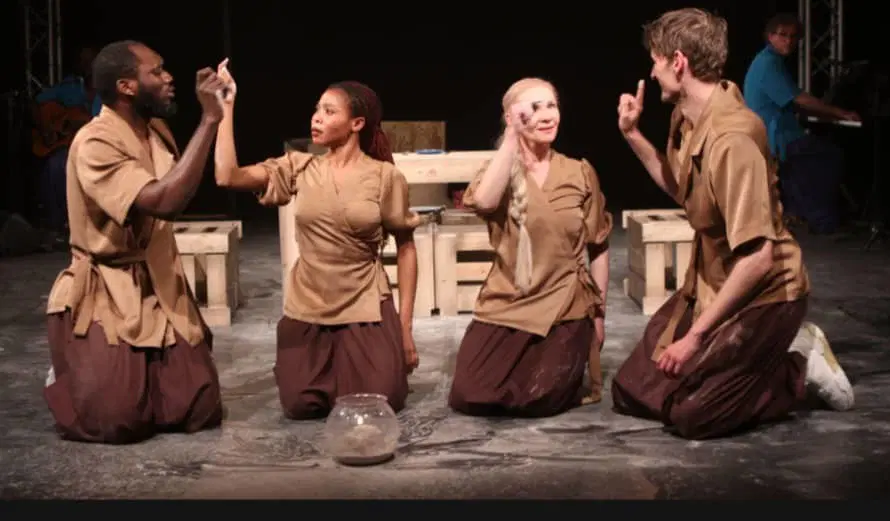
On a warm evening in Marburg, Germany, a bakery became an unlikely stage for a powerful conversation about humanity.
That was precisely on May 16, 2026, in Marburg, Germany. The premiere of Bread and Butter, an international theatre production by Kininso Creative (UK/Nigeria) and Hessisches Landestheater Marburg (HLTM), transformed a simple kitchen space into a profound exploration of community, empathy, and the rising cost of living.
While the play revolves around the humble loaf of bread, its message stretches far beyond the oven. For many, bread is a daily comfort; for others, it has become an increasingly expensive struggle. By using this universal staple as a starting point, the production invites audiences to reflect on the ideas of belonging, generosity, inequality, and shared humanity.
Unlike traditional plays that rely on heavy dialogue, Bread and Butter communicates through movement, music, and physical storytelling. This choice allows the story to bypass language barriers, making it accessible to both children and adults. While children delight in the comedic mishaps of the two lead bakers, Pan and Can, adult viewers are often struck by the deeper, quieter questions about social inequality embedded in the performance.
The turning point occurs when the bakers discover that visitors have been stealing bread because they are hungry. Instead of reacting with anger or punishment, the characters choose empathy. This pivotal moment serves as the heart of the play, presenting a vision of a community where dignity and compassion are just as essential as things like the flour and yeast used to bake the bread.
The success of Bread and Butter is a testament to the power of international teamwork. The creative vision was steered by director and concept creator Joshua Alabi and Artistic Director Carola Unser-Leichtweiß, with a dedicated team of producers, musicians, technicians, and administrators from both Nigeria and Germany. Their work mirrors the very theme of the play: that we are stronger when we collaborate and share resources.
The production was coordinated by producer and project manager Angela Peters, whose leadership supported the complex international collaboration from development through premiere. Dramaturg Cornelius Edlefsen and theatre pedagogue Michael Pietsch contributed significantly to shaping the narrative structure and audience engagement approach, while Sinmiloluwa Oyewale served as musical director and composer, creating the rich sound landscape that underpins the performance.
Behind the scenes, technical director Blessing Okunlola, technical assistant and content producer Qoyyum Areoye, Administrative Manager Chinenye Chukwudi, Communications Officer Caleb Ihenyen, digital technology officer Stephen Olugbenga Alabi and post-production specialist Zein-Abeedeen Awaiye played essential roles in ensuring the successful delivery and documentation of the project across multiple countries and institutions.
On stage, the production was brought vividly to life by an ensemble cast comprising Tobias Neumann, Aliona Marchenko, Christian Keul, Julius Obende, Chioma Enyinnaya, and Sinmiloluwa Oyewale, together, they created a dynamic world where music, movement, humour, and physical theatre blended seamlessly. Their performances transformed everyday objects and
ordinary situations into moments of wonder, inviting audiences to engage with the story both emotionally and imaginatively.
The production’s visual creativity is equally impressive. The stage is a playground of imagination where kitchen utensils become musical instruments and simple ingredients are used to build entire worlds. This inventiveness keeps the audience engaged, transforming ordinary, domestic moments into scenes of wonder.
Director Joshua Alabi began developing this concept after observing how the rising cost of bread in Nigeria was affecting families. However, the production successfully avoids being “local” to one specific country. By addressing themes of fairness and care, the play resonates deeply with audiences in Germany just as strongly as it would in Nigeria. It proves that while our daily lives may differ, our fundamental need for community and connection is universal.
In a world that often focuses on division, Bread and Butter offers a gentle, refreshing reminder: our communities flourish when we choose generosity over indifference.
As the final applause echoed in the Marburg theatre, it was clear that the production had achieved its goal—not just to entertain, but to foster a space where people can meet, reflect, and recognize their shared humanity.
Credit: Business News