
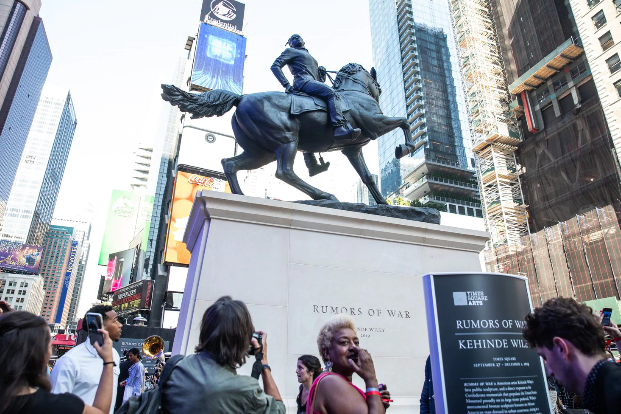
The old-fashioned, ceremonial unveiling of a statue is mostly extinct as a cultural spectacle. New art works are generally introduced quietly, amid white wine, canapés and polite chatter at exhibition openings. Now and then, perhaps a new museum may open with a ribbon-cutting. But Kehinde Wiley, the man who painted the portrait of Barack Obama that now hangs in the National Portrait Gallery, tried to reinvent the unveiling Friday afternoon in Times Square, complete with a brass band, gawking crowds, speeches by a phalanx of political notables and, finally, a few tugs on a shimmery silver cloth draped over his latest work, a monumentally scaled bronze equestrian statue.
It all went mostly according to plan. Passersby stopped to look, registering the oddity of the event in their “only in New York” mental file, and around 2:40 p.m., the cloth fell off, revealing a horse with one leg raised and its tail extended as if caught by a sudden upswelling of wind. On its back, framed against the digital image of a woman in a lacy bra and panties on the American Eagle Outfitters billboard (“Pow when you want it”), sat a young African American man wearing Nike shoes and short dreadlocks gathered in a knot atop his head. Like the figure in the statue on which Wiley’s work is based — a memorial to the Confederate general J.E.B. Stuart — the rider looks over his shoulder, as if about to turn and reengage with a battle raging behind him.


The sculpture, titled “Rumors of War,” will stay in New York until December, when it will be transported to Richmond. There it will stand permanently in front of the Virginia Museum of Fine Arts, which commissioned the work, only a few blocks from the city’s great public art shame — the collection of Confederate generals memorialized on Monument Avenue.


Friday’s event is the second major unveiling in less than two years for Wiley, who shared the stage with artist Amy Sherald for the official reveal of the Obamas’ portraits in February 2018. Wiley was already among the most famous artists working even before he became Barack Obama’s chosen portraitist. But he reportedly enjoyed the pomp and ceremony of the Washington event so much that he wanted to reproduce it for the debut of what is being billed as his largest public art work.
“Rumors of War” realizes in three dimensions the fundamental gestures on which Wiley’s career has been based for two decades. He has reached back to a venerable but fraught tradition of representation, and inserted into it a young African American man. In his paintings, he has repurposed classic, propaganda images of Napoleon and sumptuous portraits of aristocratic figures from the Renaissance. The resulting mash-up of hip-hop culture and couture with traditional, figurative painting has made Wiley an art-world star, and celebrities who don’t quite get the irony — his works are ambiguously reverential and coy about both the history of art and the young men he inserts into them — have flocked to him to have their images recorded in paint.
The New York unveiling functioned a bit like the visual bling, the play of surface color and luxurious patterning in Wiley’s painted works. The statue, it seems, needed a red-carpet moment, a chance to revel in its own arrival before it gets down to the hard work of being an intellectual riposte to the long, sordid history of Confederate mythologizing. And the old-timey feel of the event, with young musicians in tasseled hats and spangly shorts, and the sousaphone bell glinting in the sun, were all intentional.
But it was also a chance for the artist to build an audience for his work. In Times Square, it will be seen by more people in an afternoon than it may see in a week or more in Richmond. So when Wiley spoke to the modest crowd, he pitched the new work not as a conceptual project, but as simply an image of an African American, depicted heroically, and installed on one of the busiest intersections in the world.
The statue of Confederate general J.E.B. Stuart along Monument Avenue in Richmond, upon which Wiley’s new work is based. (Salwan Georges/The Washington Post)
“We demand more,” Wiley said. “We say ‘yes’ to something that looks like us.” In his speech, he spoke vaguely of “war calls,” using the term to suggest the urgency of the cultural moment, including not just the legacy of Confederate imagery but also the devaluation and subjugation of black bodies in popular culture. Far above the statue, which is a dark patinated bronze, a white woman on a white horse rode through a sunlit landscape in a perfume ad for Lancome.
Wiley was inspired to make the work, which sits on a stone-clad plinth the same size as the one that supports the J.E.B. Stuart statue, after visiting Richmond for an exhibition in 2016.
“He became enamored of the dark legacy of Richmond,” said Alex Nyerges, director of the Virginia Museum of Fine Arts. “We thought he’d stay a day, but he came down with his whole entourage.” Wiley was fascinated by the now infamous Confederate statues, which began filling the boulevard’s open spaces with the unveiling of a statue to Robert E. Lee in 1890, which attracted a crowd of about 100,000 spectators. Wiley proposed the idea of a statue that would question, or mock or somehow displace, the reflexive deference those statues have commanded for decades.
“It was the best idea I had ever heard,” said Nyerges, who persuaded his board to commission the work, the most expensive commission in the museum’s history. Nyerges sees the proximity of Wiley’s work to Monument Avenue as a “majestic, inclusive” and profoundly subversive response to the city’s Civil War dilemma: “Richmond is locked in a struggle over what to do with those memorials,” but with Wiley’s work, he says, “we change the whole conversation.”
By a little after 3 p.m., Wiley had a scotch in his hand, and was still thronged by friends, fans and well-wishers, and the Malcolm X Shabazz High School band, from Newark, was still playing with gusto. Wiley said in an interview that he picked the J.E.B. Stuart statue as his model not for any historical reference, but because “of the gestural feel of the horse,” which is definitely one of the perkiest equine figures in Richmond. The larger purpose, he said, beyond challenging the legacy of Confederate symbolism, was to confront the American “love affair with destruction.” As in his earlier works, he wanted to “play against the toxic notes of black masculinity associated with things like criminality.”
Like the historic statues it mimics, “Rumors of War” sits on a stone support well above the ground, forcing the viewer to look up. It is too far away, too elevated from the earth to be closely scrutinized. The young man’s face feels far away, and like many of the old bronze generals sitting on horses all over the world, he doesn’t seem entirely at ease in the saddle.
When its New York moment is over, the statue will begin the second stage of its life, shedding some of the temporary celebrity it will enjoy for the next few months to take up the challenge of destabilizing a city’s stultifying landscape of racist imagery. The young man on the horse has a fight ahead of him.
One reason people make statues out of bronze and place them in public spaces is to make the figures represented seem to be inevitably and always there, like the trees and the roads and even the sky above them. Their weight and seeming permanence is part of their message.
But Wiley knows that.
– Philip Kennicott (originally published in The Washington Post)