
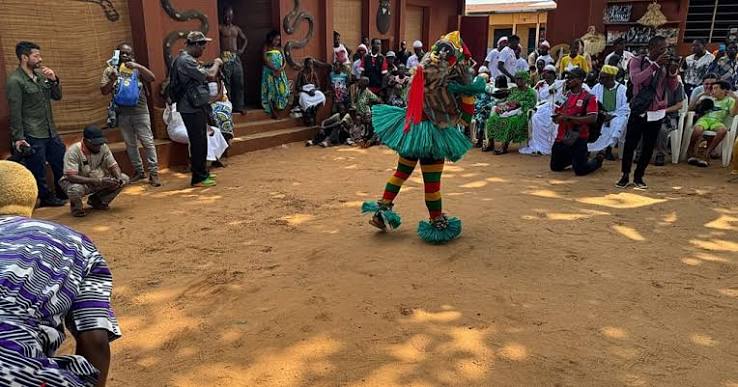
For two days, Benin’s political capital, Porto-Novo, came alive with the mythical Egungun, Zangbéto and Guèlèdè figures during the Mask Festival, as ceremonies and parades filled the city with color and tradition.
Professor Mahougnon Kakpo said that masks were both unique and universal and that they carried a message.
“Mask is universal. Every people, every civilization has masks because those who came before us, our venerable elders, created ideas and words that they embedded in the masks. Masks are not just what we wear on our faces and take off. Masks represent a message,” the professor said.
That message, passed down by the ancestors, is what the festival aims to share beyond the communities that know its codes. Behind every mask lies a story.
“Sacred masks carry a message, just as secular masks also carry a message. And to diversify these masks, we made the festival international. And when we speak of an international festival, it means that masks that are not only Beninese take part in the event,” he added.
For foreign visitors, the experience often began with wonder. Martin Cruz, who had been in Benin for two weeks, said he had discovered the festival for the first time in Porto-Novo, along with its costumes, dances, hairstyles and deep cultural significance.
He said he planned to buy books to better understand the ceremonies, the masks and the dances, and said he was very impressed by how deeply this culture was embedded in the population and the wider community. He described the spectacle as magnificent.
In Porto-Novo, the Mask Festival is helping shape a tourism strategy built on immersion, understanding rituals and meeting tradition bearers.
Its future growth will depend on how well it can expand without losing its.
Credit: Africa News
Joel Kouam