
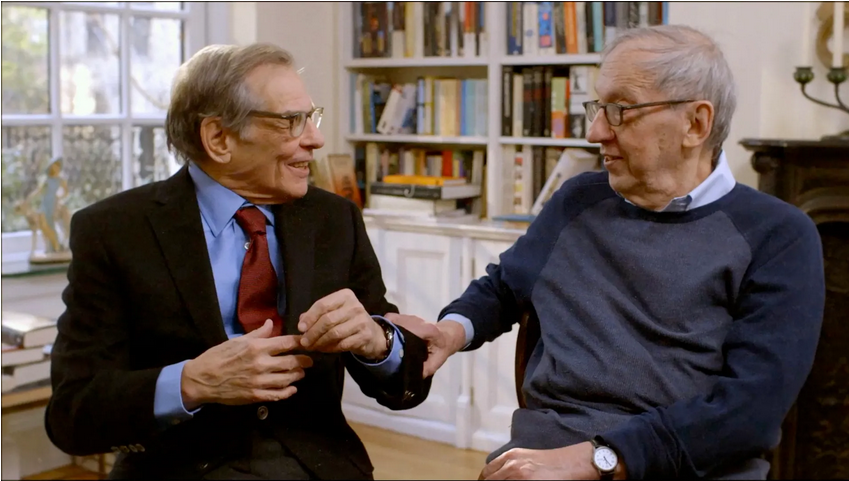
“Turn Every Page: The Adventures of Robert Caro and Robert Gottlieb,” a documentary by Lizzie Gottlieb about an author and his editor (her father), had its première on June 12th at the Tribeca Film Festival. The working relationship between the two Bobs began with “The Power Broker,” Caro’s 1974 blockbuster about Robert Moses, and has continued through four volumes of a projected five-volume biography of Lyndon B. Johnson.
Lizzie had noticed that while many of her father’s writers socialized with her family, Caro did not—she did not meet him till her father’s eightieth-birthday party. (Gottlieb is now ninety-one; Caro is eighty-six.) In fact, Gottlieb and Caro had a long history of antagonism, squabbling over things large and small, including the semicolon. Lizzie’s first hurdle was to persuade both men to be in the film. “Absolutely not” was her father’s response. Caro’s was similar, but he was won over after seeing a film Lizzie made about her brother Nicky (“Today’s Man,” released in 2006).


The film is perfectly balanced. Bob Gottlieb is shown at home with a manuscript on his lap, the door open to a garden on a sunny day; at a bookstore in Paris; and in a rehearsal space for the Miami City Ballet (he is on the board). In one scene, Lizzie rather tenderly buttons her father’s shirt over the microphone wire. Bob Caro is seen going through his daily routine: dressed in a suit and tie, he commutes on foot to his office, where he writes in longhand and types up his pages on a Smith Corona Electra 210. (People often write to him and offer to sell or give him their typewriters. He accepts the free ones and cannibalizes them for parts.) Lizzie asks him if he worries about losing the typescripts, as he doesn’t use a photocopier or a computer. By way of answer, he reaches into a box behind him and brandishes a sheet of carbon paper.


Gottlieb was, of course, the editor of The New Yorker for more than five years, from 1987 to 1992, and before that the head of Knopf and before that the editor-in-chief of Simon & Schuster. In the film, the montage of books he has edited goes on and on—hundreds of books, by authors including Niccolò Tucci, Doris Lessing, Joseph Heller, Nora Ephron, John Cheever, Salman Rushdie, and Toni Morrison, to name a few. Gottlieb has also written several books himself, among them “Avid Reader,” a memoir. His voice is high and reedy, and he is wonderfully articulate, especially about his love for his daughter.
Caro speaks with a strong New York accent and is also very articulate and very funny, whether intentionally or not. In his office, he starts to volunteer something—his reason for taking down the top row of notes for the outline of his book, which he keeps pinned to a corkboard on the wall—and then changes his mind. When the interviewer pursues it, he gets grumpy and turns his back on the camera. He relives his early days as a reporter at Newsday, where he was hired as a joke during the managing editor’s vacation. (The boss had a prejudice against the Ivy League, and Caro went to Princeton.) It was that editor, Alan Hathway, who gave Caro his method and his ethic as an investigative reporter (and the documentary its title), telling him to “turn every page.” (Caro tells the story in a Personal History published in The New Yorker issue of January 28, 2019.) Looking for a literary model for the opening of “The Power Broker,” a way to dramatize the scope of Roberts Moses’s impact on New York, he landed on the catalogue of ships in Homer’s Iliad.
Video From The New YorkerA Street Musician Fights the Stigma of Albinism in Africa
When Caro was almost finished with “The Power Broker,” he got an agent, Lynn Nesbit, and she matched him up with Gottlieb. If there is any enmity between Caro and Gottlieb, it would seem to be a remnant of Caro’s pain at the amount of material Gottlieb cut from “The Power Broker.” The manuscript was enormous—more than a million words, some three hundred and fifty thousand of which had to be cut just in order to make the book fit between covers. (The average book, if I’m writing it, has between seventy-five thousand and a hundred and twenty-five thousand words.) After a long day of cutting, Caro proposed that they publish it in two volumes, but Gottlieb refused, saying, in Caro’s recollection, “I might be able to get people interested in Robert Moses once. I’ll never get them interested twice.”
The story moves on to the Johnson biography, which was originally supposed to be three volumes but has grown; Caro is working on the fifth and final volume. (At the Q. & A. after the film, questions about when he might deliver it were off limits.) He and his wife, Ina, who works as his researcher, moved for a few years to the Hill Country of Texas to better understand the culture that produced Lyndon Johnson. One scene shows them working side by side at the magisterial L.B.J. Presidential Library, in Austin. In perhaps the most intimate scene of the movie, Caro lets the filmmaker into his home and shows her the cupboard over the refrigerator where he stuffs his carbon copies.
Bob Gottlieb’s obsession with plastic purses does not go undocumented. He just likes them. He is shown reading in bed, and the wall behind him is lined with shelves displaying his collection. His wife, the actress Maria Tucci, describes the time she was asked by a therapist what kind of objects her husband collected. She thought about it, and then—she bursts into hysterical laughter—said, “Never mind.”
During the Q. & A. that followed the première, for which the two protagonists and the director were onstage with the writer Steven Johnson, an audience member complained that “The Power Broker” is so massive and so heavy that he can hardly hold it, let alone read it in bed, and asked why it is not available as an e-book. (I inhaled it back in the eighties, when I lived in Astoria. It explained so much about the city, including the intricacies of the Triborough Bridge.) Caro said that, after so many hardships, the experience of publishing the book was perfect—it won the Pulitzer Prize and has been reprinted sixty-four times—and he doesn’t want to mess with it by turning it into an e-book.
Lizzie hoped to catch the author and the editor in the act: working together on a manuscript in the publisher’s office. It happens—spoiler alert—but there’s a catch: no audio. Caro says, “It’s sort of a private thing.” Before they get to work, the two Bobs search for a pencil. Nobody in the office has one. Someone produces a mechanical pencil and asks, “Is that O.K.?” Gottlieb rejects it. They keep looking till they find a proper wood pencil with an eraser tip. Caro sharpens it with an electric sharpener in the hall. They get to work, playing pencil and eraser, Gottlieb taking things out, Caro restoring them. The film’s soundtrack is effective here: a Chet Baker rendition of “Do It the Hard Way,” by Rodgers and Hart, that makes editing look like dancing. (Sony Pictures Classics has bought the film and will give it a theatrical release later this year or early in 2023.)
Souvenir pencils were handed to the audience on the way out. A party followed at the Chelsea, where two specially created cocktails were offered on trays at the door: the Mot Juste, a gin concoction, and the Semicolon, a variation on the Manhattan. In the film, David Remnick attempts to define the semicolon: “I know how I use it, which is to say that you would have two sentences that have a causal relationship, and they are better joined than unjoined.” Caro likes semicolons and employs them freely; Gottlieb is suspicious of them, and objects to their overuse. Full disclosure: I was also interviewed about the semicolon, in my capacity as a copy editor, and appear briefly in the film. Also, after the movie, I went back for extra pencils.
Source: www.newyorker.com