
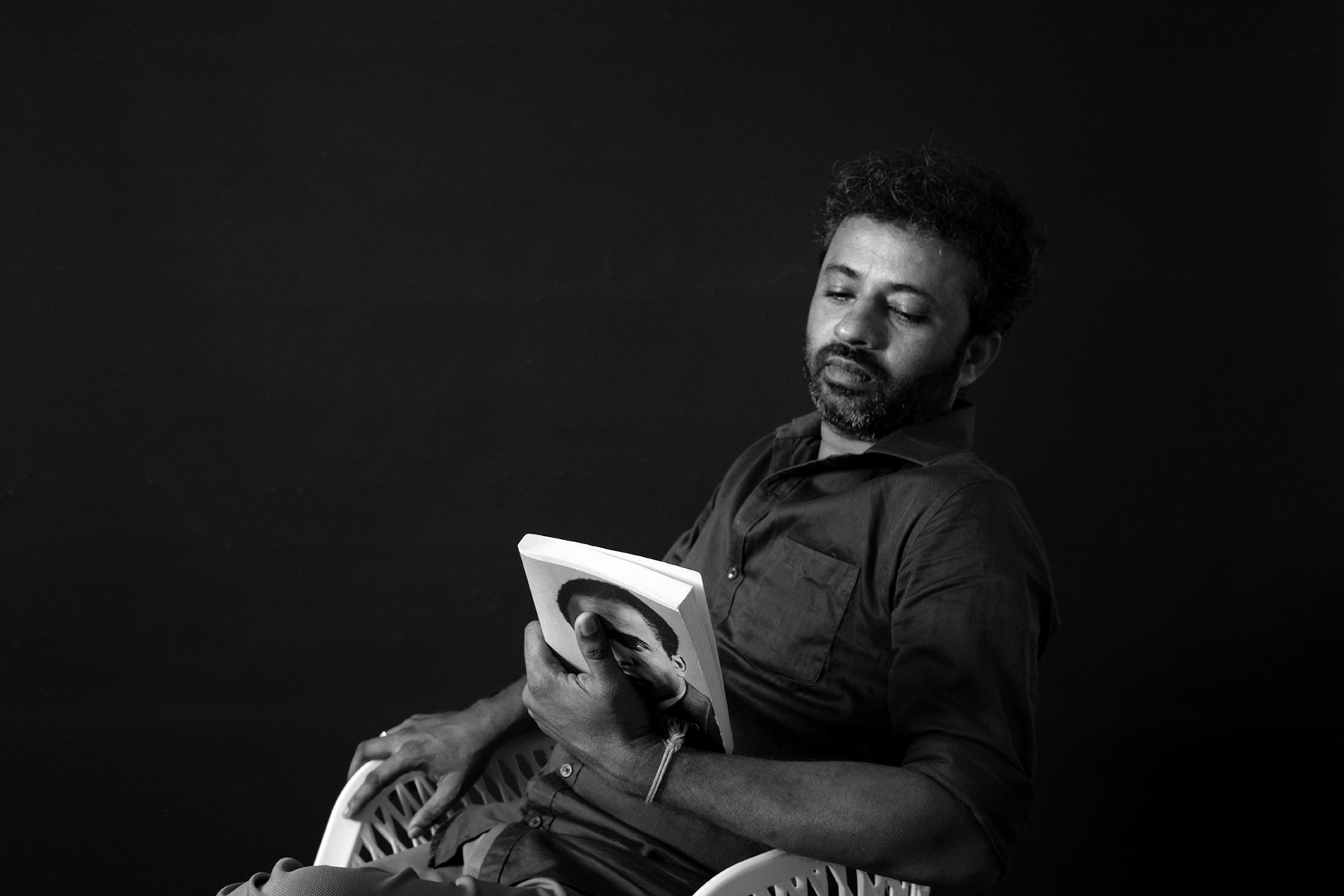
More than four months after Sri Lanka Customs detained two of his books on national security grounds, Tamil novelist Theepachelvan Piratheepan says the experience has deepened his fear of state surveillance but strengthened his resolve to continue writing from the Tamil homeland.
The Kilinochchi-based writer, who teaches Advanced Level students, reflected on the continued detention of two of his books, the broader targeting of Tamil literature, and why he believes successive Sri Lankan governments continue to view Tamil writing as a threat.
The books formed part of a consignment of approximately 500 copies printed in Tamil Nadu that arrived in Sri Lanka on 18 March, containing five different titles. Customs disrupted its release, with officers claiming the publications could threaten national harmony and national security, suspicion having first arisen, officials said, from a map of Tamil Eelam on one of the covers alongside what Customs described as a limited inspection of the contents.
“My agent informed me on 28 March that the books were being held because they were considered dangerous for the country,” he said.
The seizure prompted widespread condemnation from Tamil writers, civil society organisations and Sinhala literary figures, and led to a meeting on 18 April involving Customs officials, representatives from Sri Lanka’s Arts Council, government officials, writers and lawyers representing Theepachelvan. No immediate decision was reached. Three books were later released following sustained public pressure and social media support, while two titles remain in state custody: a collection of interviews published between 2008 and 2024, and a compilation of previously published newspaper columns.
‘How can they judge books they cannot read?’
Theepachelvan questioned how officials could determine the books posed a security threat when there was little indication they had meaningfully examined their contents.
“They knew only that they were Tamil books,” he said. “How could someone decide they are dangerous without even understanding the language?”
He contrasted the treatment of Tamil publications with Sinhala books printed in India, which continue to enter Sri Lanka without similar treatment.
“This is not just about my books,” he said. “Many Tamil writers have faced this. The intention is clear.”
For Theepachelvan, the seizure reflects a longer history of attacks on Tamil literature and memory, and he drew a parallel with the burning of the Jaffna Public Library in 1981.
‘State surveillance extends beyond books’
The novelist said the latest incident could not be viewed in isolation. In 2024, he was questioned by Sri Lanka’s Terrorism Investigation Division over one of his books, an experience he says fundamentally altered the conditions under which he writes.
“It affected me,” he said. “I live here. I work here as a teacher. When you know 40 journalists have been killed in this country and you are being questioned by the state, of course you become afraid.”
Although he continues writing, he admitted the pressure has changed how he approaches his work. “I was scared then, and I am still scared now,” he continued.
He also alleged that Sri Lankan intelligence agencies continue monitoring not only himself but those around him. “They speak to my friends and my workplace. There is a pattern.”
Rather than arresting him outright, he believes authorities are attempting to isolate him through other means. “They are trying to stop my continuation: through my books and my speech.”
He cited another recent case involving a Tamil teacher whose literary work on classical Tamil texts, including the Thirukkural and Silappathikaram, allegedly attracted attention from the Criminal Investigation Department because of perceived links to him.
“My lawyers have told me that, in the authorities point of view, all of my books have become an issue.”
‘Governments change. The system does not.’
While Sri Lanka has presented itself internationally as pursuing democratic reform under successive administrations, Theepachelvan said Tamil writers continue to experience the same patterns of repression.
“The government has not changed,” he said. “My situation is proof of that.”
He argued that the current administration differs from previous governments not in its objectives but in its methods.
“Earlier governments acted openly. This government has learned from that period. They are doing the same things, but more carefully so they do not damage their international reputation.”
The continued reliance on Section 120 of Sri Lanka’s Penal Code particularly concerned him. The provision, which criminalises acts deemed to create “disaffection” towards the government, has long been criticised by rights advocates for its broad wording and its compatibility with restrictions previously imposed under Sri Lanka’s Prevention of Terrorism Act.
“The law itself goes against freedom of expression,” he said.
‘Fiction matters’
Although his novels often draw heavily on lived experiences of war, displacement and the aftermath of the Mullivaikkal genocide, Theepachelvan explained that fiction offers a degree of protection unavailable to journalists or memoirists.
“Fiction is imagination,” he said. “It cannot be treated in exactly the same way as journalism. When journalists write, what they publish can become evidence.”
Yet even fiction, he noted, increasingly appears to be treated by the state as testimony. “Now even my novels are treated like witnesses.”
Despite writing about some of the most traumatic chapters of Tamil history, he insists his responsibility remains to truth. “I don’t write for myself. There are ethical questions. Sometimes I have had to sacrifice certain truths because of the circumstances. But I will always try to write truthfully and respectfully.”
‘Writing for the characters and not the audience’
Asked whether he writes with Tamil readers, Sinhala readers or the diaspora in mind, Theepachelvan rejected the premise. “I never think about the audience. I only think about the characters of my stories.”
Whether writing Sinite or his earlier novels centred on student life at the University of Jaffna, he said his focus remains immersing himself in the world his characters inhabit.
“I think about how the characters speak, how they walk, how they live within their culture.”
‘The protests helped’
Theepachelvan credited the release of three books not to any formal legal mechanism but to sustained public mobilisation, highlighting support from Sinhala writers, English and Tamil media, and social media campaigns.
“The protests helped,” he added. Without that pressure, he believes none of the books would have been released. Yet he described the government’s decision to release only part of the shipment as contradictory. “The government behaves like it has two characters.”
With two books still withheld, Theepachelvan expressed little confidence that domestic institutions would deliver justice. In July, the writers’ organisation PEN International added its voice to the calls for their release, describing the confiscation as an act of censorship striking at the heart of literary freedom.
“My only hope now is the Human Rights Council,” he concluded.
Recalling his earlier questioning by the TID, he said he had consistently maintained one principle. “As a Tamil civilian sharing my experiences, I have the right to do so. I hope international mechanisms can give me justice.”
‘Truth cannot be stopped’
Despite the physical detention of his books, Theepachelvan argued that literature has become increasingly difficult for states to suppress. “We live in a digital world,” he noted. “If my book exists as a PDF, nobody can stop it.”
While he values the physical object of a printed book, he believes literature ultimately transcends borders. He pointed to continuing revelations such as the discoveries at Chemmani, arguing that attempts to suppress evidence or memory inevitably fail. “The truth should never be stopped.”
‘I can’t live anywhere else’
Theepachelvan has already begun work on a new novel, Kulanthai Veeran (The Child Warrior), which he describes as one of the works closest to his heart. Unlike Sinite, which he describes as a more professionally driven project, the new novel focuses on children, a subject he says resonates because his own childhood was shaped by war.
“My childhood was affected by the war. That is why I want to write about children.”
Translations are already underway in both Canada and India. Despite repeated encounters with state scrutiny, he says he has no intention of leaving Sri Lanka. “I cannot live anywhere except Sri Lanka. And I cannot live without writing.”
Even when travelling abroad, he said, he finds himself wanting to return to Vavuniya. “That is where I want to write.”
Ending with a message to young Tamil writers, he urged them not to allow fear to silence their experiences.
“You know the pain of war. You know what happened, even minute by minute. Our children should never have to experience it again. So write. Tell our own people. Tell the Sinhala people. Tell the world. Be strong. And always be truthful.”
Credit: .tamilguardian