
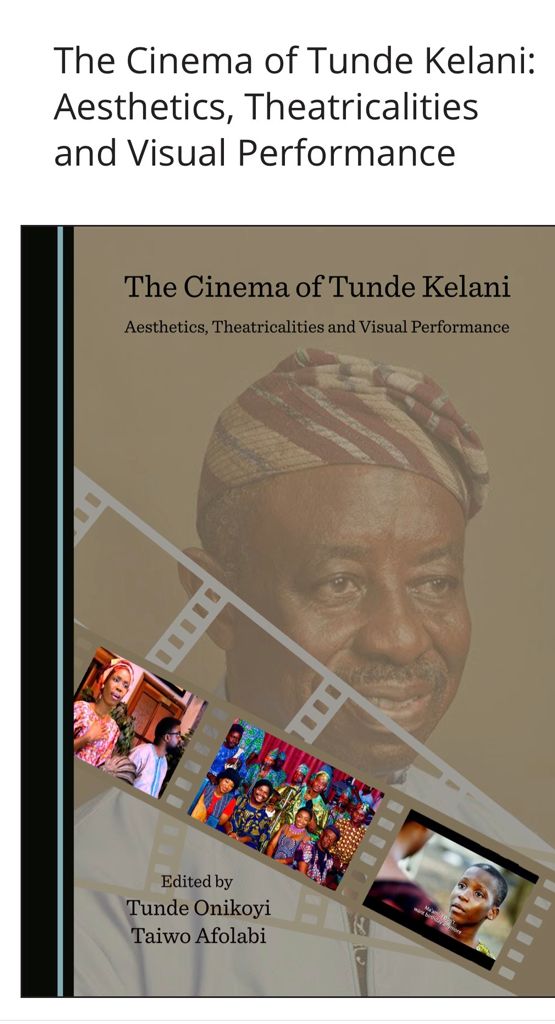
A collection of short reviews by renowned scholars around the world on a new book by Nigeria’s renowned cinematographer and director, Tunde Kelani, will whet the appetite of the media, researchers, scholars and general readers as the book prepare to roll out. Here are excerpts of the short reviews below:
Biographical, artistic profile of an outstanding director


This collection of fifteen essays explores the biographical and artistic profile of one of Africa’s leading filmmakers, Tunde Kelani. Expansive in scope and extensive in depth, the essays collectively testify to the commanding stature of the prolific auteur whose career spans decades of modern African cinema. The volume contributes significantly to the much-needed bio-critical studies of Nigeria’s trailblazing cultural producers, especially in Nollywood.
***Nduka Otiono, Associate Professor and Graduate Program Supervisor, Institute of African Studies, Carleton University, Canada

A look through TK’s Yorubacentric masterpieces
This collection of essays on the works of one of Africa’s most influential moviemakers is a major addition to the debates and studies on Nigerian and African cinema. Tunde Kelani, through his Yorubacentric masterpieces, has used his films to contribute to burning issues in Nigeria, Africa and by extension, the world as a whole. Reading the foreword, introduction and, eventually, the essays gives the reader a sense of being at a conference where these works are being dissected, for the first time, to reveal their philosophical, aesthetic, political and humanistic underpinnings. Although critical opinions on Tunde Kelani are scattered in theses, dissertations and scholarly essays, this is, perhaps, the first book that discusses him as a true African auteur whose works can compete, favourably, with those of auteurs in other climes. There is no doubt that anyone interested in film, teachers, students, practitioners and the general public will find this book refreshingly illuminating.
**Tunji Azeez, Professor of Theatre, Film and Cultural Studies, Lagos State University, Nigeria
It captures TK’s essence as ‘auteur’ practising representational sovereignty
It is exciting to see the publication of this new volume, The Cinema of Tunde Kelani: Aesthetics, Theatricalities and Visual Performance, devoted entirely to the cinematic works of the foundational Nigerian filmmaker, Tunde Kelani. The editors Babatunde Onikoyi and Taiwo Afolabi have very astutely brought together established experts and new voices from Nigeria and around the globe to produce a treasure trove of scholarly contributions spanning topics and areas of interest as diverse as intertextuality in Kelani’s work; his role as a modern auteur; his place within Nollywood; genre development; legal narratives; edutainment as “embedded entertainment” on HIV education; Trans-Sociological Hybridity discourse; representations of motherhood; gender and masculinity; Yoruba cultural practices; African indigenous knowledge; science and technology; and the recentering of Indigenous language, culture and Yoruba aesthetics. There have been many volumes on the origins of Nollywood and its global reach as a cultural and economic powerhouse, the diasporic influence of Nollywood, and its immense global popularity, but also the controversy it stirs up. Onikoyi and Afolabi’s volume, which is simultaneously delightfully entertaining yet appropriately erudite, successfully captures the essence of Kelani as an “auteur” within the cinema of Nigeria and Nollywood, and indeed within African cinema and the global industry. Kelani rightfully takes his place alongside other giants of African cinema such as Ousmane Sembène and Med Hondo, who were tireless advocates for the “Africanizing” and development of African film aesthetics from within the continent—by, for, and about Africans!
What are the ways in which Africans tell their own stories in their own voices? These are the questions that Sembène, Hondo and others have asked since the very beginnings of African film production in the 1950s and 1960s. Should African film be entertainment and commercially-oriented, or should it be pedagogical, with the goal of raising the consciousness of the African masses? What types of narrative and aesthetic structures are best suited to African cinematic storytelling? Tunde Kelani has asked the same questions and stages his stories in what he knows best—the Yoruba experience—and this, often within a historical frame, taking into consideration that local histories are also the products of global interactions, including colonialism. Furthermore, Kelani’s insistence on promoting Indigenous languages and storytelling in his own Indigenous language of Yoruba solidly positions him within the cadre of global artists advocating for and practicing representational sovereignty. His work invites and provokes conversation with other global artists and thinkers who maintain that art and life are interconnected in Indigenous systems of thought.
**Professor Sheila Petty,
Professor of African Cinema, University of Regina, Saskatchewan Canada.
Pluri-focal journey into TK’s works
This compelling multi-disciplinary collection of essays offering a pluri-focal journey into the world and work of one of Nigeria’s leading veteran filmmakers is unquestionably an important contribution to film studies, and to African film studies in particular. Its timely celebration of this pioneering and pivotal figure, who bridges the generations and styles from the celluloid era of the 1970s to the ubiquitous Nollywood of present, is a salutary reminder of the diversity of Nigerian cinema. Most propitious too is the editors’ choice to privilege the critical voices of an array of scholars culturally embedded in the very Yorùbá aesthetics, language and world view that characterize Kelani’s unique and rich cinema, destabilizing asymmetries of knowledge production in what is truly a decolonial gesture and proposing a wealth of original, complexifying frames of analysis and layered readings, insightfully complemented by Kelani’s own voice.
**Melissa Thackway,
Independent Researcher and Translator