
Director: Akinola Davies Jr.
Writers: Akinola Davies Jr., Wale Davies
Stars: Sopé Dìrísù, Godwin Egbo, Chibuike Marvelous Egbo
Synopsis: Two young brothers explore Lagos with their estranged father during the 1993 Nigerian election crisis, witnessing both the city’s magnitude and their father’s daily struggles as political unrest threatens their journey home.
From a child’s perspective, the world, adult by necessity, is a giant mystery. We do not understand the process of the world, at large. But more importantly, we are protected from even our parent’s experience of that world. We must be protected from the complex, difficult reality. This is true no matter the individual context, but becomes especially true in times of great change. Given our own context in the world right now, it is not difficult to imagine the struggles of parents during a period of political upheaval. But this is not the first time, nor the last, that parents will have to make these kinds of decisions. How much can children be told? What can they handle? And even more importantly, how do we remain close to them despite the forced distance of life?
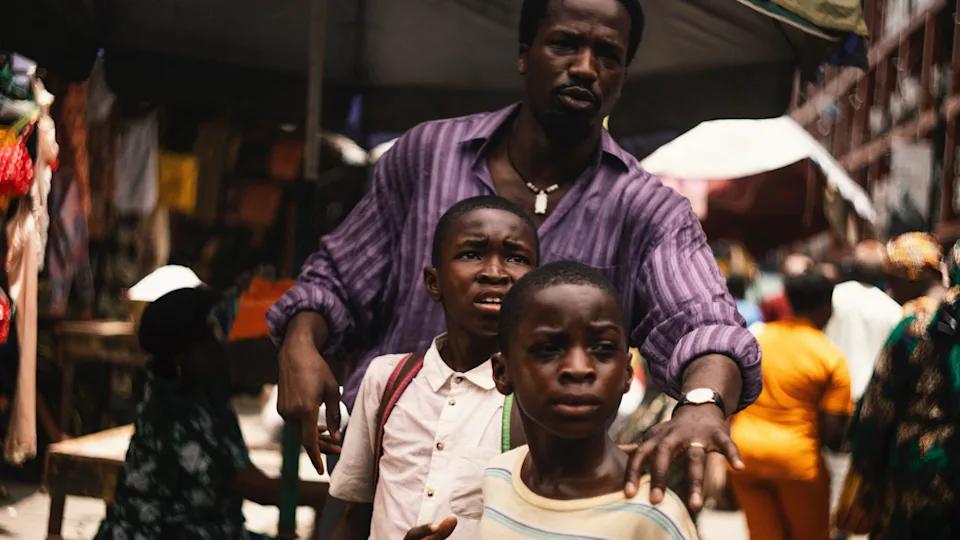
My Father’s Shadow, a purposefully distant but deeply emotional resonant film, follows Folarin (Sopé Dìrísù) and his two young sons, Aki (Godwin Egbo) and Remi (Chibuike Marvelous Egbo) in 1993 Nigeria. As the film opens, it becomes immediately clear that we are meant to be in the shoes of the two young protagonists, as the camera angles up at Dìrísù, making us feel the size and power differential immediately. This is one of many choices that Davies Jr. employs that gives the film both a sense of reality and tangibility which draws the viewer closer, despite the possibility of missing context related to Nigerian history. Given that this is his first feature, Davies Jr. shows incredible acumen and skill from the opening frames and never wavers in tone or prowess. Terms like “one to watch” are thrown around by critics constantly, but Akinola Davies Jr. is truly gifted and in need of immediate notice.
This possible missing context of Nigerian life actually ends up being a positive, as most children are unaware of the political machinations of governments, as well. As Folarin guides his children through the city of Lagos, they are introduced to many new experiences; including stories of their parent’s love, possible infidelity, the mystery of their father’s past, the struggles of class, and, god forbid, food with onions. As most viewers have also never visited Lagos, the opening half of the movie, in many ways, is also an education for us. Davies Jr. also uses side conversations and television reporting of violence (along with constant military presence) and elections to major effect, keeping us tied to that particular moment in time.
The film also jumps in time, using obvious cuts to black, and picking up later in the day. In this way, the director incites the idea of memories. After all, looking back, even on our most memorable times, we cannot remember the entire day, verbatim. Instead, these moments are frozen in time, while still being broken, amorphous and sometimes confused. But when the film decides to spend time in one place, there is a reason. Sitting on the beach, Folarin details the story of his brother to his oldest child, Remi. Finally, just for a moment, we see the reality of the father, becoming fully human in our (and his son’s) eyes. Dìrísù’s performance, particularly in this scene, makes one wonder why he has not yet become a massive star. His ability to be present, along with his delivery of his character’s continued grief tells us everything we need to know about Folarin. The camera, guided by cinematographer Jermaine Canute Bradley Edwards, finally takes a moment to linger in the sand with father and sons, to great effect. In the midst of pain and strife, family life continues.
The choice to shoot My Father’s Shadow on 16mm film gives much needed texture. It gives us the impression that the world created here can be touched, only to dissipate when we get too close. This clearly parallels the boys’ visit to Lagos with their father. As they are raised in the country, this new world in the city is strange, frightening, and intoxicating. And the same can be said of their father, a man who clearly loves them but has made sacrifices that take him away from them and their mother.
As Folarin says, “Everything is sacrifice, you just have to pray you don’t sacrifice the wrong thing.” This is a powerful statement that every adult understands, while children are left to puzzle. While children sacrifice toys and food, adults sacrifice something much more important, time. We must make these sacrifices, especially with children, so life can continue in a cruel world. This becomes especially difficult because children cannot understand why this must be so, at least not until many years later. And for many of us, by then it is too late to be understood. My Father’s Shadow is a truly beautiful film about sacrifice, memory, and family. It is rare that greatness in an auteur is so immediately evident as it is from Akinola Davies Jr., but this film is legitimate, clear proof of this fact.
In the midst of a battle for democracy, this film offers us a deeper look at how we are to process familial loss in the long run. Even when we remember our parents, do we remember them as they were? Or is it more surreal than that? Our connection in these small moments, the lessons they taught us, and yes, the sacrifices they made, help us understand their importance in our lives. And sometimes, when we lose them, all we can do is remember as we cry.
Credit: Insession Film