
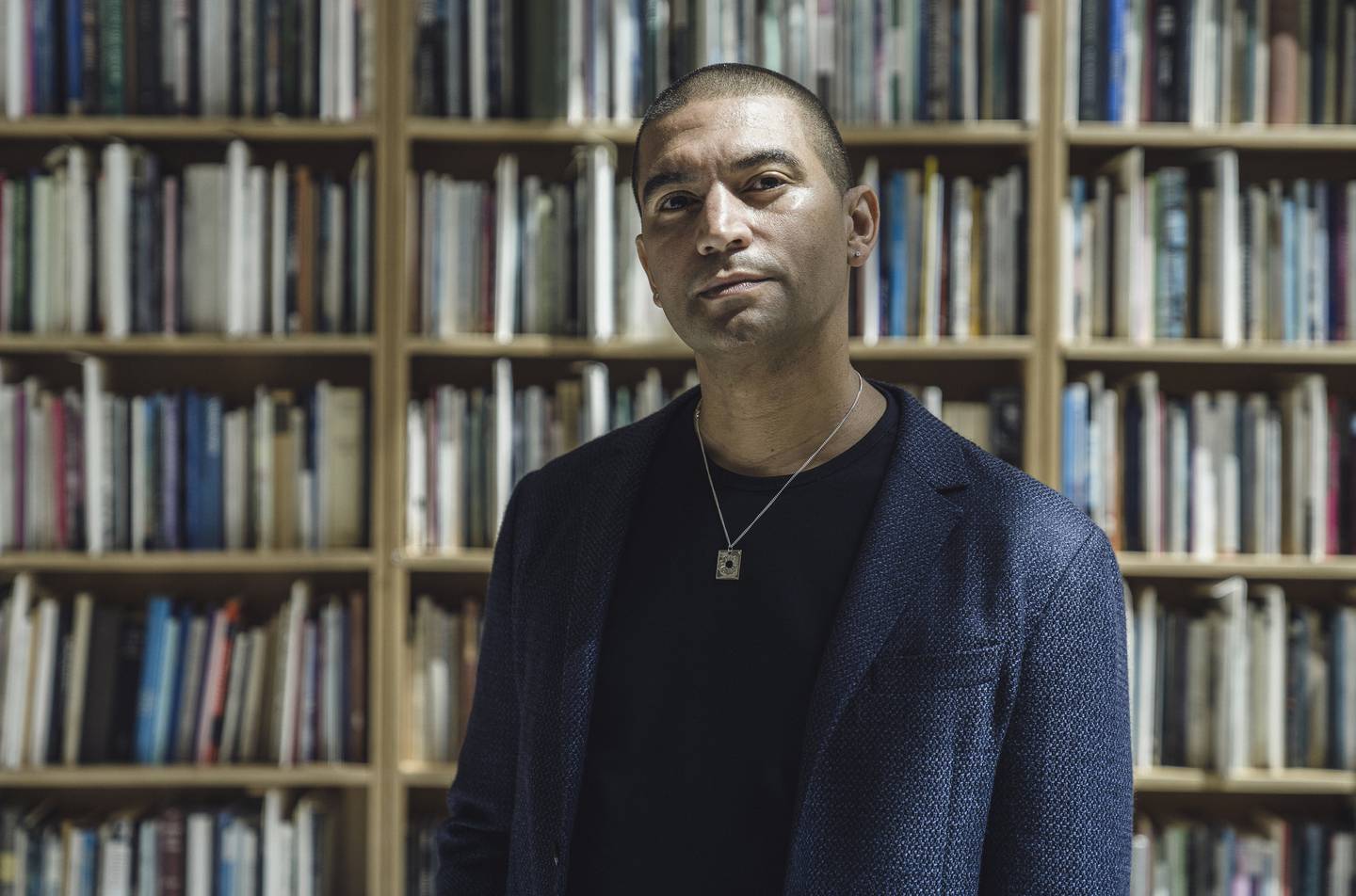
Adrian Matejka, Indiana’s poet laureate from 2018-2019, is still trying to figure out Chicago’s bus system. He laughs about missing his bus heading to the Poetry Foundation on Superior Street because a new neighbor recognized him and said, “I love poetry, and heard that you’re the new editor. Let’s talk.”
He graciously introduced himself and Matejka offered his thanks to the neighbor for supporting poetry. As he left his building, he watched the bus drive away.


“I ended up sitting out there pouring sweat with a suit coat on in the sun and made it here — earlier than y’all did, luckily, so I was able to settle down. If you had been here 10 minutes earlier, you would have thought: ‘Man, this guy is in over his head,’” he said.


Matejka is laid back with a lilting voice that one can only surmise comes from years of honing his craft in public readings. The list of writing awards he’s been nominated for is long: His third collection of poems, “The Big Smoke,” was a finalist for the 2013 National Book Award, the 2014 Hurston/Wright Legacy Award and the 2014 Pulitzer Prize in poetry, while his most recent collection of poems, “Somebody Else Sold the World,” was a finalist for the 2022 Rilke Prize.
:quality(70)/cloudfront-us-east-1.images.arcpublishing.com/tronc/6PGISJBPAFEONFVD25NZLTFIPM.jpg)
Now, the Indiana University at Bloomington Ruth Lilly professor in English is also Poetry magazine’s first Black editor in its 110-year history. His arrival comes after Michelle Boone in 2021 became president of the nonprofit Poetry Foundation, which oversees the magazine. She is the first woman and person of color to lead the institution.
Matejka takes the editorship after the Poetry Foundation came under fire for its initial response to protests following George Floyd’s death in 2020 and what some perceived as a slow response in providing financial aid to artists during the pandemic. In June 2020, Poetry Foundation President Henry Bienen resigned after more than 1,800 people signed an open letter denouncing the foundation for failing to do more to support marginalized artists. Since then, the foundation issued a plan to work toward long-term equity and expanded grant funding.
“It’s wild to be the first Black editor … to be the first editor of color at all, it’s a wonderful honor and also points to the complicated legacy of this magazine,” Matejka said. “It’s such a central institution to the work that poets do and at the same time, for a long time, it was incredibly homogenistic.” He said it’s not that dissimilar to the laureateship in Indiana in the sense of a bigger arts organization/entity not really thinking about diversity or how to be representative in these communities until the past 10 years.
“When Gwendolyn Brooks won the Pulitzer in poetry in 1950, there wasn’t another Black Pulitzer Prize winner until Rita Dove in 1987. There are long stretches between these acknowledgments and in between the institutions, they are catering to the people who cater to them,” Matejka said. “For a very long time, poetry — the art — was just highlighting white men, occasionally a white woman, an action that reflects our country’s resistance to diversity. The good thing about a democracy is that if you have a lot of voters of color, they can vote for candidates of color, but that’s not how arts organizations work. It’s not how literary journals work. It’s not how magazines work; but now they do. Michelle is here; our staff is incredibly diverse and we’re all holding hands in common cause to make (the magazine) look more like what our community looks like.”
We spoke with Matejka at the Poetry Foundation building about his plans as editor of Poetry magazine before his first issue is released in October. The interview has been condensed and edited for clarity.
Q: Did this position seem like a good segue after the laureateship or did you see an opportunity and apply for it?
It’s kind of in between those things. I left the laureateship after my two years. COVID happened, but I was still teaching. And then this opportunity presented itself. … When they first interviewed me, I wasn’t sure if it was the right job for me, but I hadn’t talked to Michelle and I hadn’t met the board or the current staff at the magazine. I just was thinking about that (open) letter, thinking about the work that was involved in that and trying to figure out how I might situate myself as a poet but also as someone who thinks about community all the time and thinks about what I can do to support poetry in the world.
Q: Can you share your goals for this position? We all know cultural change takes time.
I’m lucky because the staff with the foundation and magazine are all committed to that (change). It makes it a little bit easier to start to think about how to affect it when everyone is in agreement that we need to make some changes. Now we have to figure out what that change looks like.
For me, it starts with the magazine and how it’s positioned in the world, in the pages. And who are we creating space for on those pages who haven’t been in there before? We’re committed to trying to have a third of each magazine be people who haven’t been published in it before, and this is an ongoing thing.
One of the things I decided we were going to do as a magazine is instead of trying to figure out how to rectify all the omissions and erasures that have happened over the long history of the 110 years of this magazine, we’re going to focus on figuring out how to highlight the people that should have been there to start with.
In the first issue, there’s going to be a folio of poet Carolyn Rodgers, who’s from Chicago, a phenomenal poet and was never in the magazine, and she’s part of the Black Arts Movement.
Q: With the cultural shift, there’s also the building of trust. For those who’ve been unseen for so long, how do you tell them the magazine is working to gain their trust?
It’s already showing in the magazine; people aren’t looking in the same way. I hope they will look now. We got a Black president. We’ve got a Black editor. That not only looks different in the staff room, it looks different in the pages too. We can’t really tell them anything that’s going to convince skeptics that change has happened, but when they see it, when we show them through our programming and in the pages themselves, that’s when I think it all starts to become clear that this is a whole other Poetry Foundation.
Q: Was there any hesitation on your part in steering this transformation?
The challenge for me was trying to figure out whether or not I could be a good steward of this magazine, while also taking care of my own work and how that would affect me, the human being. I’ve been an editor before full time and I wasn’t able to find a way to write. One of the things that I was thinking about with this job was that maybe there’s a different version of writing I’m supposed to be doing now. Right now is a time where the kind of creating I’m doing is creating spaces for people and making opportunities for others. And if I walk away from that, what kind of person does that make me? Who am I in the world when I was being offered this opportunity to have access to these resources and to have a platform in Poetry magazine to showcase poetry in the world? I’m gonna say “No, I’m good?” I’m going to work on my own poems?
That is a perfectly acceptable decision to make and I’m sure some people did, who were approached about the job. It’s not that I don’t understand that. It’s just that so many people helped me as I was coming up as a writer and a scholar, so many people who didn’t have to take their time out to mentor me. They didn’t have to take the time out to look at a poem. The people who stopped their lives to help me, I’d be disrespecting them if I didn’t take advantage of those opportunities to do that for other people.
Q: Any plans for community outreach? For those in marginalized communities to come to the Poetry Foundation and engage with you?
There are two competing things: incredible need in our community for exposure, access to education about poetry, and there’s a hunger for it. And then there are a number of people who do that work, but then they overextend themselves trying to figure out how to do it. And at a place like the Poetry Foundation, it becomes a question of how do you get here? Are we going to be available in that moment?
One of the things that I would like to do with the magazine is turn it outward, and we’re going to people as opposed to them coming to us. That’s going to involve the staff. But a lot of that, at least in my vision going forward, is going to involve contributors and community members who are already doing this work and we can support them because we can’t do it all by ourselves. That’s what I learned as a laureate. … I think that’s the way we’re going to be — not only trying to do the work ourselves but trying to find ways to create connections and create access through existing organizations.
Source: https://www.chicagotribune.com/