
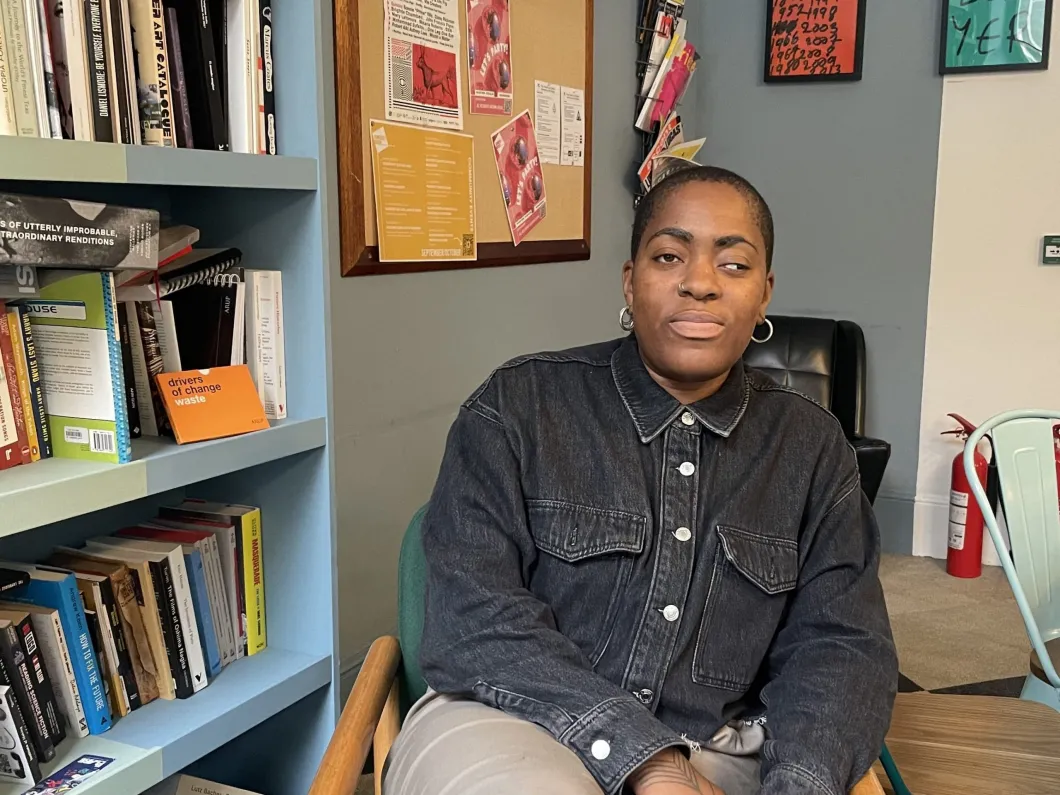
Onyeka Igwe’s practice excavates the unstable ground of the colonial archive, approaching it not as a fixed repository of knowledge but as a site of friction, opacity, and unresolved violence. Her films and installations confront the archive by attending to what is missing, suppressed, or rendered inaudible. Igwe reactivates materials often treated as inert – celluloid reels, visual records of past bureaucracies, abandoned and forgotten spaces. What emerges is not a reconstruction of history but an attunement to its dissonances: a historiography felt through the body, where colonial violence, far from being in the past, persists as a condition of the present.
In the First Floor Gallery, two video works – both part of No Archive Can Restore this Chorus of (Diasporic) Shame (2024/26) – unfold in close relation to one another. Presented on the window front, the moving image blends with the institution’s architecture and urban surroundings, situating its sonic and visual field within the specific conditions of its display. The film traces the afterlives of British colonialism in Nigeria through the abandoned site of the former Nigerian Film Unit in Lagos – once a key outpost of the Colonial Film Unit’s propaganda apparatus. Today, the building stands in disrepair. The images once housed there are difficult to access – not only due to their material degradation, but also because of a broader reluctance to confront what they contain.
Rather than restoring these lost or inaccessible films, Igwe approaches them obliquely. The opening sequence lingers on the building’s exterior and interiors – rooms filled with dust, cobwebs, and decaying files and film cans – allowing the archive to appear as both present and withdrawn. When the first video ends, a dense soundscape emerges underlined by animated captions in the new video.Composed of testimonies, field recordings, and archival fragments gathered across Nigeria and the United Kingdom, the work draws on the utopian promise of Nnamdi Azikiwe’s inaugural address – a leading figure in the anti-colonial movement, he became Nigeria’s first president in 1963 – while tracing histories of protest, conflict, and resistance from colonial rule to the present.
Central to the film is a choral composition arranged by artist and musician Tanya Auclair and performed by a thirteen-person a cappella ensemble. It reimagines songs associated with the Egba Women’s Revolt of 1947, a protest against colonial taxation led by the Abeokuta Women’s Union under the leadership of Funmilayo Ransome-Kuti. The cacophonous composition refuses coherence in favour of multiplicity. It offers a counterpoint to dominant Western representations of Nigeria, articulating instead a polyphonic, insurgent mode of remembering and speculating that exceeds the visual regime of the archive.
Description of image
The film’s title is inspired by Julietta Singh’s No Archive Will Restore You (2018), a hybrid book that blends essay, memoir, and poetic theory to radically rethink the archive – not as a collection of documents, but as something inscribed in and through the body. The title is programmatic: no archive, institutional or otherwise, can restore what has been lost. Rather than promising recovery or coherence, Singh foregrounds rupture, opacity, and the persistence of what resists legibility. Igwe’s work echoes this position, foregrounding the limits of archival restitution and the impossibility of fully recovering what has been erased or disavowed. Instead, the film conjures what might be understood as the “sonic shadows” (Alexander Ghedi Weheliye) of colonial moving images.
A lightbox installation titled anomalies and cobwebs (2026) and the video with integrated captions, No Archive Can Restore this Chorus of (Diasporic) Shame (2024/26) – both produced for this exhibition – deepen this inquiry. The latter translates sonic registers into captions in the animated spatial replication of the abandoned location of the Nigeria Film Unit. Now, the sound and its written translation furnish the space, complicating questions of transcription and legibility.
Across all three works, Igwe stages the archival encounter as a space of unease – where knowledge remains unstable, relational, and sensed rather than secured. Her installation renders perceptible the affective and spatial architectures of imperial power while simultaneously gesturing toward their undoing. It unsettles the presumed fixity of historical narratives and opens a space for speculation and forms of witnessing that do not rely on possession. In this way, research becomes a both ethical and poetic practice: a means not of fully recovering the past but of establishing a more attentive and accountable relation to its remains.
Onyeka Igwe was born in London, UK, in 1986 and lives in London.
Credit: Art Daily