
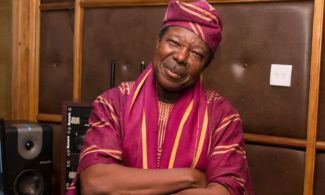
Legendary Juju musician King Sunny Ade marks his 80th birthday, a milestone for a career that defined and internationalised Nigerian popular music.
Born Sunday Adeniyi Adegeye on September 22, 1946, the master guitarist, bandleader and cultural ambassador has spent over 60 years as the soundtrack to Yoruba and Nigerian high-society celebrations.
Ade revolutionised traditional Juju music in the 1970s and 80s by introducing the electric pedal steel guitar. Its weeping slide, layered over the percussive thud of the ‘gangan’ talking drum and interlocking guitars, became his signature, earning him two Grammy nominations and global recognition.
What began as a localised post-war Yoruba folk genre became an international stage spectacle, filling concert halls from Lagos to London and Seattle.
The Afrobeats blueprint
Industry historians argue that today’s Afrobeats explosion rests on foundations laid by King Sunny Ade.
In 1982, he became one of the first African acts to sign to a major Western label, Island Records, years before Nigerian pop stars began selling out arenas abroad.
His impact extended beyond sound to performance. Drawing on his background as a dancer, Ade strapped on his Fender Telecaster and introduced synchronised choreography across a 20-man band, a sharp departure from the static bandleaders of his era. That model remains visible in the large-scale live productions of Burna Boy, Davido and Wizkid today.
Musically, the multi-layered percussion arrangements that underpin contemporary Afrobeats hits were honed in Ade’s analogue sessions decades ago. His catalogue continues to be sampled by Adekunle Gold and Flavour on ‘Yoyo,’ which interpolates his 1982 classic ‘Ma Jaiye Oni,’ and by American rapper Petey Pablo on his Timbaland-produced 2001 single ‘I Told Y’all,’ which sampled ‘Syncro System’.
A catalogue of classics
Among his vast discography, four records stand out: ‘Ja Funmi’ (1982), his Island Records breakthrough, a prayer for divine protection turned dancefloor anthem; ‘Synchro System’ (1983), the Grammy-nominated title track that proved Yoruba lyrics needed no translation; ‘Ma Jaiye Oni’ (1982), the mid-tempo anthem that codified post-oil-boom luxury and enjoyment; and ‘Ariya’ (1976), an early masterpiece that became the definitive sound for Nigerian celebrations.
At 80, Ade’s longevity also prompts a wider question about the future of Juju music.
Unlike Afrobeats’ three-minute, digitally produced, streaming-driven model, classic Juju demands large orchestras, extended improvisations and deep mastery of Yoruba praise poetry, a costly proposition in today’s industry.
With peers like Chief Commander Ebenezer Obey long retired from secular music, no younger artist has built a mainstream career on traditional Juju at Ade’s scale. Most have pivoted to hybrid electronic fusions.
Whether a successor emerges or the genre evolves into new forms, Ade’s influence is undisputed. For over half a century, he has remained Nigeria’s Juju King, and his music is timeless.
Credit: Nation