
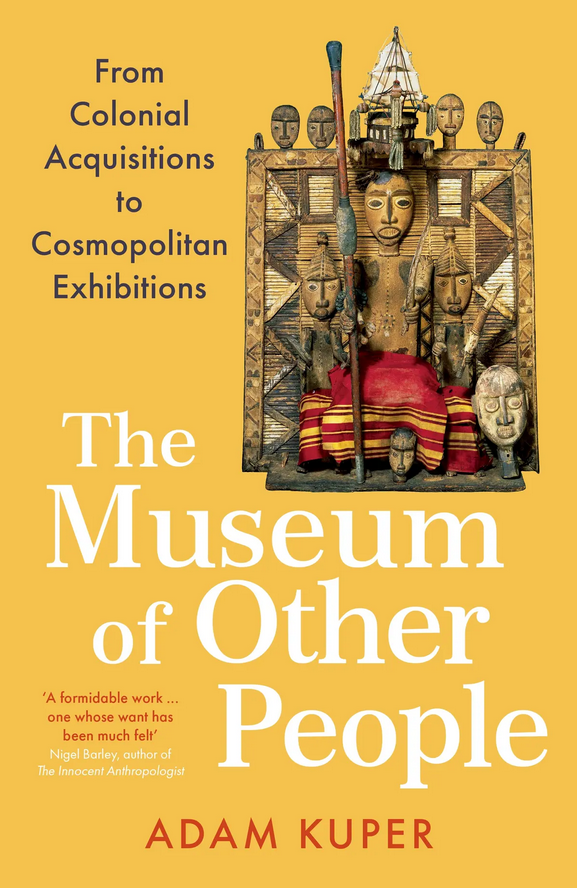
“Decolonisation,” says the philosopher Frantz Fanon at the start of his 1961 book, The Wretched of the Earth, “is always a violent phenomenon.” In The Museum of Other People: From Colonial Acquisitions to Cosmopolitan Exhibitions, a roomy and level-headed book, Adam Kuper surveys one specific theatre of conflict: the rise and fall of the anthropological or ethnographic museum (these terms, along with much else, have long been the subject of some dispute) in Western Europe and North and Latin America, and the conflicting approaches—historicist, evolutionary, comparative, universalist—that shaped them.
Bogus science
To say that many such collections are intimately bound up with the Western imperialist project, tainted by bogus race science and, in some cases (though not as many as might be supposed), steeped in blood, is to state the obvious. Many Western anthro/ethno collections were explicitly presented to the public as a 19th-century counterpart to the “Triumphs of Caesar”: trophies of conquest. Later, putting some serious public-sector muscle into collections devoted to “other people”, as in Mexico and more recently the US, might cement complex national identities and make othered people in those nations feel valued. Or it might turn identity into a cage from which there could be no escape.


Kuper, an academic anthropologist of some distinction and currently a professor at the London School of Economics, steers a pragmatic course through these perilous waters. He is often ready with a counter-argument or a minority report. Objects might indeed have been acquired nefariously: bought for a pittance, bartered for drugs to treat illnesses that arrived with a boatload of colonists, ripped from the ground by tomb robbers or (as in the notorious 1897 raid on the capital of the Kingdom of Benin) seized by force of arms.


Conversely, they might have been exchanged for European objects at potlatch ceremonies or secular convivial booze-ups; or sold to gullible foreigners at inflated prices; or handed over as a conscious act of renunciation, after a willing religious conversion; or just cheerfully given up by someone who quite liked the idea of people on the other side of the world looking interestedly at their stuff.
Even if a compelling case for repatriation has been made, you cannot step into the same river twice
With a few notable exceptions, there is no way of accessing the ethical metadata associated with a given object simply by looking at it, and acquisitions were often not well documented. And even if a compelling case for the repatriation of a given object or collection has been made, you cannot step into the same river twice; something that has spent 200 years in a museum cannot, by definition, be handed back to the same people it once belonged to.

The book’s author Adam Kuper Photo: Zoe Norfolk
Among brisk accounts of several institutions and universal expositions, and the contesting ideas that formed them, Kuper looks twice at the Pitt Rivers Museum in Oxford: first, as a paradigm of the museum as imperialist goody-bag, shaped by the tastes of one distinctly swashbuckling man and displayed “typologically”, as a kind of giant buffet of human endeavour, decidedly unenlightened in some respects (“a museum that belongs in a museum”), but possessed of a strange innocence and an undeniable chaotic energy; and, later, as a case study in the practical business of decolonisation.
Treatment of Dead Enemies
The museum’s current curators have produced a colour-coded map, available on entry in a little booklet, suggesting ways in which visitors might be “triggered” by different exhibits. One notorious but much loved case, “Treatment of Dead Enemies”, contained shrunken and deboned heads created by the Shuar of South America. Despite their popularity—“A spokesman for the Friends of the Museum protested that they were a particular favourite with the children,” observes Kuper—and despite the distinctly lukewarm enthusiasm of the Shuar for their return, the objects were taken off display in 2020 and Kuper was refused permission to use pictures of them in his book. The case is now covered in text panels; presumably the heads, and the unexpectedly jolly skull rack from Papua New Guinea that formed the centrepiece of the case, are in store (like the vast majority of athro/ethno collections).
Kuper’s closing remarks about a bright future in which a network of agile “cosmopolitan museums” swap exhibits and data in an open-minded, freewheeling and non-racist way—a kind of “techno-potlatch”, if you will—is not without appeal. But it is a little arid. In fact, a decolonised but not decluttered Pitt-Rivers-type display is surely not just possible but readily attainable; it would be a matter partly of tightening up the language of the labels (using “Oceania” to denote a third of the world’s surface is one egregious example), and partly of applying an anthropologist’s curiosity to what the pioneers of the 19th century would have described as the civilised races—moving the little ivory crucifix from “The Human Form in Art” into “Sympathetic Magic”, say, or slipping a few Venetian codpieces in alongside the penis sheaths.
Source: theartnewspaper.com