
The Neolithic Age may be something of a misnomer, falsely offering stone rather than perishable wood as the period’s primary building material, but its monumental architectures sure make a compelling counterpoint. England has massive stone circles, France rows of upright megaliths, and Poland, somewhat less famously, pyramids.
Also known as Giant’s Graves or Kujawian mounds, after the area in northwestern Poland where they were first identified in the mid-1930s, the pyramids were megalithic tombs built in the 4th millennium B.C.E. to house the remains of a single important community figure. Less dramatic than their later Egyptian equivalents, the pyramids were built by agricultural settlers in the dense forests of Central Europe and take the form of elongated triangular earth mounds lined with massive stones.


Still, they show the remarkable coordination and craftsmanship of Neolithic peoples who were capable of moving 10 ton stones and arranging monuments that in some cases reach the height of a one-story house and run for more than 600 feet.


The most recent evidence of the country’s pyramids has appeared in Wielkopolska, an area in west-central Poland whose first sites were discovered in 2019. Now, two more pyramids have been uncovered in a Dezydery Chłapowski Landscape Park by researchers from Adam Mickiewicz University.

The outline of the pyramid tomb of Funnel Beaker culture. Photo: courtesy The Complex of Landscape Parks of the Wielkopolska Voivodeship.
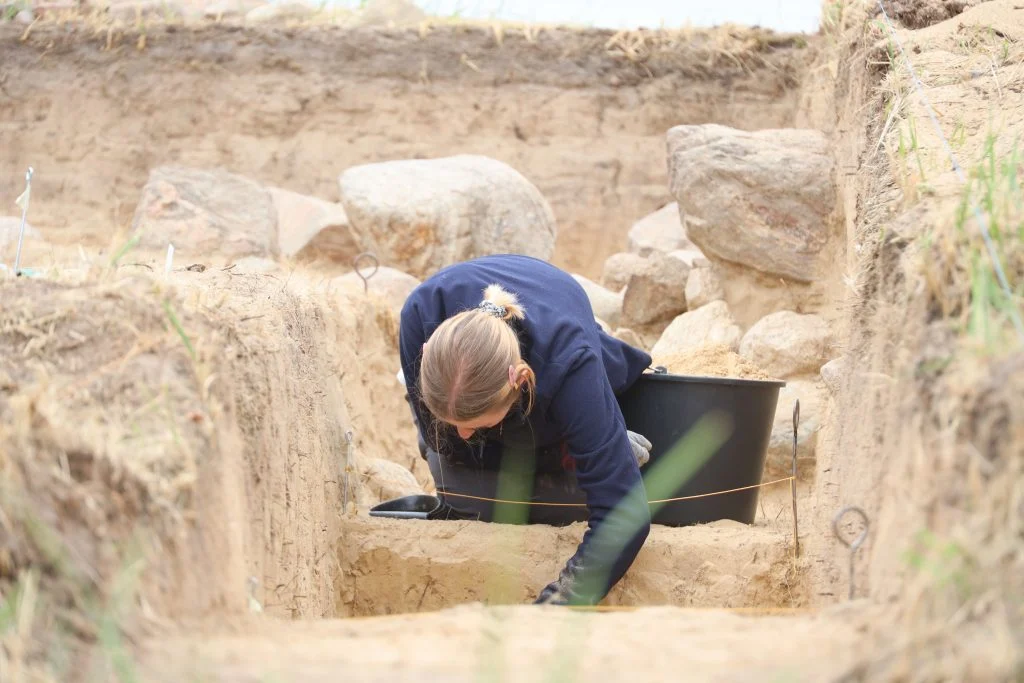
The earth and stone structures were first identified using advanced remote sensing technology that displayed the outline of their characteristic trapezoidal shape. Initial excavations have confirmed the findings with archaeologists tentatively dating the structures at roughly 5,500-years-old. This connects them with Funnelbeaker culture, a semi-agrarian people that emerged in north-central Europe and is identified by its ceramics with funnel-shaped tops.
As researchers noted, the structures have diminished over time as local peoples have removed stones for building projects. The largest boulders that once marked the entrances to the pyramid are absent, but they still feature stone enclosures that mimic the shape of Neolithic houses and follow the convention of running a line from west to east, potentially suggesting a worship of the sun. The next stage will involve a full excavation of the two pyramids and their contents.

Exposed fragment of the tomb’s stone enclosure. Photo: Photo: courtesy The Complex of Landscape Parks of the Wielkopolska Voivodeship.
Inside the pyramids, the individual was typically buried in an enclosed around along with valuable items. They were laid to rest face up, with their feet pointing east to the pyramid’s entrance. “In the case of this megalith, the skeleton has probably not survived, but grave goods may have,” Artur Golis, a specialist at the national park told the Polish Press Agency. “Potentially, these could include stone axes, hatchets, pottery, or characteristic clay vessels.”
Although researchers consider Funnelbeaker cultures to have been relatively egalitarian societies, they did opt to venerate an important member of their community and it’s believed each generation built a pyramid for either a leader, priest, or shaman.
In addition to the two confirmed pyramids, there are a further three potential sites within the Dezydery Chłapowski Landscape Park. Researchers hope further excavations will shed light on Funnelbeaker cultures within the region.
Credit: Artnet