What's Hot?
DGN Pays Courtesy Visit To AVRS, Seeks Expanded...
At MASA 2026, A Choreographer’s Tribute To Abidjan’s...
‘The Specialists’ Bags 7 Nods At Canada’s IBDFF...
Minister Urges Cultural Preservation, Highlights Keris Heritage
America’s First National Art Museum Honours The Country’s...
Ogun, Artnovation Showcase Cultural Partnership at Milan Design...
French Film Star Nathalie Baye Dies At 77
Top Takeaways From CinemaCon: The Year’s Hottest Movies
Zimbabwe Birds: The Iconic Stone Sculptures Are Finally...
From Paris To Palm Springs: Davido & Afrobeats...
  • Home
  • Arts & Exhibitions
  • Culture & Festivals
    • Culture Africana
    • Culture People
  • Fashion & Lifestyle
    • Music, Movies & More
  • News
    • Travel News
  • Opinion
    • Reviews (The Critics)
  • TCN Literati
  • Tourism & Hospitality
The Culture Newspaper
Arts & ExhibitionsWhat's Hot?

3,600-Year-Old Cheese Found in an Unusual Site in China Offers New Clues About Ancient Food Preservation

by The Culture Newspaper October 1, 2024

Fermented dairy and mummies might not seem like the most obvious pairing, but archaeologists in China have just uncovered what they believe is the world’s oldest cheese—found in a 3,600-year-old tomb at the Xiaohe Cemetery in present-day Xinjiang. The discovery offers a surprisingly tasty piece of history that’s been buried for millennia.

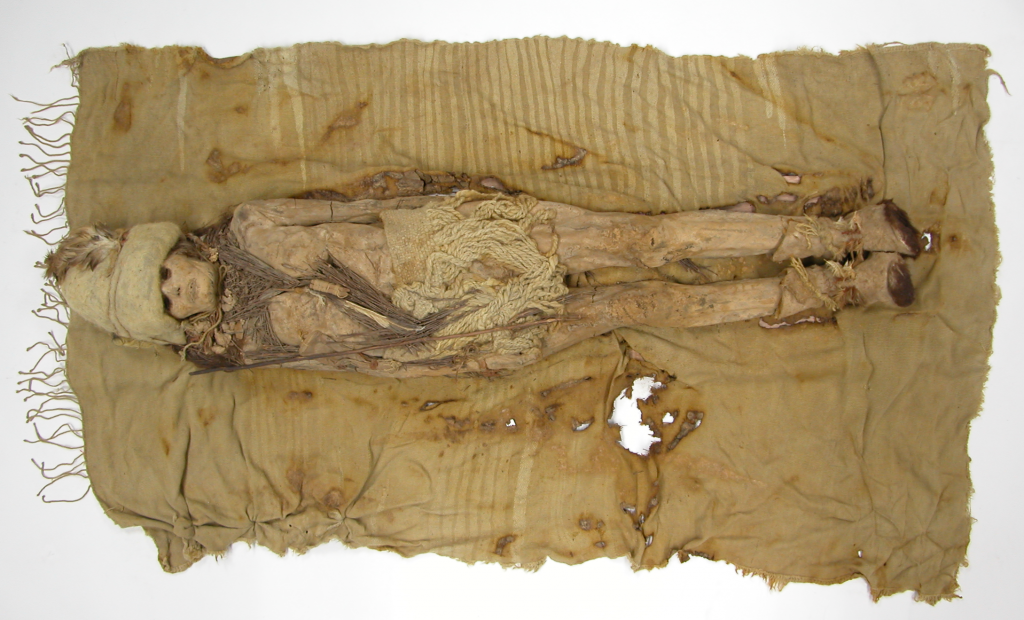
In 2003, researchers excavated a 3,600-year-old coffin at the burial site in northwestern China, which contained a young woman with an unknown substance laid out across her body. Recent DNA analysis by the team of researchers at the Chinese Academy of Sciences in Beijing has revealed that this substance was kefir cheese, with its inclusion alongside the mummy highlighting cheese’s cultural significance to the Xiaohe peoples.

Ancient mummy wrapped in cloth, laid out on a weathered blanket.

A mummy from the Xiaohe cemetery, and dairy remains are scattered around the neck of the mummy.
Copyright: Wenying Li, Xinjiang Cultural Relics and Archaeology Institute.

Kefir cheese is made by fermenting milk with kefir grains, then draining the liquid to create cheese. The researchers found DNA traces of both goat and cow milk in the samples. In the report they have just published in Cell journal, the researchers hypothesize that, since the Xiaohe populations are known to be “genetically lactose intolerant,” the development of fermenting processes could have enabled them to add dairy to their diet, since the “process of cheese production reduces the lactose content significantly”—in addition to “extending the shelf life of raw milk.”

It turns out the shelf life doesn’t quite stretch to three-and-a-half millennia. “Regular cheese is soft. This is not. It has now become really dry, dense and hard dust,” Fu Qiaomei, paleogeneticist and co-author of the report, told NBC News. So unlike the honey found in ancient Egyptian tombs, this cheese is not for eating—but it does shed new light not only on the ways that Bronze Age populations interacted across the globe, but also how human cultural development has affected microbial evolution.
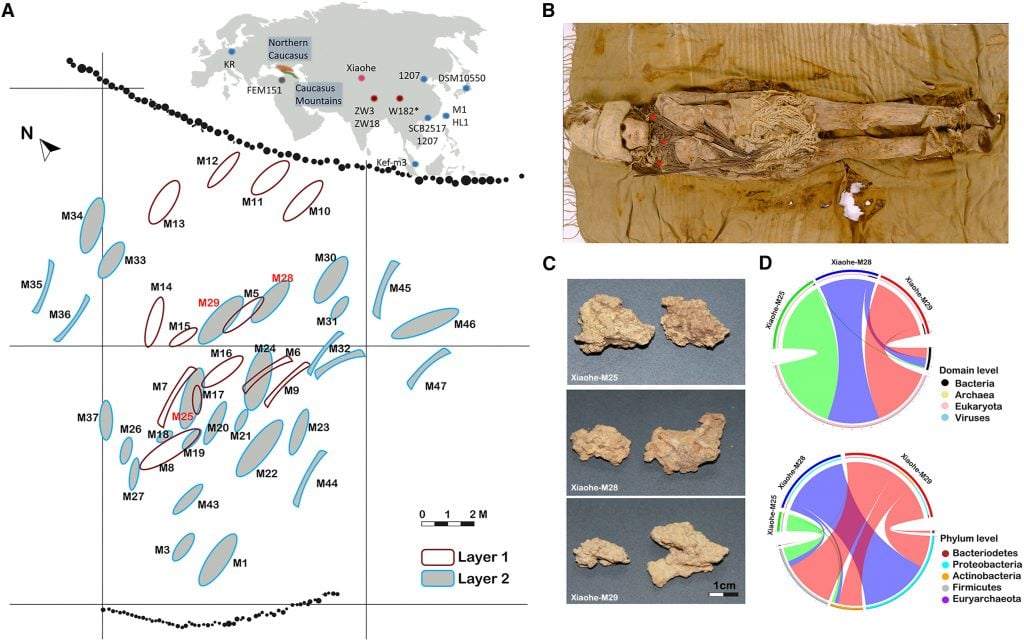
Map, ancient mummy, cheese fragments, and microbial analysis charts depicting the discovery of 3,600-year-old cheese.

Courtesy Fu Qiaomei.

“It was previously suggested that kefir was spread from the Northern Caucasus to Europe and other regions,” the authors wrote in the report. But “we found an additional spreading route of kefir from Xinjiang to inland East Asia.” Their analysis of goat DNA suggests the spread of ancient populations from the Caucasian steppe, which “served as a corridor for human interactions.”

READ More  US Mission Promotes Preservation of Nigerian Rock Art

Further, analysis of bacterial specimens in the cheese has enabled the researchers to track the evolution of the Lactobacillus species that are crucial to fermentation and particularly of a subspecies, L. kefiranofaciens, with probiotic qualities. The researchers suggest not only that selective processes by humans during the fermentation process encouraged the development of these strains, with benefits for the immune system and the production of antibodies. They also observed horizontal gene transfer (HGT) events—a process where genes are exchanged between species, rather than inherited—with implications for our understanding of the problem of growing antibiotic resistance today.

The fermentation of milk can be traced back to around 6,000–4,000 BC in India, while it is known that Mediterranean populations were consuming cheese by around 5,000 BC. However, the new discovery is among very few examples of dairy remains preserved from more than 3,000 years ago, which has made detailed analysis of how and why prehistoric peoples created cheese very difficult. The title for the world’s oldest cheese residue was previously held by an example found in a tomb near Cairo in 2018—the first Ancient Egyptian cheese ever discovered—believed to be 3,200 years old.


3600yearoldaboutanancientcheeseChinacientcluesfoodfoundinnewofferspreservationsiteunusual
0
FacebookTwitterPinterestLinkedinWhatsappEmail
The Culture Newspaper

previous post
Ancient Peruvian Site Yields First-Ever Throne Room of a Female Ruler
next post
Saudi Arabia, Qatar Agree To Boost Cooperation In culture And tourism

You may also like

At MASA 2026, A Choreographer’s Tribute To Abidjan’s...

April 19, 2026

Minister Urges Cultural Preservation, Highlights Keris Heritage

April 19, 2026

America’s First National Art Museum Honours The Country’s...

April 19, 2026

Ogun, Artnovation Showcase Cultural Partnership at Milan Design...

April 18, 2026

Zimbabwe Birds: The Iconic Stone Sculptures Are Finally...

April 18, 2026

U.S Museum Repatriates Marble Head To Turkey

April 18, 2026

The Metropolitan Museum Of Art: Everything You Need...

April 17, 2026

World’s Earliest Tools & Weapons On Display At...

April 17, 2026

Michael Jackson Fans Swarm Berlin For Biopic Premiere

April 16, 2026

Met Museum to Stage Giacometti Show in Temple...

April 16, 2026

Leave a Comment Cancel Reply

Save my name, email, and website in this browser for the next time I comment.

Recent Posts

  • DGN Pays Courtesy Visit To AVRS, Seeks Expanded Access To Royalty Benefits For Members
  • At MASA 2026, A Choreographer’s Tribute To Abidjan’s Urban Culture
  • ‘The Specialists’ Bags 7 Nods At Canada’s IBDFF Ahead Of Global Release
  • Minister Urges Cultural Preservation, Highlights Keris Heritage
  • America’s First National Art Museum Honours The Country’s 250th

Sponsored

Recent Posts

  • DGN Pays Courtesy Visit To AVRS, Seeks Expanded Access To Royalty Benefits For Members

    April 19, 2026
  • At MASA 2026, A Choreographer’s Tribute To Abidjan’s Urban Culture

    April 19, 2026
  • ‘The Specialists’ Bags 7 Nods At Canada’s IBDFF Ahead Of Global Release

    April 19, 2026

Categories

  • Arts & Exhibitions
  • Culture & Festivals
  • Culture Africana
  • Culture People
  • Fashion & Lifestyle
  • Food
  • Music, Movies & More
  • News
  • Opinion
  • Photo News
  • Reviews (The Critics)
  • TCN Interview
  • TCN Literati
  • Tourism & Hospitality
  • Travel News
  • Travel Trends
  • Travelogue
  • What's Hot?
  • World Culture

Connect with us

Connect with us
  • Facebook
  • Twitter
  • Instagram
  • Youtube
  • About Us
  • Advertise With Us
  • Privacy Policy
  • Contact Us

@2025 - The Culture Newspaper. All Right Reserved. Maintained by Freelart

The Culture Newspaper
  • Home
  • Arts & Exhibitions
  • Culture & Festivals
    • Culture Africana
    • Culture People
  • Fashion & Lifestyle
    • Music, Movies & More
  • News
    • Travel News
  • Opinion
    • Reviews (The Critics)
  • TCN Literati
  • Tourism & Hospitality