
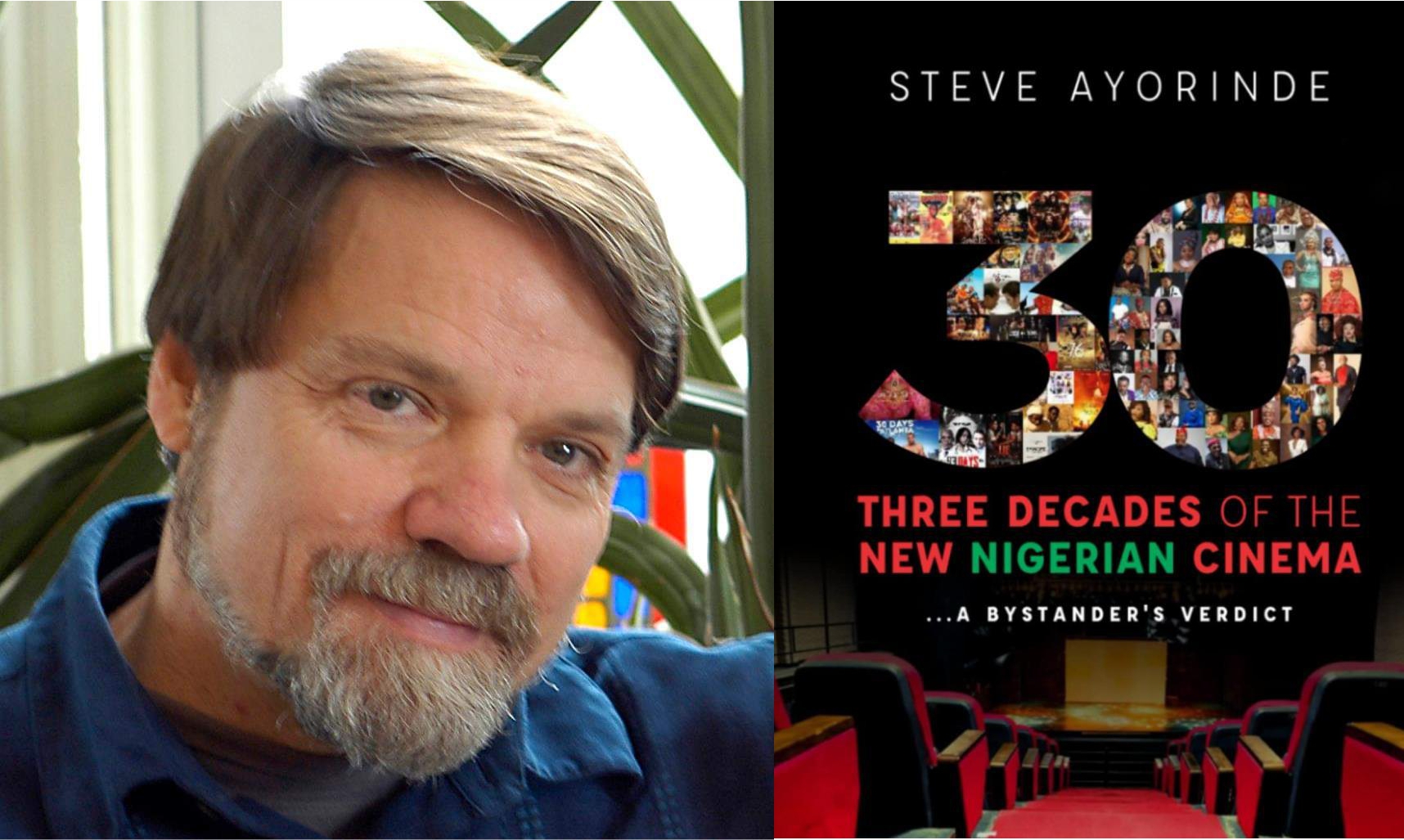
I’ve felt grateful to Steve Ayorinde ever since I read his pioneering 1996 newspaper articles (written with Chido Okafor) about the emergence of what later would be called “Nollywood,” “Rave of the video” and “Enter the boys from the East.”
Recommended Article
- 30: Rescuing Nollywood’s History from Oblivion
- Guinness World Records Certifies Hilda Baci’s ‘Cook-a-thon’ As World’s Longest Cooking Marathon
- Egypt bans Dutch archaeology team from Saqqara due to museum’s Afrocentric exhibition
- 3 British tourists missing as boat catches fire in Egypt’s Red Sea
- Burna Boy makes history again with 2023 UCL final performance
I was trying to make sense, as an academic, of this fascinating new phenomenon, and Steve’s pieces were the first I found that gave some kind of handle on what this thing was and who the people were who were creating it.
It was years before I wrote anything that didn’t cite those two articles.


Ayorinde was then part of the legendary staff of the late-1980s and early-90s Guardian. He continued his illustrious journalism career as a writer, editor, and publisher at other publications, and then began a different sort of career as a Commissioner with the Lagos State Government. He also has extensive experience as a juror for film festivals and awards ceremonies.
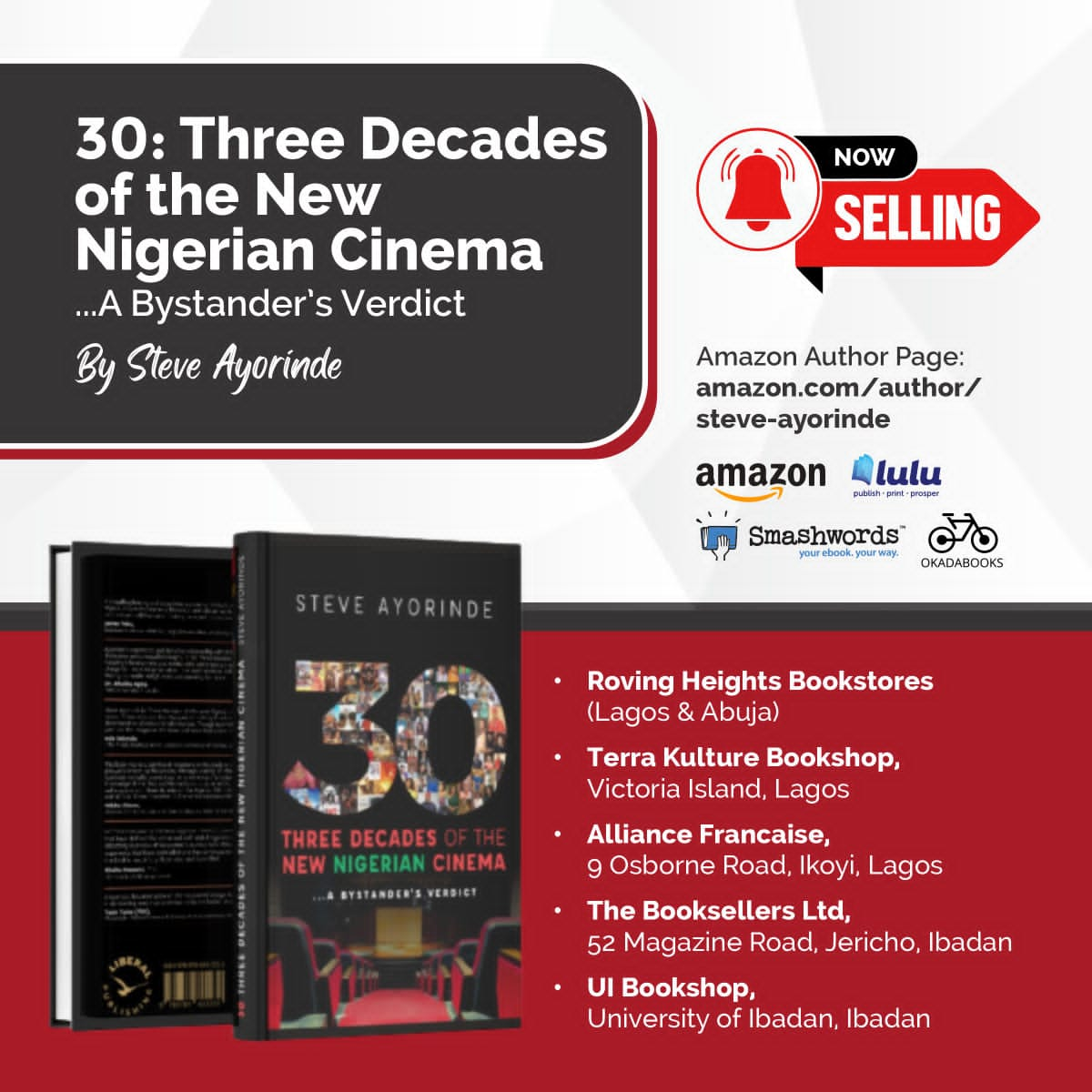

In one way or another, the film industry has always been in his bailiwick. You don’t see a masquerade by standing in one place, as the old saw has it: Ayorinde has moved around but he’s never lost sight of the movies, and the fruits of decades of steady observation and judgment are here in this new book, which I’m pleased to be able to help welcome into the world.
He’s organized his book around 30s, in honour of the 30 years of the Nollywood industry: 30 greatest films, 30 directors, and so on. Thirty is a big number, casting a wide net: it’s not exclusive like a top-10 list, and this is not a book full of arguments about why one film or person is more important than another.
It’s inclusive and, from an historical point of view, complicating. This, to my mind, is all to the good. Chimamanda Adichie has warned us memorably against the dangers of a single story.
The book takes an historical turn at the end: the penultimate chapter memorializes thirty departed Nollywood figures, and the last chapter chronicles major developments in and around the industry, decade by decade. (Here Ayorinde’s long experiencce as an observer close to the action—and sometimes involved in it—bears fullest fruit.) Otherwise, the book is only loosely organized chronologically, and is not dedicated to creating historical narratives, though it’s always clear that Ayorinde understands the historical context of whatever he’s talking about.
Perhaps his central interest is revealed by a recurring interest in recent remakes of Nollywood classic films: works from the past that have continuing cultural vitality and commercial potential into the future.
The vitality of the link between the past and the future is as crucial for a film culture as for any other branch of culture and society. Nollywood, as a major branch of contemporary Nigerian culture, is nearly as vast and various as the country is, and doing justice to its complexities must necessarily be a collective task.
“A Bystander’s Verdict” such as this one is a valuable contribution, and I hope we will see many more. There are other encouraging signs that Nollywood’s history is beginning to get the attention it deserves: to cite just a few, Ayorinde takes note of the new Masters of Arts programme in Film Culture and Archiving at the National Film Institute; a few neglected pioneer filmmakers such as Ola Balogun have begun to get the attention they deserve from preservationists, historians, and programmers; I’m pleased to see that three of my mid-career American academic colleagues (Matthew Brown, Noah Tsika, and Connor Ryan) have new books that explore in depth Nollywood’s prehistory in film exhibition and television.
But these efforts are only a tiny fraction of what will be required to rescue Nollywood’s history from oblivion. Videotape and compact discs are highly perishable media and they are perishing at a frightening rate, taking the primary record of the video film industry’s first decades with them; and the founding generation is not immortal.
This is an emergency! The time to act is now.
And there’s the slower, softer tragedy of a rising generation of Nigerian filmmakers who know very little of Nollywood’s heritage because the mechanisms through which they might know it simply aren’t there. The industry has always been resolutely pitched towards the present moment and the future, by commercial necessity as well as inclination.
In the old market for videotapes and VCDs, with rare exceptions films were only visible for a couple of weeks; in the new world of streaming services, films are available for perhaps three years. Fans give some favorites a surreptitious, ghostly afterlife on YouTube, but this is hit or miss.
Into the resulting void in cultural memory floods American content. Nigerian popular culture has always thrived on robust interactions with foreign influences, but for the dynamic to be healthy, the Nigerian influences have to be able to hold their own. There’s no reason to fear for the rate of current production—it’s keeping the past alive in the present, as other film cultures do, that’s the problem.
So I want to close by enthusiastically endorsing ideas for a pair of institutions that Ayorinde mentions in passing, and expand upon them a bit. One is for a permanent digital archive of Nigerian films. The other is for a museum dedicated to Nollywood.
The internet invites utopian visions of a universal, complete catalog of Nigerian films, accessible from anywhere. In practice, this would be a great deal of work to set up and maintain… but the task is far from impossible, and we should settle for nothing less. One possible structure would be a non-profit foundation coordinating a consortium of participating organizations, including perhaps one or more foreign research universities that might provide computing power and expertise.
The website would provide pay-for-view access at variable prices for content to which the foundation had secured the rights; otherwise it would link to other online providers.
Securing rights to masses of older films should not be very costly—iROKO’s founder Jason Njoku has commented acidly on how Nollywood producers “nuked” the value of their catalogs of films by putting them up on YouTube for free. But this work of securing rights will have to be done between the rock of the anarchic old “informal” market and the hard place of the new corporate control of huge swaths of Nigerian media. MultiChoice, for one, has been quietly and assiduously amassing content rights on a grand scale and would not surrender control.
The website of this archive could play many roles beyond simple servicing of the access to films, becoming a central institution in preserving, curating, and advertising Nigerian film culture for its global constituency of fans, industry professionals, and scholars—a virtual town square for all things Nollywood.
A Nollywood museum might be linked to the archive, or be a freestanding institution. A museum would have several functions, one of which is the obvious one of archiving objects. At a certain point I spent a good deal of time interviewing people who had been involved in making the 1992 film Living in Bondage, a couple of whom said they had copies of the shooting script.
These copies were… somewhere… but couldn’t be found at the moment, and I never saw them. Anyway, I was struck by the immense value such an object would have for future historians: this undoubtedly is a landmark film in a film tradition that is certainly never going to go away, and will seem even more important in a hundred years than it does today. And I was equally struck by how little value the object seems to have now: effectively none, which is to say, there is little reason for anyone to take care of its preservation.
And then I thought: what about the glorious designer clothes the actors wore, which had so much to do with the film’s original impact? Are any of them lying around at the bottom of someone’s box? And would people not pay to get into a room to see them displayed on mannequins, surrounded by many screens looping clips from the film?
A museum would also address Nollywood’s strange placelessness, its failure to build its own spaces. In Hollywood one can take studio tours or visit that sidewalk with the footprints of stars, but in Lagos, where would one go? Nollywood is an invisible kingdom, comprised originally of myriad tiny production outfits occupying unprepossessing offices and always shooting on location. It had to fight its way into the multiplex cinemas when they appeared.
The starstruck can visit the Nollywood celebrity hangout currently in favor (under the trees at the National Theatre, in the old days, then Winnie’s Guesthouse, O’Jez, and OldSkool at the National Stadium), and the intrepid can make their way to the film markets in Ebinpeju Lane in Idumota or Alaba. There are tourists in Lagos, but there is very little for them to go see: a Nollywood museum would be a welcome addition to the circuit. Freedom Park and Terra Kulture have shown what is possible for multifaceted cultural centres in downtown Lagos.
A Nollywood museum could have, as well as permanent and temporary displays of objects and myriad screens showing one thing and another, screening rooms large and small for openings and retrospectives, meeting rooms for workshops and film clubs, a café and restaurant…
It’s good to dream and think big. It’s even more necessary to remember and reflect, and we must thank Steve Ayorinde for his latest contribution to that collective project.
** Prof. Haynes, a Professor Emeritus at Long Island University, in Brooklyn, New York, USA, originally wrote this as Foreword to Steve Ayorinde’s Book – 30: Three Decades Of The New Nigerian Cinema – A Bystander’s Verdict.