
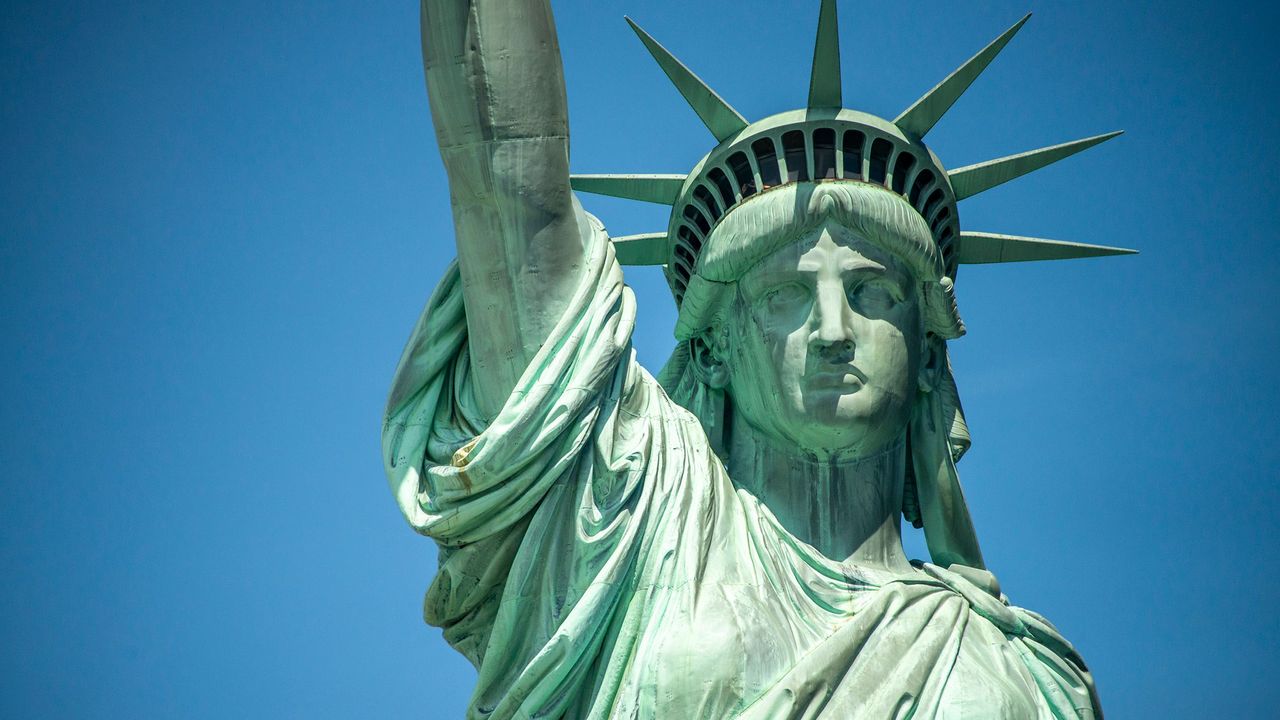
Controversy over an Amy Sherald painting of the Statue of Liberty reveals divides over US national symbols, joining debates that have centred on the statue since it was first unveiled.
So fixed is our focus on the radiant points of her spiky crown and the upward thrust of her flickering lamp, it is easy to miss altogether the shackles of human enslavement that Lady Liberty – who is at the centre of a fresh skirmish in the US’s accelerating culture wars – is busy trampling underfoot. Her meaning contains multitudes. It pulls her in many directions.


Messily inspired, as all great art is, by a mixture of sources – from the Roman goddess Libertas, to the Greek sun god Helios, to the multifaceted Egyptian goddess Isis (who fascinated the sculpture’s creator, the French artist Frédéric-Auguste Bartholdi) – the Statue of Liberty seems hardwired for debate. She boldly embodies the one straightforward truth about cultural symbols: their truths are never straightforward.


From the moment the statue was unveiled in October 1886, it provoked criticism from both ends of the political spectrum
The current controversy over the essence of Bartholdi’s 46m (151ft)-tall copper sculpture, ingeniously engineered by Gustave Eiffel and formally presented to the United States as a gift from France on 4 July 1884, is a striking painting by African American contemporary artist Amy Sherald that reimagines the Statue of Liberty as a black transgender woman.
Earlier this month, Sherald, best known until now for her 2018 official portrait of First Lady Michelle Obama, was advised that her work, Trans Forming Liberty, might upset US President Donald Trump – who in January issued an Executive Order recognising two sexes only – male and female – and therefore should not be included in her upcoming exhibition at the federally funded Smithsonian’s National Portrait Gallery in Washington, DC. Rather than contemplate removing the work, Sherald decided to cancel the show altogether, citing “a culture of censorship”.
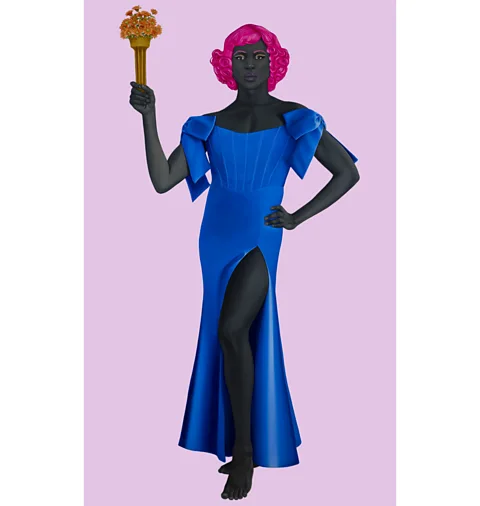
The contested work is currently on display at New York’s Whitney Museum as part of Sherald’s touring exhibition American Sublime and is characteristic of the artist’s instinct to dislocate her subjects and unsettle expectations. Sherald often achieves this, as she does both in her portrait of Obama and in Trans Forming Liberty, by translating her subjects’ complexions into an uncanny greyscale (or “grisaille”), nudging viewers to look past skin colour and reassess their assumptions about what constitutes race. The model for Sherald’s work, Arewà Basit, a black artist who identifies as non-binary trans-femme, is portrayed against a flat, periwinkle background, hand on hips, wearing a vibrant ultramarine gown that recalls the otherworldly resplendence of Renaissance Madonnas, and neon fuschia hair.
The torch she lifts has been supplanted by a clutch of humble Gerbera daisies, traditionally a symbol of joy and hope – a subtle subversion that faintly calls to mind the disarming weapon wielded by Banksy’s Flower Thrower, who too is powerful in his powerlessness. Of the intended potency of her own work, Sherald has explained that her painting “exists to hold space for someone whose humanity has been politicised and disregarded” – a sentiment that arguably rhymes with the hospitable spirit of the statue itself, which is famously affixed with a sonnet by Emma Lazarus, summoning “homeless, tempest-tossed” “masses yearning to breathe free”.
A polarising symbol
That synchronicity, however, may be both the painting’s profoundest allure and deepest liability. From the moment the statue was unveiled in October 1886, it provoked criticism from both ends of the political spectrum. Suffragettes insisted the sculpture’s depiction of a woman embodying liberty was too ironic to be taken seriously when women themselves were denied the right to vote. At the same time, conservatives objected to any incitement of migrants to flock to the US – those “huddled masses” the sculpture silently summons. By recasting Lady Liberty as a totem of unfulfilled promise, Sherald’s work aims to send a tremor down the fault-line of the American conscience.
A
While neither Trump nor anyone in his administration has, as yet, publicly condemned Sherald’s painting or its representation of a black transgender woman, the organisers of her scheduled exhibition, which was due to open on 19 September, had reason to fear imminent repercussions to its funding should the work go on display. In March, barely two months into his second term, Trump signed an Executive Order entitled “Restoring Truth and Sanity to American History”, which is aimed at curtailing financial support to museums and projects that, in its words, “degrade shared American values, divide Americans based on race, or promote programs or ideologies inconsistent with Federal law and policy”. Stating that the Smithsonian had “come under the influence of a divisive, race-centered ideology”, Trump instructed US Vice-President JD Vance to enforce his order. It was only a matter of time before Sherald’s recasting of Lady Liberty as black and transgender would catch Vance’s eye.
It was after meeting with Vance, who according to an anonymous source quoted by Fox News expressed concerns about the “woke” nature of Sherald’s work, that organisers of Sherald’s show began having second thoughts about including the painting in the exhibition – triggering the artist’s subsequent withdrawal from the project altogether. In recent months, enforcement of Trump’s Executive Order has intensified clashes over what kind of story the country’s symbols tell – or should be permitted to tell.
The exclusion of Sherald’s painting from public view has likely only amplified its exposure and impact. What’s more visible than something hidden?
Among the notable flashpoints is Independence National Historical Park in Philadelphia, Pennsylvania, home to the Liberty Bell. The White House has given the institution until the end of July 2025 to apply to all of its programmes a review to ensure that the narratives it projects “remind Americans of [the nation’s] extraordinary heritage, consistent progress toward becoming a more perfect Union, and unmatched record of advancing liberty, prosperity”. Particular issue has reportedly been taken with the Park’s inclusion in its displays of information relating to the ownership of slaves by America’s first President, George Washington, to the brutality that slaves suffered, and to the treatment of Native Americans.
Whatever is ultimately decided about the texture and tone of the exhibits at the Independence National Historical Park and of those at other federal museums and institutions now undertaking reviews, the resonance of cultural symbolism is difficult to control no matter how strenuously a government may try. Some bells can’t be unrung. Cracks remain. The exclusion of Sherald’s painting from public view has likely only amplified its exposure and impact. What’s more visible than something hidden?
As for Lady Liberty herself, Eiffel’s proleptic reliance when constructing the statue on a pliable wrought-iron pylon framework that functions like a network of springs, enabling the sculpture’s thin skin to flex and clench without breaking, has ensured the sculpture’s survival against the unpredictable buffets of time. Will the elastic meaning of liberty itself prove as resilient?
Amy Sherald’s exhibition American Sublime is at the Whitney Museum in New York City until 10 August.
Credit: BBC