
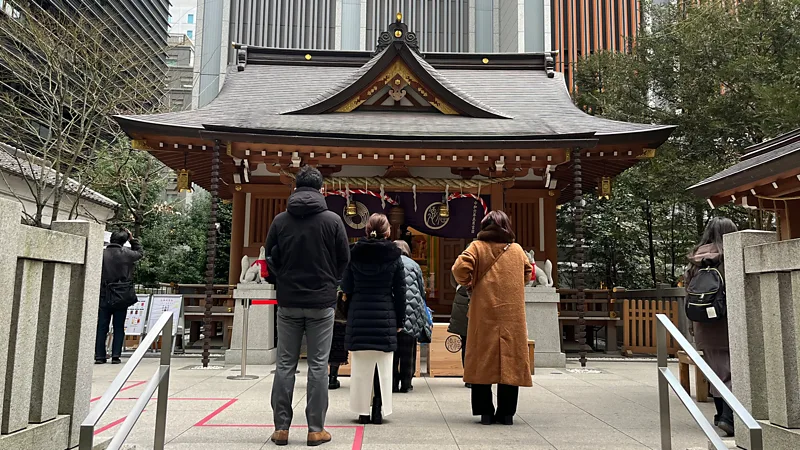
Hidden in the buzzing Nihonbashi district, this more-than-1,000-year-old shrine is believed to hold the power to let you see your favourite bands up close.
It’s easy to feel overwhelmed in Tokyo’s bustling Nihonbashi district. Suit-clad executives come and go from power lunches, well-heeled shoppers pack massive department stores and high-rise buildings nearly block out the sunlight from the ground below.
Just as I found myself mentally overloaded by the neighbourhood’s crush of people, I stepped through a bright red torii gate and into a tiny, peaceful oasis called Fukotoku. I inhaled deeply and instantly felt calm.
While Tokyo is home to hundreds of similar Shinto shrines, I soon learned that this one draws devotees for a very specific reason. Instead of asking the kami, or Shinto gods, for good fortune or health, believers come here for a very specific wish: concert tickets.
Built in the 9th Century, Fukutoku Shrine is dedicated to Inari, a deity believed to bring abundant rice harvests and prosperity. In 1590, the prominent samurai Tokugawa Ieyasu visited the shrine and became so enamoured with it that he became a patron. With that patronage came perks.
“He had such an affinity for the shrine that he allowed it some special privileges, including hosting lotteries,” said Beth Carter, assistant professor of Japanese at Case Western Reserve University in Cleveland, Ohio. “It really became very, very popular.”
The lotteries helped fund shrine improvement, while winners kept a share of the jackpot. Over time, Fukutoku’s reputation as a place to seek luck grew. Inari had always brought bounty; now people came to ask the kami for winning lottery tickets, too. Over the next 400 years, Fukutoku remained a haven for those looking for fortune.
Fast-forward to the 1990s and a new musical movement added to the shrine’s mystique. As J-Pop exploded, bands such as Glay, Speed and Morning Musume sold out venues across Japan and inspired a new form of super-fandom.
“Japanese idol culture became absolutely huge,” said Krista Rogers, a reporter at the Tokyo-based news site SoraNews24. “There is a term called oshi. Your oshi is the band member that you support, the one that you idolise.”
Dedicated fans purchase all sorts of merchandise to support their oshi, from T-shirts to decorated bags and buttons. But the one thing they may not be able to buy, however, is a ticket to see them perform.
That’s because many major concerts in Japan use an online, multi-step lottery system. Fans enter for the chance to buy tickets, and can only purchase them in limited quantities if they are selected. The system is designed to make the process fairer, but some fans look for a bit of divine intervention to boost their odds. If praying at Fukutoku is believed to work for winning scratch-off lottery tickets, fans hope it might bring luck with concert tickets, too.
“We have a saying: ‘Do everything you can and leave your fate up to luck’,” said Cyber Bunny, a Tokyo-based guide and content creator. “Japanese people will do basically anything to increase their chances, even by 1%. They think [going to Fukutoku to pray for tickets] is better than not doing it. It’s better than nothing!”
During the pandemic, concerts stopped but devotion to oshi did not. Ulli Nambo, a guide with Arigato Travel who points out the shrine during her food tours, remembers that when restrictions lifted and acts resumed touring, fans crammed into Fukutoku, eager to reunite with their favourite bands.
“You couldn’t even see the praying area because there were so many people,” she explained. “The street had to be closed because way too many people crowded in.”
On the day I visited, Fukutoku buzzed with believers who bowed their heads in silent reverence. First, they purified their hands and mouths at the temizuya, or water fountain. Once cleansed, they bowed deeply twice before the main altar, clapped twice to summon the kami, offered silent prayers and bowed once more in gratitude.
Some then headed to a kiosk to purchase ema, small wooden cards costing approximately 500-1,000 yen (£3-4.70/$4-$6). They then jotted specific requests onto each ema before tying them to massive racks. A quick scan revealed dozens of pleas from hopeful concertgoers to see bands ranging from ZeroBaseOne to BTS, all praying to win the lottery in two to three weeks and receive the ultimate jackpot: the chance to see their oshi in person.
Japan’s indigenous Shinto religion has no strict dogma nor does it focus on absolutes. Present moment wonders are considered holy. But is it permissible to pray for something as temporal as concert tickets?
“There are a number of Japanese scholars who urge us to not look at these types of interactions as materialistic exchanges, but rather the religious ritual and the preparation of it,” said Carter. “When you receive something that you desire, you get happiness, you get an internal calm and an internal peace of mind that then prepares you for a spiritual exchange that perhaps you were not ready for before.”
Taishi Kato, a 22nd-generation priest at the Hattori Tenjingu shrine in Osaka, agrees. If proper respect is paid to the kami, he says people are welcome to pray for what they wish – whether at his shrine, Fukutoku or elsewhere.
“We open the door to everybody,” he stressed. “People can seek out the shrine they want, and if they sincerely offer prayer, then it’s OK to ask for what brings them joy.”
Listening to live music has often been called a religious experience. In Tokyo, it can also be well worth praying for, as Rogers found out. Once, when her oshi, Ayumi Hamasaki, came to town, Rogers entered the lottery without success. The next time Hamasaki announced a tour, Rogers didn’t leave it up to chance – she went straight to Fukutoku.
“I prayed, and somehow I got the ticket,” she recalled, with a laugh.
Credit: BBC
Erika Ebsworth-Goold