
What's Hot?
Neon’s ‘Clarissa’ Receives Hearty Standing Ovation Following Cannes...
France Announces Team Of Architects For Louvre Overhaul
The Odyssey’ Is My Most Extreme Film Project...
Togo Becomes Latest Country To Eliminate Visa Requirements...
African Music Entering A Correction Phase, Not A...
“How Movie Editors Bring Out the Best in...
5 Nollywood & African Films to Add To...
Shakira Wins £50m Tax Refund From Spanish Government
Kano Board Sanctions Two Kannywood Stars Following Video...
John Travolta Honoured With Lifetime Achievement Award At...
  • Home
  • Arts & Exhibitions
  • Culture & Festivals
    • Culture Africana
    • Culture People
  • Fashion & Lifestyle
    • Music, Movies & More
  • News
    • Travel News
  • Opinion
    • Reviews (The Critics)
  • TCN Literati
  • Tourism & Hospitality
The Culture Newspaper
Culture AfricanaNews

‘Reparations: Colonial Debt’ Documentary Sparks Fresh Conversations About Africa

by The Culture Newspaper August 22, 2025

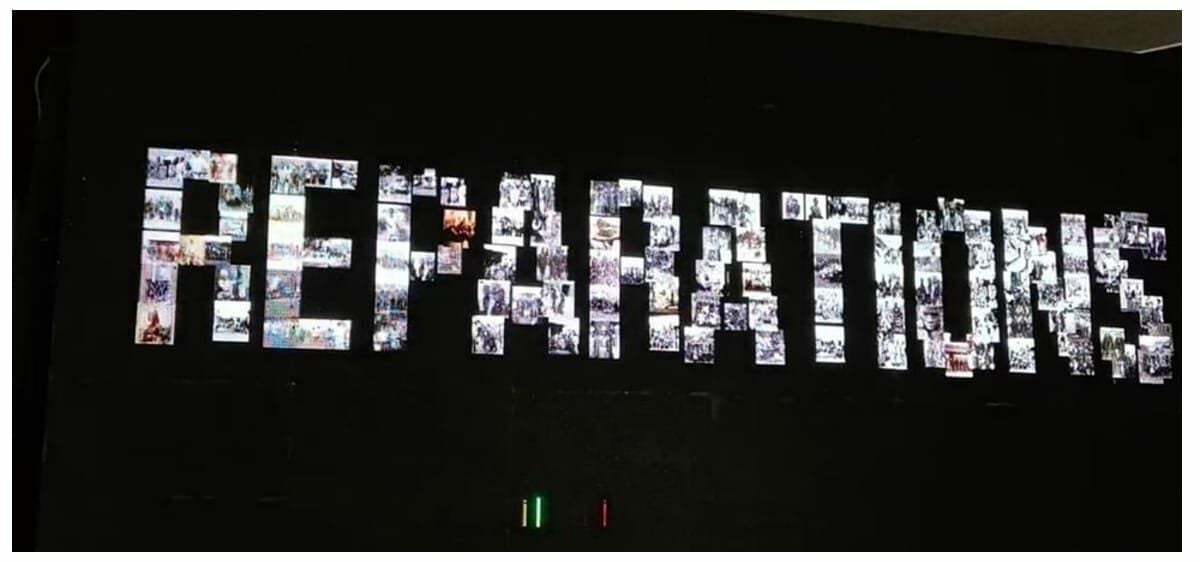
On August 19, the Nigerian audience witnessed the premiere of the documentary “Reparations: Colonial Debt”, by Senegalese filmmaker Ibrahima Sow, on Trust TV.

The film sheds light on the crimes committed by European powers during the transatlantic slave trade and colonisation, the long-lasting consequences of these events, and the enduring economic grip of France on its former colonies in West Africa. It also outlines possible legal mechanisms for African nations to pursue reparations from France and other colonial powers.

Following the screening, the TV station hosted a studio discussion featuring Amsfree Ajanaku, Executive Director of the Grassroots Center for Rights and Civic Orientation, and Mukhtar Imam, Professor of Political Science and International Relations. The conversation centered on France’s ongoing influence in Africa, the legitimacy of reparation claims, and the evolving political dynamics in the Sahel region.

Ajanaku strongly criticised France’s role in Africa today, questioning whether former colonies can truly be considered independent when their economies remain tied to French interests. “Maybe what the French have basically done is to masquerade the real intentions as partnership. Much of this partnership has been exploitative, demeaning, reducing the dignity of African countries to the point one wonders if they are truly independent,” he argued.

On the subject of reparations, Ajanaku insisted that the debate is urgent and must take place at the level of heads of state. He underlined the connection between colonial crimes and today’s social and economic challenges in Africa. “The discussion about reparation is not just a monetary discussion. It connects the dehumanization and atrocities of the past to the inequities of the present. Poverty, ignorance, and disease that ravaged the people of Africa are the result of clear historic disparities in economic relations. Africa, with all its abundant resources, should not be confined to extraction alone but must play in value addition,” he stressed.

For his part, Professor Mukhtar Imam echoed this criticism, highlighting the destructive nature of France’s colonial policy of assimilation, which he described as “one of the most fierce versions of colonialism.” However, he noted significant changes underway in West Africa, particularly within the Confederation of Sahel States (AES). “A lot of these countries are beginning to shake off the shackles which France put on them politically, economically, and otherwise. We’re beginning to see a paradigm shift,” he observed.

Addressing the question of reparations, Imam pointed out that the movement is gaining global traction: “We have a lot of international organizations, advocacy groups currently advocating and championing for reparation. Some of them are even led by groups in Europe.”

In both Nigeria and Ghana, public debates on reparations have intensified in recent years, linking the demand not only to historical justice but also to the urgent need for structural economic change.

The conclusion of both the documentary and the subsequent discussion was clear: reparations are not merely symbolic but essential for restoring historical justice. Words are no longer enough — Africa must now take concrete steps to claim what is owed.

READ More  Entries For Nigeria Prizes 2026 Open With Focus On AI, Poetry, Documentary Filmmaking

Credit: African Features

aboutAfricacolonialconversationsdebtdocumentaryfreshreparationssparks
0
FacebookTwitterPinterestLinkedinWhatsappEmail
The Culture Newspaper

previous post
“Gospel, Afrobeats Stars Are Copying My Song”- Jaywon
next post
New AMP Chairman Aims To Transform FCT Into A Film Production Hub

You may also like

Neon’s ‘Clarissa’ Receives Hearty Standing Ovation Following Cannes...

May 19, 2026

France Announces Team Of Architects For Louvre Overhaul

May 19, 2026

The Odyssey’ Is My Most Extreme Film Project...

May 19, 2026

African Music Entering A Correction Phase, Not A...

May 19, 2026

“How Movie Editors Bring Out the Best in...

May 19, 2026

5 Nollywood & African Films to Add To...

May 19, 2026

Shakira Wins £50m Tax Refund From Spanish Government

May 18, 2026

Kano Board Sanctions Two Kannywood Stars Following Video...

May 18, 2026

John Travolta Honoured With Lifetime Achievement Award At...

May 18, 2026

Eric Dane’s Family Saddened Over Oscars “In Memoriam”...

May 18, 2026

Leave a Comment Cancel Reply

Save my name, email, and website in this browser for the next time I comment.

Recent Posts

  • Neon’s ‘Clarissa’ Receives Hearty Standing Ovation Following Cannes Premiere
  • France Announces Team Of Architects For Louvre Overhaul
  • The Odyssey’ Is My Most Extreme Film Project — Christopher Nolan
  • Togo Becomes Latest Country To Eliminate Visa Requirements For Africans
  • African Music Entering A Correction Phase, Not A Decline – Tiwa Savage

Sponsored

Recent Posts

  • Neon’s ‘Clarissa’ Receives Hearty Standing Ovation Following Cannes Premiere

    May 19, 2026
  • France Announces Team Of Architects For Louvre Overhaul

    May 19, 2026
  • The Odyssey’ Is My Most Extreme Film Project — Christopher Nolan

    May 19, 2026

Categories

  • Arts & Exhibitions
  • Culture & Festivals
  • Culture Africana
  • Culture People
  • Fashion & Lifestyle
  • Food
  • Music, Movies & More
  • News
  • Opinion
  • Photo News
  • Reviews (The Critics)
  • TCN Interview
  • TCN Literati
  • Tourism & Hospitality
  • Travel News
  • Travel Trends
  • Travelogue
  • What's Hot?
  • World Culture

Connect with us

Connect with us
  • Facebook
  • Twitter
  • Instagram
  • Youtube
  • About Us
  • Advertise With Us
  • Privacy Policy
  • Contact Us

@2025 - The Culture Newspaper. All Right Reserved. Maintained by Freelart

The Culture Newspaper
  • Home
  • Arts & Exhibitions
  • Culture & Festivals
    • Culture Africana
    • Culture People
  • Fashion & Lifestyle
    • Music, Movies & More
  • News
    • Travel News
  • Opinion
    • Reviews (The Critics)
  • TCN Literati
  • Tourism & Hospitality