
Two months ago, Mr. Ehi Bramah invited a few people to his Adna Hotel in Ikeja GRA, Lagos to witness the unveiling of his online newspaper, Naija Times.
To those who attended that momentous occasion and many more who joined via zoom, the birth of NaijaTimes did not just signal the arrival of yet another quality Nigerian publication serving news daily via online platforms.


It was also an attestation that something good could come out of a bad, dark period in world’s history.


Braimah’s publication is a product of the lockdown, curfews and restrictions occasioned by the Covid19 pandemic.
Airspaces were shut everywhere. Social and physical distancing measures were firmly in place across the globe. Many business had to go online to stay afloat.
As such, it made sense for smart entrepreneurs to rethink their strategy and gravitate more towards businesses whose values, in terms of production and delivery, are largely online.
And so NaijaTimes was born after its publisher and Editor-in-Chief, together with his betterhalf, had spent several months in virtual solitude as a partaker in an involuntary social experiment that required everyone to stay indoors; to constantly wash their hands and wear masks.
But NaijaTimes was just a part of the identical twin that Ehi Bramah conceived while the world was on lockdown earlier this year.
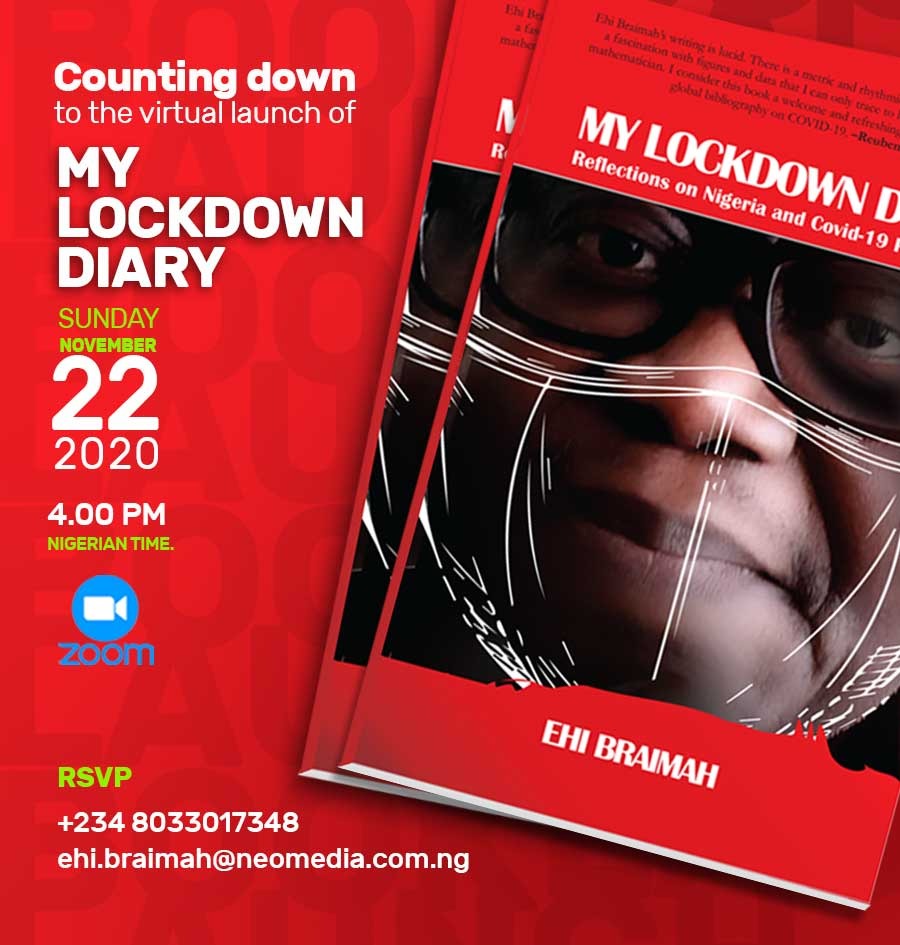
The other sibling to the baby that came two months earlier is the one we are christening today, this 255-page book that brought its name from the womb of a global quarantine – My Lockdown Diaries: Reflections on Nigeria and Covid19 Pandemic.
Like art and literature, journalism has always been drawn to plagues and pandemics.
Writers seek inspiration from them, oftentimes to capture the essence of life at a time that a community or even the world at large battles with the fear, anxiety and dilemma associated with large-scale diseases and deaths.
This was the fearful juncture that the whole world found itself in the first quarter of the year when the virus wreaked havoc from Wuhan in China and then to the rest of the world.
By the beginning of April, Lagos and Abuja, like many major cities of the world, had gone on total lockdown. The new reality demanded that as shutters came down all over the world, people had little say in which social habits and indulgences they could keep.
A new normal had arrived and it didn’t look like it would be in a hurry to depart.
But stories do matter! Writers could not ignore such an unprecedented global development in modern history.
It was the drive to get busy and capture the essence of those unusual times that goaded Ehi Braimah into writing a weekly opinion article in order to document what was going on nationally and globally while he was on a forced quarantine.
Between April and July, he had penned 32 timely articles which formed the bulk of the compilation in this book.
In May, he had informed his wife that those articles would not end up only as archival materials for the myriad of newspapers that gave him the privilege of publishing each of the articles.
His aim was to add his voice to the list of rich publications that come out during unusual times. He wanted to be part of the Pandemic Literature emergeing every time the world witnesses such a dilemma.
What then makes for inspiration in uncertain, befuddling times?
How do we survive such trauma still tormenting many parts of the world?
What authors like Braimah do with this type of book is not to give quick answers but to encourage survivors not to forget about how we got here and why the world must be constantly reminded of things that need to be done, through science and good, responsible governance, in order to stay ahead of the deadly pang of a pandemic.
And so the 32 articles written for the purpose of this book draw attention to two things.
One, that the author, although a graduate of Industrial Mathematics, did not miss his initial calling when he first ventured into journalism as a Sports Writer before fame and fortune smiled on him in PR and advertising.
This book, therefore, signposts his gift of beautiful prose and deep, clear thoughts.
At a time when absolute values are increasingly amorphous, it is comforting to be able to say that a few voices of reason are able to stand up with elegance and pride to speak truth to power in decent, civilised language.
Such is this debut book by Ehi Braimah, which is further proof of his intellectual prowess and literary creativity.
The other import of the book is the apparent desire of the author to stay close to the story.
Out of the 32 articles written during the lockdown, at least 12 directly addressed the issues around Covid19 and the attendant new normal.
In all of these 12 articles, Braimah writes with an unmistakable appetite for true change and is more persuasive when he offers informed opinion on the lessons we ought to learn from all these, especially in Nigeria.
If history illustrates the effects of pandemics on nations and communities, what a book like My Lockdown Diary does is to give a more intimate view of how the virus bites hard and the take-always for individuals and authorities.
Right from the first chapter, ‘Coping with the deadly coronavirus’, his words of admonition are discernible. And I would love to quote him:
” As we join hands together to overcome the pandemic, the political leadership in Nigeria should understand that coronavirus, as bad as it is, has a useful lesson for us all: we must build functional and properly equipped healthcare facilities in all the local government areas in Nigeria as a matter of National emergency,” he writes.
Each of the chapters dealing with the deadly virus has useful nuggets that should engender change. Remarkably too, he writes quite in sync with the thoughts recently expressed by The Humanities Institute, University College in Santa Cruz, USA, that when we consider that changes, both short term and long term, which the coronavirus may bring for us “we should remember that the world we know today was shaped by the pandemic of the past” and that “the realisation can help us go with (these) difficult days.”
The author took the liberty to include eight of his previous articles, before the lockdown, in this book to make the compilation 40 chapters, with each article constituting a chapter. They further attest to his wide range of thoughts and the need to address developing stories, from politics to sports and entertainment.
But still on the main 32 lockdown articles, however, the reader would appreciate the reason for the book more.
It’s like a mini account of events between April and July and how Braimah deploys candid, sometimes witty and sometimes melancholic narrative style in capturing different events.
Remarkably, he uses the book to celebrate also people, both the living and the dead.
For the departed, he has kind words to say about the reggae superstar, Majek Fashek in Chapter 16; Ibidun Ighodalo in Chapter 19 and the former Chief of Staff to the President, Abba Kyari, whose story he used to illustrate the deadly pang of the coronavirus, being the first high-profile death linked to covid19 in Nigeria.
He did not join the furious gang of those who speak ill of the dead just because they had a different view on national issues.
The jolly-good-fellow and bridge-builder in the author shows in Chapters 20, 28 and 32 where be celebrated Chief Dele Momodu, Dr. Tony Elumelu and Dr. Julius Adelusi-Adeluyi.
The Rotarian in him also crops up glowingly in Chapter 23 where he discusses ‘How Rotary Is Making The World A Better A Place.’
And then his PR background comes to the fore in Chapters 24 and 25 with instructive articles – ‘Why APCON Is Still In Limbo’ and ‘Advertising Boycott Against Facebook.’
He took a few global shots too, first in Chapter 14 on George Floyd and how the Black Lives Matter movement was reinforced with his horrifying death in Mineapolis.
In Chapter 17, be practically wrote Dr. Akinwunmi Adesina into his second term as President of African Development Bank (ADB) in his article ‘Who Is Afraid Of Akinwunmi Adesina.’
Perhaps, we should remind Ehi Braimah that Nigeria still needs the intervention of his pen in writing another citizen into office at the World Trade Organisation (WTO).
Above all, My Lockdown Diary is a well-written and beautifully printed book with few, negligible errors.
The only major printer’s devil that will require correction in subsequent editions is in the Introduction where, on page xxiv, it was erroneously stated that Nigeria recorded its index case of Covid19 on March 27, 2020.
The correct date is February 27.
By March 27, Abuja and Lagos airports had been closed to international flights while Lagos had already begun its initial seven-day lockdown.
Nevertheless, with this book, Braimah has joined the league of writers whose voices take readers beyond statistics of global deaths to how individuals or survivors coped during the lockdown and are reliving experiences on how normal routine life took the back seat to the debilitating impact of infections, deaths and catastrophic economic impact.
As the poetry and literary world cannot forget how Alice Quinn, the former Executive Director of the Poetry Society of America, galvanised 85 poets to submit poems that reflect on life in a pandemic, culminating in a book: Together In Sudden Strangeness: Amerrica’s Poets Respond To The Pandemic, it is doubtful if the journalism and media landscape in Nigeria would ever forget Ehi Braimah’s contribution to the Covid19 reporting diaries through this book.
My Lockdown Diary is undoubtedly the story of a storyteller.
It is timely and truly thought-provoking.
But it also opens a vista into the two important worlds of the author – his family, whose opinion counts in all that he does, especially for this book, and his friends and colleagues in the media, with whom he evidently shares a deep sense of bonding and camaraderie, many to whom he appears truly grateful.
His thoughts in the Acknowledgments and Preface sections of the book contain a legion of renowned names in the media and publishing worlds whom the author is grateful to; a good chunk he counts as friends and benefactors, whose league he has now joined as an online newspaper Publisher.
Many in his cahoots are those that would be described as veterans; or for want of a better word those that the new protestations vocabulary would describe as the “gbenudake generation”.
What is however edifying is that the generation that Ehi Braimah belongs would not accept a wrong tag or misrepresentation of historical facts as these media buddies still want their voices heard LOUD and clear on matters of national and global discourse.
Nowhere is this more evident than in making available their news platforms and timely publications such as My Lockdown Diaries available to the ‘sorosoke’ generation to continue to engage meaningfully with issues even if they prefer the tech-savvy, high-octane approach.