
I’ve been thinking a lot about music and the Olympics.
These days, music is a delicious garnish or an elegant window dressing to The Games. It helps them feel special and unique and singular. There’s the Olympic Fanfare and Theme by John Williams (90 years old this week), which, like a Pavlovian bell, NBC uses with surgical efficacy to signal to our brains that “you’re about to see some pretty incredible feats of human ability.” There’s the seemingly endless breadth and variety of music that figure skaters select to accompany their routines as they flit and spin and awe around the frozen Olympic rink. And naturally there’s all the music during the opening and closing ceremonies.


But that’s not what I mean. What I’ve been thinking about is when music was an event at the Olympics.


WHAT?
Yeah! Between the 1912 Stockholm Olympics and the 1948 London Olympics, artistic competition was a vibrant part of the summer Olympic games. There were five categories in which individuals could compete, with architecture, literature, painting, and sculpture joining music.
Now I know that “the arts” and “the Olympics” together in the same sentence conjures up images of speed painting or competitive high-note singing, but that’s not what it was.
It worked like this.
Artists were invited to enter original, sports-themed works in the aforementioned categories to be judged by an expert panel. Participants were free to create what they liked so long as the works related to sports and were original (i.e., not published or presented before the Olympic games took place). Once judged, participants could be awarded gold, silver, or bronze medals for their submissions, just like the athletes.
The operative word there being could.
For unlike the athletic events, medals did not need to be awarded in the artistic events. In fact they often weren’t. This was a key difference between the arts events and the athletic ones: if the judges on the panel felt that none of the submissions were of gold, silver, and/or bronze caliber, then no medal was awarded.
This was the case for the first ever Olympic music competition in 1912, when Italian composer Riccardo Barthelemy was the only winner for music, earning gold for his composition “Olympic Triumphal March.”
More awkwardly, there were no gold or bronze medals awarded in the music competition at the 1932 Los Angeles Olympics, but Czech composer Josef Suk – probably the only famous composer to enter the competitions and/or win an Olympic medal – was awarded silver for his work “Towards a New Life.”
Second place to no one is kind of cruel, I think.
(Incidentally, this is still true of some music competitions today. For example, in both 1994 and 2007, no first-place awards were given in the piano category of the International Tchaikovsky Competition, although second and third-place awards were given. And at the 2005 International Chopin Competition, there were two third-place finishers and a first-place finisher, but no second-place finisher.)
Not that the judges at the Olympics had an easy go of it. One of the difficulties in judging the music competitions was that submitted works were not performed at the Olympics, simply submitted on paper. That’s right, judges made their assessments of the music entries by looking at them.
This is of course doable, but it does kind of take one of the most important elements of music out of the equation: how it sounds.
Another problem was that all submissions were bundled together under a general heading of “music.” This meant that a one-page song for piano and voice was likely to find itself submitted alongside a symphonic work calling for 150 instruments.
Not that size matters, but one does seem more impressive somehow than the other.
To make things a bit more fair, the music events were finally split up into categories in 1936, but by then the writing was on the wall for the arts competitions. They were held once more at the 1948 Olympics in London (there were no games in 1940 or 1944 due to World War II), but were then subsequently discontinued.
WHY WAS THIS EVEN A THING?

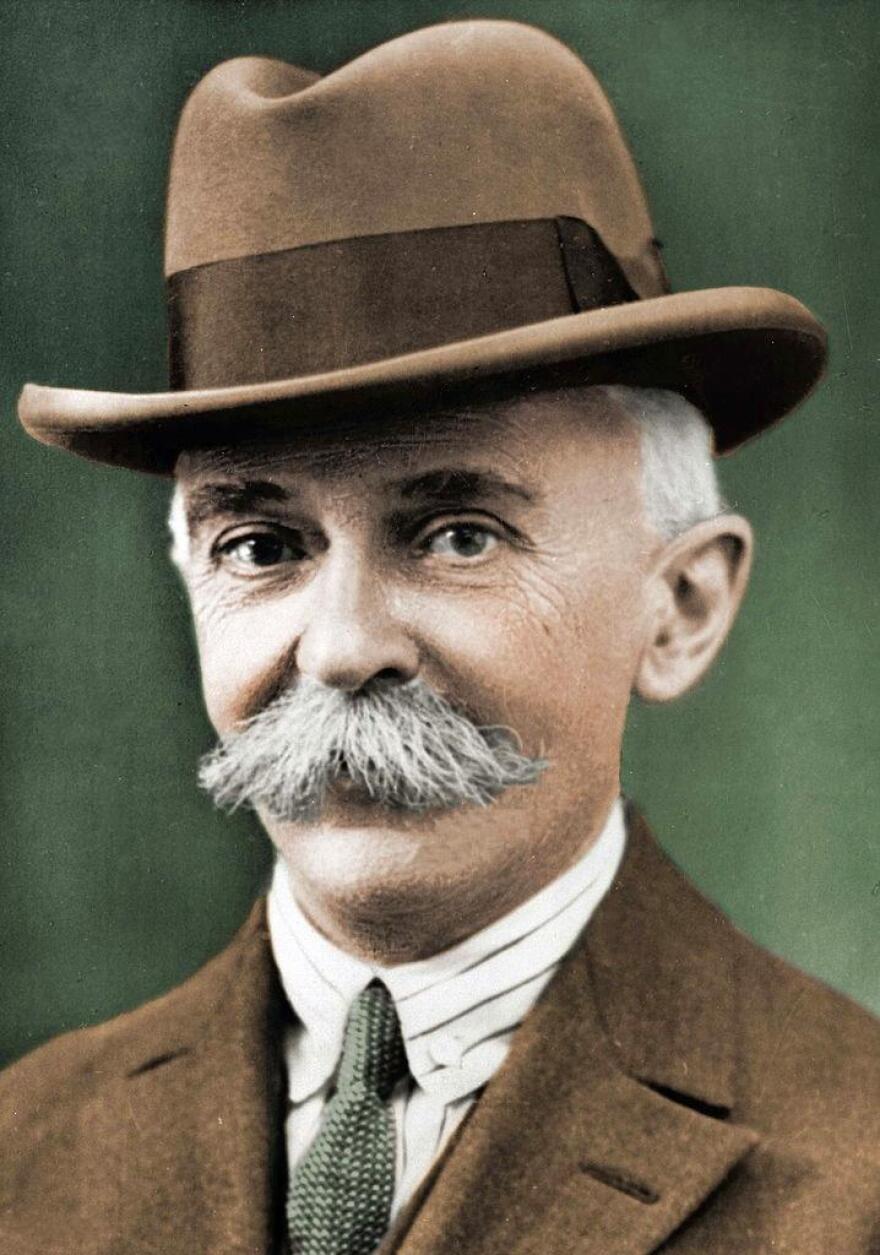
It all started with the father of the modern Olympic games, the French aristocrat Charles Pierre de Frédy, Baron de Coubertin.
Coubertin was an educator and an historian, and was passionate about two things. He held it of the upmost importance that sport and physical education be taught in French schools. And he deeply wanted to rekindle the Ancient Greek tradition of the Olympic Games.
And, being classically educated, Coubertin’s games weren’t going to be any old sporting competition either. There were plenty of those. No, he wanted his games to be steeped in the aesthetic and philosophical ideals of the Ancient Greeks.
For Coubertin, that meant including the arts.
“There is only one difference,” Coubertin once said, after failing to get the arts included in the first few Olympic Games, “between our Olympiads and plain sporting championships, and it is precisely the contests of art as they existed in the Olympiads of Ancient Greece, where sport exhibitions walked in equality with artistic exhibitions.”
And so, despite objections from many organizers, Coubertin finally had his way and the arts entered the 1912 Stockholm Olympic Games. Thirty-three works across the five categories were submitted, including a piece anonymously written by Coubertin himself under a nom de plume.
It was a poem titled Ode to Sport, and naturally it won gold.
DID THE ANCIENT GREEKS DO THIS?
In 1904, Coubertin wrote in Le Figaro, “The time has come to take the next step, and to restore the Olympiad to its original beauty. In the high times of Olympia, the fine arts were combined harmoniously with the Olympic Games to create their glory. This is to become reality once again.”
And eight years later, it was.
He was however a little bit off on his understanding of how the Ancient Greek games incorporated the arts. Yes, there were competitions in poetry and song during an Olympiad, but they were not held at the actual Olympics.
You see, an Olympiad was a time measurement in Ancient Greece, and was how the ancient Greeks counted the passage of years. An Olympiad is equal to the time between one Olympics and the next, or four years.
The only music to be found at the Olympics themselves would be fanfares to announce one thing or another, or music accompanying events like the long jump, which the Greeks believed helped with concentration. Music itself, however – like the games today – was not competing.
Coubertin wasn’t completely off the mark though. There were other games that happened in between the Olympic games, and some of those included arts competitions. The Pythian Games, for example, held in Delphi in the third year of the Olympiad where famous for their arts competitions. In fact, while these games did include some sporting events, the competitive focus was largely on the poetry and hymn singing contests, held in honor of the god Apollo.
It’s perhaps the renown of these Pythian games, where the belief that the Ancient Greek Olympic games included arts competitions.
The most important thing in the Olympic Games is not to win but to take part, just as the most important thing in life is not the triumph but the struggle.
WHY IS THIS NO LONGER A THING?
So why is this a reality no more? Well, according to an article in the Smithsonian Magazine written by Joseph Stromberg, Olympic arts competitions were discontinued for two reasons.
One was that the big names in the arts world were as a whole not inclined to participate in the Olympic events. They were suspicious of a competition originating from outside the arts world (and with such narrow thematic restrictions), and worried that their reputations would be tarnished by either a loss or a win at the Olympics.
In other words, while Coubertin wanted the arts at the Olympics, there wasn’t much in it for the artists themselves.
The second and more final reason for the discontinuation of the arts competitions at the Olympics was due to a heated philosophical debate that still rages today: should competitors at the Olympics be amateurs or professionals?
One of the central pillars of the early modern Olympic games was that athletes ought to be amateurs. However, this edict was less strictly adhered to when it came the arts. How else, after all, would you get good art if you didn’t encourage professional artists to participate?
Then in 1952 the International Olympic Committee elected a new president named Avery Brundage, who, as Stromberg writes in his article, had an “obsession with absolute amateurism [at the Olympics]… Because artists inherently rely on selling their work for their livelihood—and because winning an Olympic medal could theoretically serve as a sort of advertisement for the quality of an artist’s work—Brundage took aim at the art competitions, insisting they represented an unwelcome incursion of professionalism.”
And so, just like that, after 36 years Coubertin’s dream of having the arts as an integral part of the Olympic experience was snuffed out.
LEGACY
Over the short history of arts competitions at the Olympics (1912-1948), 151 medals were awarded in the the categories of music, painting, literature, architecture, and sculpture – mostly to Europeans. Seventeen of those medals were awarded for music. And today, none of those medals count toward the overall medal count for a given country. Which I suppose is fair.
Faster, Higher, Stronger – Together
The Olympic motto
But the arts at the Olympics are not dead. Not by a long shot.
The arts competitions were replaced with art exhibitions at the games following the 1948 Olympics, and the groundwork was laid for what is now called the Cultural and Olympic Heritage Commission. The mission of this commission is to advise the I.O.C. “on all the activities of the Olympic Movement that are related to culture in the broadest sense of the term – art, history, focus on values, academic research and patrimonial collections – with a view to promoting the Olympic ideals as widely as possible, especially among young people all over the world.”
More recently, in 2004 the I.O.C. launched a Sport and Art contest leading up to those summer Olympic games. Winners weren’t awarded medals, but they did receive cash prizes and the opportunity to have their artwork displayed at the games. This was repeated at the 2012 games.
There are also Olympian Artists in Residence, part of a program launched at the 2018 PyeongChang Winter Olympics to highlight Olympians who are also artists.
And of course, whether it’s a legacy of Coubertin’s original Olympic mission or not, the arts are an undeniably integral part of any Olympics.
From the creation of unique official logos, to the crafting of the medals and torches, to the jaw dropping designs of new stadiums and the staggering visual displays presented during the opening and closing ceremonies therein, nothing of what makes the Olympics feel like the Olympics is possible without…
Art.