
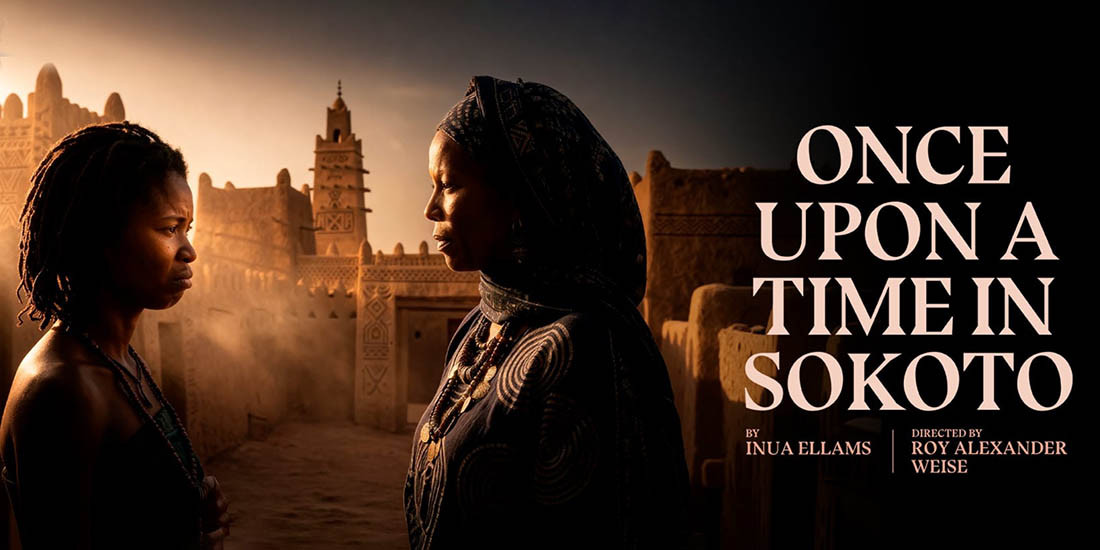
For Nigerian-British poet and playwright Inua Ellams, his new play Once Upon a Time in Sokoto is more than a carefully crafted narrative. “I think of it as a historical period drama set in pre-colonial northern Nigeria; it’s about the fall of an empire and the rise of another,” the 41-year-old says of the show.
Known for the acclaimed Barber Shop Chronicles, which brought six barbershops in the UK and Africa to the stage, Ellams’ latest work explores the wealth and fall of the Sokoto Caliphate, a 19th-century Islamic state that existed in West Africa from 1804 until it was conquered by the British in 1903.
Ellams says it is a complex story of slavery, hierarchy, gender and war that he explores with a nuance he believes is often missing when discussing northern Nigeria. “The things happening to the society and the communities in the play are historically accurate. Within that, I weave through these fictional characters who tell that story,” he says.
What is the role of the Sokoto Caliphate in the play, and how familiar are you expecting audience members to be with it?
The play begins six decades after the founding of the Sokoto Caliphate. Even though I was born in the region, I wasn’t familiar with it until I started researching it, so I don’t think audiences will be either. I tell this story through the lens of four main characters: Zinari, an upper-middle-class Muslim Fulani woman; Nafisa, a woman who Zinari’s family enslaved; Hadiru, a man Zinari employed; and Yusef, who returns home from what is now southern Nigeria with an understanding of the British forces making their way to the north and hoping to alleviate the suffering that he knows is about to come.
One of the play’s strengths is that there is no hero or villain. What does it mean for you to resist moral binaries within your storytelling?
I read Sensuous Knowledge by the Nigerian-Finnish author Minna Salami. She grew up in a Muslim household steeped in feminist theory and ideology, and pointed out that these binary systems of good and evil aren’t African. You see this when you look at the orishas (divine spirits in traditional Yoruba religion), for example. There’s no figure like Satan, who in the Western religious canon is the binary opposite of Christ. They are just forces.
Salami also talks about restorative justice. Rather than punishing people, there are practices where a community reminds a culprit of the good things they have done as a way of forcing them to question their actions. That really got me thinking about how to tell a story that dramatises those philosophical thoughts.
The play is both critical of the misuse of religion while respectful of faith. How did you find that balance?
I was born into a multi-faith household. My father was a Muslim, my mother was a Christian. Growing up, I regularly went to both the mosque and the church, so I understand religious pluralism. When news about [jihadist terrorist group] Boko Haram came, many indigenous Nigerians demonised Islam, whereas my earliest relationship with Islam was about peace and community. So, I’m able to divorce true religion from the weaponising of religion by extremist groups such as Boko Haram, or even the far right in the UK with Christianity.
How does your new play fit in with Barber Shop Chronicles, and your other work?
There are familial links between all the things that I create. In Barber Shop Chronicles, a Hausa man [an ethnic group primarily found in northern Nigeria] walks into the barbershop. He speaks pidgin English, a simplified language that mixes English vocabulary with native languages. But there’s an Igbo man [an ethnic group mainly found in southeastern Nigeria] who tells him off for not speaking pidgin correctly. The Hausa man explains that languages evolve. He says pointedly, “This is why Nigeria could never be united because of people like you.” In Once Upon a Time in Sokoto, I’m trying to narrate the divorce between the two sides of the country – why the northern mindset is so different from the southern one. I hope this explains our differences, but also the tragedy of colonial rule, and how it furthered the division.
You described the play as a tragedy. What does tragedy mean to you here?
That we don’t get to see the fantastic friendship and relationship that might have come from the two lead women. At the end, we see them resolving their differences, but there’s a battle to be fought.
Also, the tragedy of survivor’s guilt. The children of the lead characters will have it and, arguably, down the line, I have survivor’s guilt. I escaped Boko Haram, who tried to kill my father, and I understand what’s happening in the north right now.
What do you want people to take away from the play?
That in the last 200 to 300 years, not much has changed. Unfortunately, women are still struggling for liberation; capitalism and power still contribute to toxic masculinity; and many of us are still striving to tell our own stories and be understood. Also, that no war is ever justified, however much you dress it up.
Credit: northantstelegraph