
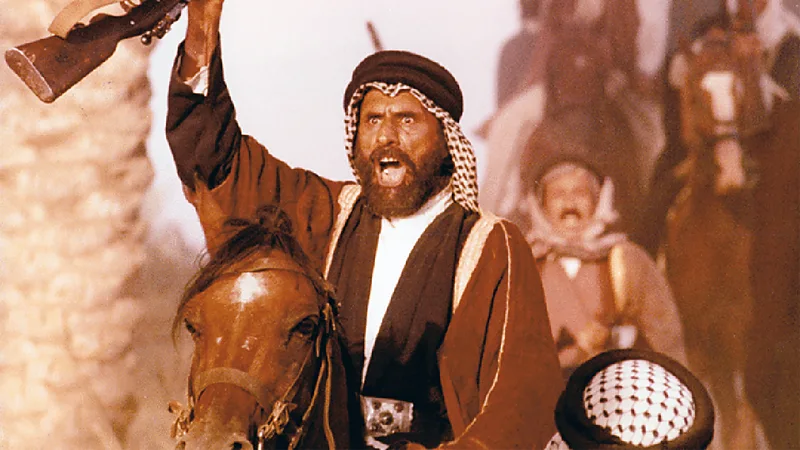
In July 1983, Clash of Loyalties was screened for the first – and almost last – time. In 2020, its producer told the BBC about conscriptions, interrogations, and a drunk Oliver Reed.
The biggest threat to Saddam Hussein’s epic Hollywood-style film Clash of Loyalties was not the outbreak of war between Iran and Iraq in 1980, a few weeks after filming began in the desert near Baghdad. It wasn’t the steady stream of cast and crew being called up to fight, disappearing from the film set without notice. It wasn’t the challenge of transporting World War One prop weapons across the border of Turkey, where customs guards stopped the film’s lorries, believing they were importing a real arsenal to aid Iraqi troops.
Instead, the film was closest to being derailed by a drunken incident in a hotel restaurant involving the film’s star Oliver Reed urinating in an empty wine bottle. “He asked the waiter to take it over to the next table, and said, ‘With my compliments,'” the film’s Iraqi-born British producer, Lateif Jorephani, told the BBC’s Witness History in 2020. “The authorities were absolutely flabbergasted… I had Telexes from ministers in Iraq telling me, ‘Pull this guy out, we don’t want him here now.’ How do I, as the producer of a multi-million-pound picture, pull the major star out of it halfway through production?”
How the Iraqi leader tried to get Iraq into the world of big movies
Jorephani managed to persuade the authorities to let him keep Reed, rather than having to reshoot the whole film – but it was a close call. “I had to fight it tooth and nail,” he recalled. The incident was just one jaw-clenching moment in a production that spanned three years and cost $30m ($100m or £76m today), roughly the same budget as its contemporary, Return of the Jedi. And when it was finally completed, Clash of Loyalties was only screened a few times – winning an award after it premiered at the Moscow Film Festival in July 1983 – before being consigned to canisters in Jorephani’s garage in Surrey, England.
Its ignominious end was a long way from the ambitions of Hussein. Soon after the Iraqi dictator came to power in July 1979, he set out a vision to establish an Iraqi film industry that could make patriotic blockbusters for a Western audience. “Hussein was very enthusiastic about encouraging Iraq to become a centre of international film productions,” Jorephani told the BBC. “Perhaps he’d thought that one day Baghdad could become Bollywood on Tigris.”
The first time he saw Oliver Reed, he was being dangled by his ankles out of a fifth-floor hotel window
Hussein envisaged a series of projects that would boost the image of Iraq globally. To start, he wanted to make a motion picture of Hollywood proportions connecting his Ba’ath party to the Iraqi revolutionaries who overturned British rule in 1920. Clash of Loyalties, or Al-mas’ala Al-Kubra (The Great Question), told the story of Iraq’s formation out of Mesopotamia, and was described by one of the actors as “Saddam’s version of Lawrence of Arabia”.
“It’s based on a real incident in 1920,” said Jorephani. During a nationalist movement to rid Iraq of colonial occupation, the British Lieutenant Colonel Gerald Leachman was killed by a rebel near the city of Fallujah. Clash of Loyalties would be Hussein’s epic retelling of the birth of a nation.
Jorephani had worked in the film business since the 1950s, making several low-budget films in the Middle East, and was approached about the project by his contacts in Hussein’s government. With Iraq bolstered by an influx of cash from the booming oil prices of the 1970s, finance was not a problem. “Our friends in Baghdad went to the big man and they said to him, ‘To get into the international film business, we have to talk money’. He said to them, ‘Whatever it takes’.”
The big-budget Clash of Loyalties had Hollywood-style sets, special effects, and hundreds of cast and crew members, all transported to Baghdad. And then Hussein invaded Iran. “I had 140 people out in Iraq during a war,” Jorephani recalled in the 2016 documentary Saddam Goes to Hollywood. “These people were accustomed to making movies in Shepperton, Pinewood, Hollywood – not being in the middle of nowhere while real missiles and bombs were going off all over the place.”
Filming in a war zone
The invasion led to a few hiccups. “We had to stop production, but the word came from upstairs that you must give the impression that life goes on as normal,” Jorephani told the BBC’s Outlook in 2016. “As far as the Iraqi leadership was concerned, ‘It’s fine, it’s going to be over in a few weeks’ time, carry on, boys, and everything would be OK.'” Filming resumed after a fortnight.
Despite the authorities’ desire to pretend that there was nothing to be concerned about, there were clues, according to the cast. One actor recalled flying out to Iraq with Reed and other cast members, and noticing a fighter jet accompanying their plane when they entered Iraqi airspace. They landed without lights to avoid a missile attack. Scenes had to be reshot after local actors were called up to the army suddenly, and there were logistical problems in delivering military props from the UK across the Turkish border.
In History
In History is a series which uses the BBC’s unique audio and video archive to explore historical events that still resonate today. Sign up to the accompanying weekly newsletter.
According to Jorephani, “The Turks said, ‘Hang on a second mate, we are neutral in the war, you can’t get this stuff through.'” He tried explaining to them, “Look, this is First World War film stuff, you can’t shoot with it, this is a gun for film-making.” But to no avail. Instead, recalled Jorephani, they had to send their lorries “through Greece, on ships, across Lebanon, across Syria, which was then more friendly with the Iranians than the Iraqis, and across the desert to Baghdad. I was really quite frustrated by then.”
But the most notorious episode in the production involved a sequence with an exploding train. “It’s supposed to be a troop train with ammunition… attacked by Iraqi rebels,” said Jorephani. Although they were mostly filming in locations away from the real-life fighting, the only disused railway line they could find was close to the Iranian border. “The day after the shoot, Iranian media claimed that the Revolutionary Guard attacked inside Iraq and destroyed a military train, killing many Iraqi soldiers.”
Events were almost as dramatic among the actors. Beyond the incident with the wine bottle, Reed’s antics included arm-wrestling, kicking in doors and picking fights. Fellow cast member Marc Sinden, son of actor Donald Sinden, said in a 2014 Esquire interview that the first time he saw Reed, he was being dangled by his ankles out of a fifth-floor window of the Al-Mansour Melia Hotel in Baghdad, after upsetting his minder, a French ex-special forces soldier. Reed was apparently screaming with laughter. “We never did find out what Olly said,” recalled Sinden. Another actor in the film, Virginia Denham, said: “Oliver Reed was a weapon of mass destruction.”
Sinden had a memorable experience of a different kind while shooting Clash of Loyalties. He said in the 2014 interview that before he flew out to Iraq, he was recruited to take photographs of Baghdad for a shady British secret agency. “I was visited by two gentlemen in suits. They claimed they were from the Foreign Office… They asked if I was going to Iraq, and I said yes. I didn’t have to tell them the date. They already knew when I was leaving.”
Shown then shelved
Sinden was told that security services would be interested in seeing his holiday snaps – anything that looked like it might have military value, such as communications antennae, government buildings, or palaces. Unfortunately, Sinden said, these photos landed him in an interrogation centre in Iraq, after Hussein’s secret police followed him. Soon after his arrival, he was taken for questioning – but managed to talk his way out, telling his interrogator: “I’m here at the behest of your glorious leader, Saddam Hussein. He is funding the film I am doing. Look, I had supper with him a week ago.” They quickly released him, and Sinden flew out of Iraq the next day, dressed in his costume of a 1920s military uniform, complete with pith helmet and pistol.
Jorephani edited Clash of Loyalties back in London, but after a few festival screenings, it was shelved. After Hussein’s occupation of Kuwait in 1990, the UN imposed international sanctions on Iraq that lasted until Hussein’s fall from power in 2003, and the film was never shown again. The dictator’s grand vision of a series of major international productions made in Iraq was reduced to one film that was viewed by only a few hundred people. “Had things worked out as the Iraqis hoped it would, we would have been in our sixth or seventh major picture of this kind,” Jorephani told the BBC’s Nick Erikson in 2016.
He was disappointed that he never got to make another film with the Iraqis, although he told the BBC in 2020: “After 30-odd years of war and bombs and destruction and killing and sectarianism… What is film-making? It’s nothing really compared to that.”
Credit: BBC