
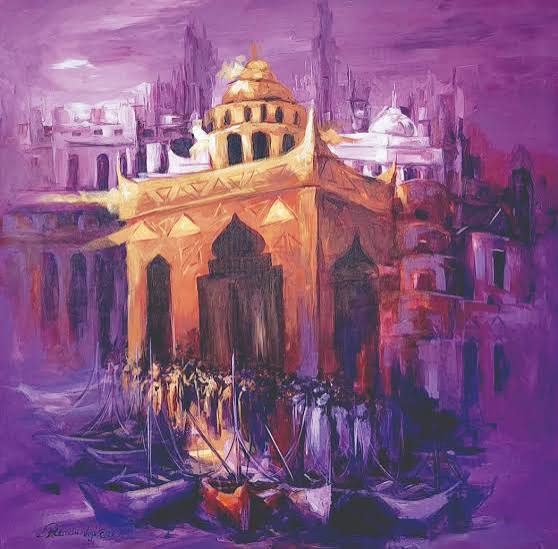
To command colour, texture and cultural memory in a single brushstroke is to practise a form of urban meditation, and this is the territory Remchi Vigs explores in his paintings. His rough-edged, textured canvases oscillate between the smooth and the implied, arresting the viewer with their vivid colours and dreamlike compositions.
For this emerging Jos-based artist, painting is a visual diary of his fascination with Northern Nigeria’s daily rhythms, social life and architectural heritage. His works probe what it means to inherit a cultural language that appears increasingly vulnerable to extinction.
“I choose painting because I tried other artistic mediums like sculpture, photography and film to pass my message, but all these were not invoking the feeling of satisfaction,” he explains. “It was only when I discovered I could do better with colours on canvas that I found my voice. Painting challenges my reasoning and leaves me with no option other than to think deeply. It also helps me to look at life with the inner eyes of an observer.”
His canvases conjure nobles on horseback at Durbar festivities, traditional architectural forms, market scenes and figurative studies of everyday people. Loose lines and broken patches of colour sometimes leave these images suspended between recognition and abstraction, lending them an almost dreamlike quality.
Jos, where Vigs lives and works, provides much of his inspiration. Its cosmopolitan character, shaped by the intermingling of indigenous communities and migrant populations, is reflected in the city’s social and cultural life. Historically associated with tin mining and agricultural trade, Jos has also endured recurrent ethno-religious conflicts that have complicated its public image. Yet its artistic community continues to explore more restorative ways of representing the city and its identity.
From the Society of Nigerian Artists (Jos Chapter) and The Enchanting Plateau Art Exhibition to independent galleries such as Juneth Galleria, Padma Art Gallery and Ecstasy Art Gallery, the city has sustained spaces for artistic exchange. More recently, JOISCOLD Art Foundation, championed by curator and archivist Ponchang Kumven, has promoted collective engagement with the Plateau’s ecology, histories and indigenous knowledge as sources of contemporary artistic inquiry.
It is within this evolving environment that Vigs belongs to a generation seeking to reimagine Jos through the interplay of memory, architecture and cultural identity.
A graduate of Fine and Applied Arts from the University of Jos, where he developed interests in drawing, mixed media and mural painting, Vigs acknowledges the influence of several artists, among them John Oyedemi, Jacob Onoja, Ezra Samu’ila, Ogiugo Edosa and Bolaji Ogunwo. Their contributions, he says, have shaped his style, palette, discipline and relationships within the art community.
His professional experience includes mural and portrait commissions, workshops and exhibitions in Nigeria and abroad. These include the Nigerian–Benin Republic Border Art for Economic Development Residency in Idi-Iroko, Ogun State; Zanzalu Art Residency in Zanzibar; Life in My City Arts Festival (LIMCAF), Enugu (2024); Cultural Canvas Art Exhibition, Abuja (2025); and Swahili Futurism Art Exhibition, Zanzibar (2026).
He was also an overall finalist in the NIPSS Blue Economy Art Competition and received the University of Jos SUG House of Parliament Visual Artist of the Year Award.
His artistic interests have gradually moved from the ceremonial imagery of Northern Nigeria’s Durbar festivals towards the architecture of ancient African settlements and historical cities. He sees architecture not simply as physical structures but as repositories of identity, history and collective memory. His paintings consequently examine how inherited designs have shaped contemporary urban development and might inform the cities of the future.
This approach finds a striking expression in Jos Terminus: Abuja Market (2024), an acrylic-on-canvas painting dominated by a tempered red backdrop. Wavy lines sweep rhythmically across its skyline, tinted by a receding sunset whose faint yellow glow falls over the bustling market. Beneath it, umbrellas and corrugated roofs shelter a shifting multitude of market-goers. Their hurried, almost abstract figures dissolve into the colourful surface, capturing something of the restless energy of everyday urban life.
Equally compelling is Riding Off (2026), an oil painting depicting a procession of Northern horsemen in Durbar ceremonial regalia, seemingly emerging from Riyom Rock, the famous Plateau landmark. Red spills into umber, burgundy and soot-like yellow, evoking the dusty atmosphere of harmattan or the heat of a sun-drenched afternoon. The horses, loosely rendered in both brushwork and form, nevertheless retain a commanding majesty and palpable sense of movement.
Two riders dominate the foreground, dressed in red and brown robes, their heads wrapped in turbans. Behind them trails a colourful procession. The figures, at once recognisable and distorted, appear to advance towards the viewer. Beyond its celebration of the Durbar, the painting suggests a dialogue between Northern ceremonial traditions and Jos’s own cultural identity. Its visual drama lies in this meeting of histories, colours and cultural references.
Vigs calls his approach Archival Futurism, describing it as “an artistic approach that reimagines ancestral architecture and historical urban spaces as living archives, using their visual memory, cultural knowledge and structural language to reflect on contemporary and future cityscapes.”
The formulation captures the preoccupation running through his work: the preservation of indigenous heritage without treating it as something sealed off from contemporary life. By bringing architectural memory into conversation with present-day urban experience, Vigs attempts to recover the visual histories that might otherwise slip from collective consciousness.
His paintings thus become more than observations of Jos and Northern Nigeria. They are attempts to remember, reinterpret and imagine their cultural landscapes anew. In their shifting colours and restless forms, the city emerges as both an inherited memory and an unfinished possibility.
Credit: This Day