
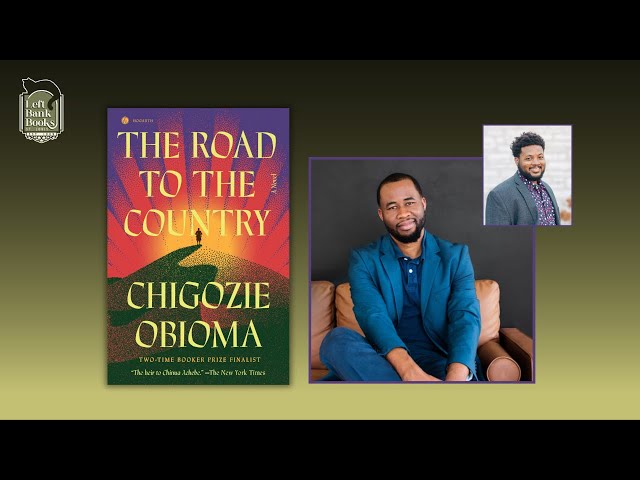
“The writer is often faced with two choices,” the late Nigerian author Chinua Achebe argued, “turn away from the reality of life’s intimidating complexity or conquer its mystery by battling with it.” Based on the three novels he has produced so far, Chigozie Obioma appears to not even be aware of that first option. His books — “The Fishermen,” “An Orchestra of Minorities” and the new “The Road to the Country” — charge headfirst into the thorniest areas of human existence. His exhilarated readers carry the cuts and scratches.
“The Fishermen,” one of this century’s most remarkable debuts, tackles destiny, fratricide and revenge in a west Nigerian town. Its expansive follow-up, “An Orchestra of Minorities,” is narrated by a 700-year-old guardian spirit known as a chi and attempts, as Obioma explained to the arts magazine Bomb, an inversion of John Milton’s “Paradise Lost” in which the ways of men are justified to the gods. Both books contain writing as magnificent as their author’s ambitions. Both were shortlisted for the Booker Prize. Neither will prepare readers for Obioma’s third novel.
“The Road to the Country” is set during the Nigerian Civil War, which took place over 2½ devastating years in the late 1960s. The war claimed a reported 1 million people, many of them children who perished from starvation. Some estimates — including Achebe’s in his 2012 memoir of what is also known as the Biafran War — put the losses even higher. “An entire generation was wrenched from the future,” as Obioma’s peer Emmanuel Iduma has noted.
The war began in July 1967, two months after a charismatic, college-educated military officer named Chukwuemeka Odumegwu Ojukwu announced the creation of the independent Republic of Biafra in Nigeria’s Eastern Region. (Ojukwu, like other real-life Biafrans, appears in the novel.) In the previous year, the area had become a refuge to about 1 million members of the Igbo people, who fled a campaign of terror in the Northern Region after being scapegoated for a coup.
The Nigerian government responded to the secession with overwhelming and merciless force. Achebe, to quote the Igbo author of “Things Fall Apart” one last time, called the war “a cataclysmic experience that changed the history of Africa.”
When “The Road to the Country” opens, the Biafran War is just underway. A poorly armed militia has formed to defend the nascent state. Casualties are mounting. People are afraid. Adekunle “Kunle” Aromire is oblivious to all of it.
A self-absorbed law student with an Igbo mother and a Yoruban father, Kunle has returned to the family’s Western Region home from Lagos for the first time in 13 months. He has spent the past decade blaming himself for an accident that paralyzed his younger brother, Tunde. (Hoping to be alone with his neighbor and crush, a fellow 9-year-old named Nkechi, Kunle had shooed the boy outside, where he was promptly struck by an Oldsmobile. Kunle has cloaked himself in guilt ever since.)