
How professionals in the movie and music industries can better collaborate for improved aesthetic and economic values was the focus of a symposium held on May 25 at the MUSON Centre, Onikan, Lagos. The hybrid (virtual and physical) event commemorated the 60th birthday of musicologist, pianist and composer Ayo Bankole Jnr.
Apart from his footprints in classical and African music, the celebrator, son of the late Ayo Bankole, has also contributed to the emergence of distinct Nigerian screen music composition, jingles, soundtracks and new forms of digital music-making.


The symposium themed ‘Music as a Creative and Economic Tool for the 21st Century Nigerian Film Industry’ came after ‘The past, present and future of Nigerian Art Music: Celebrating Theophilus Ayoola Bankole Through Ayo Bankole Jr. at 60’ held in the morning.

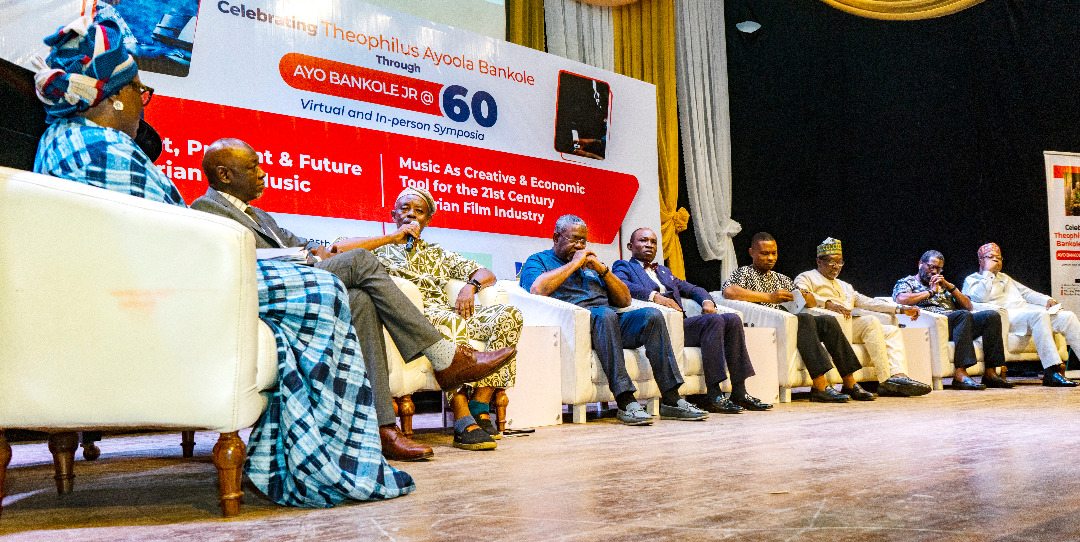
Actress Joke Silva moderated the session, featuring filmmakers, musicians and foremost critic/culture journalist. They were Tunde Kelani, Femi Odugbemi, Sani Muazu, Dr Bayo Adepetun, Seun Owoaje, Okechukwu Ogujiofor, Steve Ayorinde and Bayo Omole.
The event, which lasted about two hours, was riveting with the panellists’ insightful analyses of music in Nigerian movies and how they could better synchronise them for aesthetic and economic benefits.
‘Superior to film’
The cinematographer, Kelani, who spoke first, congratulated Bankole and painstakingly highlighted how music is an integral part of filmmaking. He lamented the meagre number of cinemas in the country compared to France and how research on Nollywood doesn’t reckon with scores. He also reiterated why producers must prioritise it.
“For me, the music is, in fact, superior to the film. In the beginning, I realised this and went around and tried to get a guitar, but they told me I must develop the melody. I realised that the music didn’t come, so I started to chase musicians around; some of my friends here, Dr Bayo Adepetun, Ayo Bankole and Kingsley Ogoro. I was very excited when the new drum machines came in the 80s and would leave my office to see Adepetun do effects.
“Sometimes, the music came by accident. I went to Kingsley Ogoro’s studio to make the sound for ‘Ti Oluwa Nile’ in the 1990s and met Tunde Adegbola in Surulere. Kingsley doesn’t speak Yoruba, so Tunde abandoned where he was going and followed me to make the sound.
“I’m working on a project, and again, Seun Owoaje comes in. Seun takes it a bit further, and it’s in collaboration with the University of Delaware. You can call it a cultural fusion, where I made the film and composed the music. The orchestra of Delaware University plays. We are sitting on a goldmine. We have to show more interest and work with the musicians. Before making the film, we should think of the song. I was going to make ‘White Handkerchief’, and once the script was ready, I took it to Beautiful Nubia for the theme music. He took me seriously and made the track ‘Ikoko Akufo’ before I shot the movie. There is no doubt that the music sometimes gives the film a unique identity. ‘Ise Oluwa’, Quincy Jones used it in ‘Root’. So, let’s get on with it, and by the end of the day, I’m sure we’ll find the direction.”


Accidental Riches
Adepetun, a medical doctor turned sound designer and composer, recalled the early days with Bankole and how he stumbled on wealth serendipitously with his first jingle.
“I taught myself and realised I had a passion for composing music. Nobody could teach me to play the piano normally because I taught myself my way; I write music my way. I met Ayo at King’s College and had a band called The Clinic. This young chap just came there and did some things. And I was like, where has this guy come from? He was playing way beyond his years. From that time onwards, we always got together whenever I had the opportunity. We played the music for fun until one fateful day when one of the guys from the ad agencies asked me to do a jingle. I asked him, what’s the meaning of jingle? He said music for radio, and I said ok, no problem.
“This is where the money part comes in. I had no idea what a jingle meant, but I knew I listened to ads on the radio. I also had synthesisers and a sequencer. I went into my study during my break and did my first full jingle, which ran for 20 years. That was Union Bank jingle. It featured the late Tyna Onwudiwe and Bankole Aluko. We quickly rushed to a studio, and I gave it to them. I did not realise that it took a two-week round trip to England to do jingles with a gentleman called Defterios or something who charged them a lot of money.
“So, I presented this tape to Lintas, and everybody came out to look at this oddity; this guy in a white tunic who’s also a doctor who’s just done this thing. The MD said I shouldn’t be annoyed with what they would give me because they had spent a lot of money on this particular job. They gave me an envelope, and I had not held that kind of money in my hands. This was N4000. Understand this: a plane ticket to London was three hundred and something naira, and I went into my study, did this for four hours, and they gave me N4000!
“Ayo was always around, and I told him, let’s do these jingles. That was how I started, and I think we had some success. There was a particular day we did nine jingles. Of course, the law of diminishing returns set in by the time we finished. Then on just the cash flow, I built the first, second and third studios without borrowing a penny from the bank. Then we had the precursor of what is today’s Nollywood. There was Lola Fani Kayode’s ‘Mind Bending’; Ayo and I got together. Then ‘Checkers for the late Tunde Oloyede. People don’t understand that music is an integral part of the film. Music up till today, unfortunately, is still an afterthought. By the mid-90s, I went into other things, not just music for film, sound design, music for film, and television. A dozen times, I will feel so happy with myself for having composed something beautifully, and I would play it for everybody. Ayo would come and listen to it, and he would say that’s nice. I’ll go home and return the next day only for Ayo to have torn it up, put it together again and made me feel like a baby. Till today, he never ceases to amaze me with what he comes up with. As far as music is concerned, we have always been on the front burner, talking about software and everything. We are proud to have installed the first and now second Dolby Atmos studios in Africa in Lagos.
“Now we can put music to work with film how we want to add value to those films, to make them more successful and bring more box office profits. Last year, I went through two different extremes of scoring music for a TV series called ‘Castle and Castle’ and ‘King of Boys’. For ‘King of Boys’, I composed 34 pieces of music. For the first time, music wasn’t an afterthought because as they were writing, we were thinking about the music, themes, characters, the situations. How best to blend the Lagos, Nigerian gangster, and African gangster with Western music to make it more internationally accepted.
“Having said that, current musicians need to learn that there’s a big difference between doing music and music for the film and TV industry. While we have some incredible musicians, world-famous but most of them cannot score music for film. We use their music from time to time to enhance the value of some of the movies or television series we do, or even radio jingles, but it’s not the same. I would like to humbly say that for me, Ayo and some others, we have been able to not just give people what they’d love to hear but often found a way for them to make a living, and to contribute to the film industry in particular, and the economy in general, through music being done the proper way. People are beginning to make a good living and contribute from our industry to the general economy.”
Critical Investment
Frontline producer/director, Odugbemi expressed happiness that Nigerian producers are now beginning to understand the place of music in movies.
“I’m pleased with what we now have as sound in Nigerian cinema. If there is any place I think we needed a quantum leap, it has been the music, sound, effects and all the things you mix to create a mood. We’ve needed it to accentuate the performances and the storytelling. I think it’s in the last five years that those elements have also come into our storytelling. So, if we are going to create a visually impactful film industry, we don’t bring sound and music as an add-on. There has to be something that is part of our interpretative approach and creative intent. Previously, what we were doing was filling the spaces. But now, we have a goal in terms of creativity.
“So that is a way I think it loops into our title: how do we create an economy out of it as a product? Well, the first thing is we need to invest in it. It is not just investing in the equipment but understanding what is uniquely ours that can better define our films. Our stories so that what you all Nigerian pop music is doing out there can be visually brought into a space of interpretation.
“One thing that makes music interesting is that it is a language, and I think as a language, it has ways you use it to express different human feelings. For our cinema and our stories to not only travel, but travel in a way that has branding and interprets our storytelling, it becomes vital for us to stand in a place where those pieces of music are not the things that are paid for as retail, they become valuable assets in terms of the IPs of the stories themselves. For anything I do on TV, the only asset I tell people will make people come back to it is that opening music. And because you watch it every day, the music has to be something that calls to something very deep inside us. It’s not something foreigners can do for us because interpreting who we are cannot be outsourced.”
Accentuating Pedestal
Narrating how he gets music for his films, actor, producer, and director Sani Muazu recalled how a centre at the Ahmadu Bello University, Zaria, recorded folk music but became defunct when he joined television.
He also disclosed his close friendship with gospel musician Panam Percy Paul as young boys in Jos and how the musician started assisting them in creating a mood for their productions when he became a TV producer. However, Paul’s preference for gospel music made him establish his music studio, Lenscope Media, in 1995.
“I started Lenscope Media and didn’t know how to produce music. But as a facility owner, I was able to buy mixers, monitors and others. Lenscope Media became one of the first places that churned out music for television and film in the northern part of Nigeria. When Kannywood started, people in the television industry had to come to Jos, Lenscope Media, to produce music. But even then, there was a conflict in me because what we were doing was to read your scripts and create music. And then you will have to go and listen to what we have already made to be able to score your film, which was even then, against the grain for me. I wanted a situation where we’ll look at your shots or edited material and produce music that will suit the exact mood we want to create for the particular scene.
“But lo and behold, the music grew bigger than me. The music we were producing mainly to score a movie and create mood went to Kano and found a new market. Indian films had affected Hausa film viewers because they didn’t just want to watch movies with music as the background. They needed to hear or to see singing. I became disenchanted when some of the music we produce, mainly to score movies in Jos, went to Kano, and people sang and danced around flowers. I thought this was not the intention. Little did I know that Kannywood was another ballgame altogether. It had grown into a culture of its own. In 1995, I was invited to Niger on a cultural visit. I discovered that one of our earliest pieces had become theme music for most of their cultural events.
“It was wonderful to realise that what we never thought would go beyond Nigeria, and music has this fantastic way of evolving. When you are talking about making money from it, sometimes it is not just the cash; it is the satisfaction you derive. Music, to me, is not just a tool that helps tell a story. It is the story because producing music is another pedestal that accentuates the story or mood, culture, period, and frame of mind. And it affects the audience in the same way. Once you can get it right, it has a way of getting to the audience.”
Thinking Global
Giving his take on the subject, the producer of ‘Living in Bondage’, ‘Nneka the Pretty Serpent’ and ‘Amina’, Okey Ogujiofor, said he didn’t know music could be an additional source of revenue. He lost money because of this ignorance.
“One of the things we don’t have here that is causing problems for us is that we do not have a film music industry. Abroad, there is the film music industry. As long as the film does well, the music will do well. If we can collaborate with musicologists, who will then compose global sounds for us that we can put in our universal pictures so that when we put them out there, the audience will have a reason to enjoy the film and turn around again and enjoy the music. Hence, it becomes killing two birds with one stone. That’s what we’re not doing here. Because we have refused to collaborate, Nigeria’s music industry is doing well globally. Our films are doing so well globally, but there’s no marriage yet. There is no film you watch that you will not hear a sound, but how global are those sounds? That’s the point. So what causes this disparity is that the producers, me because I’m not going to talk about another person; the vision and knowledge that we can make money from music has never been there. But it is coming now. Whilst there is no knowledge, vision is lost. When a producer knows he can make money from music, the vision to deliberately create music that will sell the film becomes very important. That determines who you call to score your music and the musician you want to collaborate with. And it’s a cultural export because the spirit of every film is in the music, and if you don’t get it well because you’re ignorant, or you do not have a vision, you lose it. So most of our industry practitioners have very little vision for the industry. They’re not thinking global. If you are thinking global, make sure the film and sound are ok. These two elements that make up the film mimic life, and as long as they’re ok, you can see the movie anywhere in the world.”
Music as an afterthought
On the point when he would like to get the script, composer Seun Owoaje who scores movies said he would prefer it at the conceptualisation stage. “Different composers have different routines, but for most composers who are serious about creating something original and compelling, the best time to get the script is before the first shots. So that at least the composer can go through the scripts and have an artistic image. Going through the script is a project; you are going through it with discussions with the producer and director to get their viewpoints and worldview of what they want to create. They can be on the same page. To get an artistic image and understanding of what the movie is about.
“What is happening in the vast majority of the Nigerian film industry is a transgression of the going through these routines, wanting to bypass these routines. For most Nigerian film music, it’s like an afterthought. After everything has been done, this film doesn’t have music. You can produce, do it, and they do it in a session. I’ve seen that happen countless times. That is transgression or bypassing the regular routines we are to go through. We ought to have a spotting session where the composer sits with the director and producer. That is one of the processes.
“The Nigerian film industry has come a long way. I’m proud of that because we can push the musical dimension further. Our films can become more interesting and creative if we focus on it and fine-tune these techniques.”
Crucial Law
Bayo Omole, who joined virtually, spoke about how creativity in the music industry affects the film industry. He also touched on the law’s importance and why it must be binding on all parties. “There’s a lot of rigour in their work, and bringing this onto the film industry requires just two things. The satisfaction of your work being used in music but more importantly, for you to enjoy the pleasure, you must be alive. You have to be thriving. This is why it is essential to pay attention to the economics of the whole process.
“It takes time, skill, experience, persistence, and diligence to produce quality music that can become something that can evoke emotions in movies. For instance, if you’re commissioned as a film scorer, it takes a lot of time to do that. All of you have attested to that. But something is missing. There’s the institutional deficiency in harmonising all this to become something that can pay everyone across the board. It’s the law. The law is what ties everything together. In Nigeria today, copyright law is the law. But it will interest you to know that even beyond Nigeria, sitting right there, I know composers who have put in a lot of work, whose work has been used in thriving movies that have been licensed to Netflix. And they did not even recognise the composers. They did not license the music. There’s a serious and profound need for deep introspection. If we see music like you have all identified as not an afterthought, see music as something you have to plan for, integrate into the filmmaking process, see music as something that has to be budgeted for.
“The point here is that all those relationships must be governed by law; we must all as a whole collectively understand that first and foremost, people have to be paid for the intellectual property. Why? Everything we do, everything composers do, everything performance due is compressed into that thing called intellectual property. So if somebody has compressed his time, his intellect into something that a movie is utilising, and viewership generates funds, then there has to be paid for that. And what happens is that when that happens, there’s better production quality.”
Fanciful, False Narratives
Critic and former Lagos State Commissioner for Tourism, Arts and Culture, Steve Ayorinde, highlighted how music had played its part in Nigerian film’s evolution, not just soundtracks. He mentioned the likes of Stanley Okorie, Sammy Okposo and Tope Alabi, who had stints as movie soundtrack producers.
“There are many big artists today that if you want to tell their stories, part of their trajectory will include what they have done for the movie industry. What is lacking is what I think Mr Odugbemi and a few other people have pointed out, which is to say that the ecosystem is very modest. The fanciful, false narrative that takes us nowhere is part of what the Nigerian film industry would need to purge itself of. We are not the second largest film producer in the world, but I understand where we’re coming from when we say that. What led to that, around 2005 and 2006, was something that UNESCO did: highlight that we were the third ‘wood’ after Hollywood and Bollywood but ended with wood. It’s got nothing to do with the size of the industry.
Hollywood is number one because of the totality of the industry’s worth, including its music ecosystem; what it contributes. India, which we say is the second, produces more films than Hollywood.
“The false narratives can’t help us, it can’t help the industry, and it comes to what Mr Ogujiofor said about the non-existent marriage between the film industry and the music industry. Unlike Nollywood, I think that the music industry has found its character, and that character is devoid of the politics that is killing Nollywood, slowing it down in terms of achieving its full potential.
“Part of why the Fela Estate is as big as today is the royalties that are still dropping annually. Now you have a Davido featuring in ‘Coming to America 2’. If that film had won at the Oscars, Davido would have been part of the success story. Now you have Afrobeats, even though I have a problem with that nomenclature. But then we have Afrobeats, which defines our contemporary sound now getting into the main arena of the heartbeat of American music with Beyonce asking Burna Boy, WhizKid and Tiwa Savage to come and be part of Lion King. Do you know what I mean? And then the film’s soundtrack, you know, they’re there. 10, 15 years ago, we used to sing one day somebody would bring home the Grammys, now we have won the Grammys. What of Nollywood? I’m not saying this to denigrate Nollywood; I’m saying that let us drop the false narratives so that we work at our pace and work on the things that matter and take us to where we are going.”