
What's Hot?
AJOFEST @ 40: RMD, Theatre Legends Reunite To...
Pan Macmillan Acquires Stake In New River Books
AFRIFF Unveils Star-Studded International Jury, Blockbuster Lineup For...
Readbug LitFest 2026 To Inspire Young Minds Through...
African Cultural Film Festival To Light Up Houston
Sean ‘Diddy’ Combs Moved To Low-Security Facility In...
Cross River State Govt Welcomes Ekuum Band Into...
‘Sinners’ Director Ryan Coogler To Reboot ‘X-Files’ For...
Ibeme Laurina Captures Life, Memories And African Traditions...
“They won’t Submit To Headies Yet Complain” –...
  • Home
  • Arts & Exhibitions
  • Culture & Festivals
    • Culture Africana
    • Culture People
  • Fashion & Lifestyle
    • Music, Movies & More
  • News
    • Travel News
  • Opinion
    • Reviews (The Critics)
  • TCN Literati
  • Tourism & Hospitality
The Culture Newspaper
Arts & Exhibitions

Ancient Lipstick Dating Back More Than Three Millennia Is Found in Iran

by The Culture Newspaper February 15, 2024

This Valentine’s Day, get your honey a vial of ground hematite. A container of red lipstick from the Bronze Age was discovered in Iran, according to a new study published this month in the journal Scientific Reports by teams from Tehran and Italy.


The small vial is among a trove of artifacts first discovered in 2001, when the Halil river in the Kerman province in southeastern Iran flooded several graveyards from more than 5,000 years ago. The flooding led to items from the burial sites surfacing.

The object would end up in the collection of the Archaeological Museum of Jiroft, though its precise provenance remains unknown. The vial and its contents are dated to some point between 1936–1687 B.C.E., what the team called a “relatively early date” but “far from surprising, considering the long-standing, well-known technical and aesthetic tradition in cosmetology in ancient Iran.”

The container is made of greenish chlorite and bears intricate craftsmanship with “fine incisions,” according to the study. Researchers characterized its specific size and “slender” shape as “distinct and unlike any other similar object currently known,” indicating that cosmetics were likely branded and packaged in a similar way they are marketed today.

The team theorized that the shape and thickness of the vial also suggest it could have been conveniently held in one hand with a copper or bronze mirror, “leaving the other hand free to use a brush or another kind of applicator.” This is supported by a fragment from the Turin Papyrus 55001 found at Deir el-Medina in Egypt, showing a young woman painting her lips and holding such a vial.

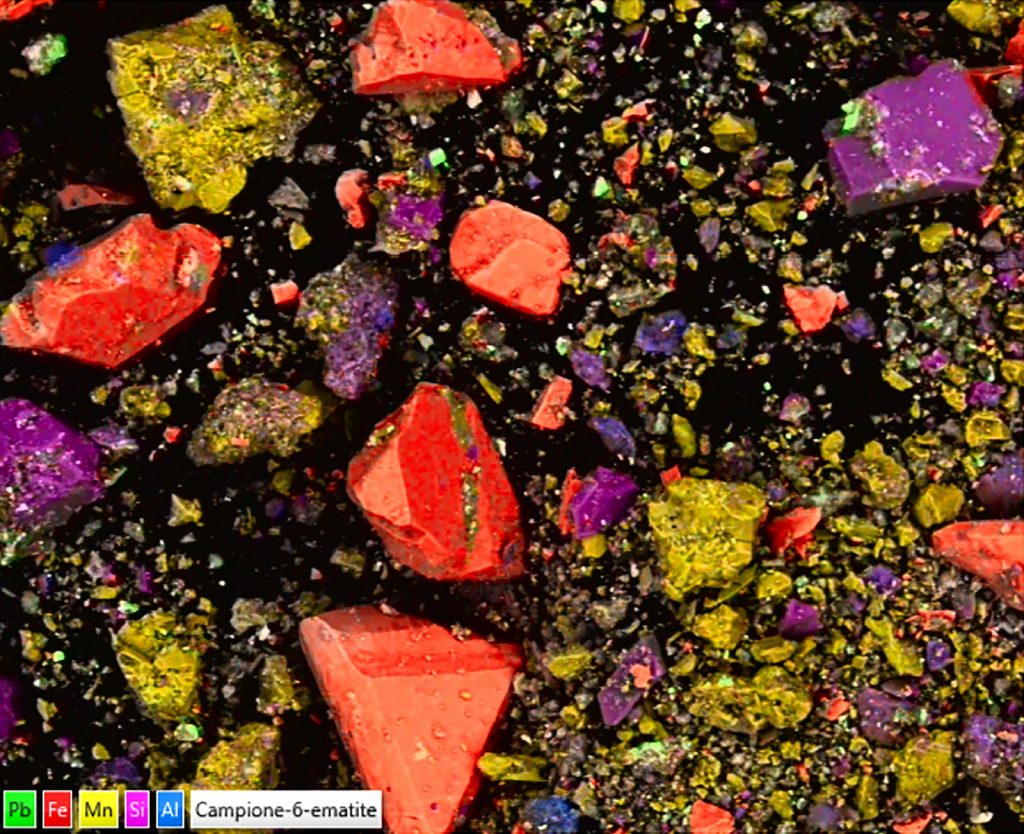
“What was left of the contents was effortlessly extracted in the form of a loose, dark purple fine powder,” the study authors said. “Soil burial contamination, in principle, cannot be excluded but in the light of subsequent observation at the optical microscope it looks minimal.”

The team used a variety of technologies to analyze and date the pigments, discovering mineral components including ground hematite, quartz, braunite, anglesite, and rare tiny crystals of galena—a lead mineral. “The respective amounts of lead minerals are very limited,” the researchers wrote, adding that the minerals that produce a deep red—primarily hematite—make up more than 80 percent of the analyzed sample.


The powder also contained some vegetal fibers, which the researchers suggested were possibly used to make the lipstick fragrant. “Ultimately, the deep red cosmetic is compatible with a lips coloring preparation—probably the earliest so far analytically reported,” the researchers said.

The researchers noted that it remains unknown precisely the agency, gender, or sex-specific identities of anyone buried in the graveyards in the region and, as such, impossible to precisely conclude who might have used the lipstick and under what conditions.

“In case this and other cosmetic substances, in certain periods and in certain contexts, should turn out to be consistently associated to female burials, one could explore the possibility that this gradually enhanced technology was also a function of increasing social stress to which women were exposed in times of fast social change,” the researchers concluded.

READ More  Italian Artworks Head To Phoenix Art Museum Next Month

ancientbackdatingfoundiniranislipstickmillenniamorethanthree
0
FacebookTwitterPinterestLinkedinWhatsappEmail
The Culture Newspaper

previous post
10 Most Expensive Paintings Ever Sold
next post
Chinese Online Literature Attracts Worldwide Fans

You may also like

Ibeme Laurina Captures Life, Memories And African Traditions...

October 16, 2026

Museum Marks 60 Years Celebrating County’s Heritage

October 15, 2026

Sola Olumuyiwa Paints The Pulse Of Lagos Iin...

October 12, 2026

Kokopelli Gallery Marks Five Years With “Call And...

October 6, 2026

British Museum Announces Changes To Ease Bayeux Tapestry...

October 5, 2026

Artists Announced For 2026 Lagos Biennial

October 5, 2026

In Lisbon, Ndikama Museum Reconnects with Benin’s Golden...

October 4, 2026

Ogun Quarterly Visual Arts Exhibition To Boost Creative...

October 1, 2026

David Bowie’s Venue Ban Lifted For New Exhibition

October 1, 2026

UK Retains Free Entry To National Museums For...

September 30, 2026

Leave a Comment Cancel Reply

Save my name, email, and website in this browser for the next time I comment.

Recent Posts

  • AJOFEST @ 40: RMD, Theatre Legends Reunite To Relive Cultural Revolution
  • Pan Macmillan Acquires Stake In New River Books
  • AFRIFF Unveils Star-Studded International Jury, Blockbuster Lineup For 15th Edition In Lagos
  • Readbug LitFest 2026 To Inspire Young Minds Through Stories That Build Worlds
  • African Cultural Film Festival To Light Up Houston

Sponsored

Recent Posts

  • AJOFEST @ 40: RMD, Theatre Legends Reunite To Relive Cultural Revolution

    October 17, 2026
  • Pan Macmillan Acquires Stake In New River Books

    October 17, 2026
  • AFRIFF Unveils Star-Studded International Jury, Blockbuster Lineup For 15th Edition In Lagos

    October 17, 2026

Categories

  • Arts & Exhibitions
  • Culture & Festivals
  • Culture Africana
  • Culture People
  • Fashion & Lifestyle
  • Food
  • Music, Movies & More
  • News
  • Opinion
  • Photo News
  • Reviews (The Critics)
  • TCN Interview
  • TCN Literati
  • Tourism & Hospitality
  • Travel News
  • Travel Trends
  • Travelogue
  • What's Hot?
  • World Culture

Connect with us

Connect with us
  • Facebook
  • Twitter
  • Instagram
  • Youtube
  • About Us
  • Advertise With Us
  • Privacy Policy
  • Contact Us

@2025 - The Culture Newspaper. All Right Reserved. Maintained by Freelart

The Culture Newspaper
  • Home
  • Arts & Exhibitions
  • Culture & Festivals
    • Culture Africana
    • Culture People
  • Fashion & Lifestyle
    • Music, Movies & More
  • News
    • Travel News
  • Opinion
    • Reviews (The Critics)
  • TCN Literati
  • Tourism & Hospitality