
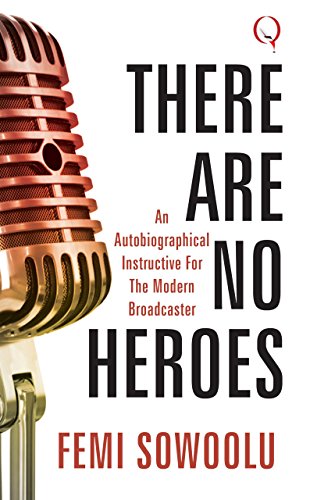
Title: There are no heroes: An autobiographical instructive for the modern broadcaster
Pages: 236
Price: ₦5000.00 ($17.00)
Author: Femi Sowoolu
Publishers: Quramo Publishing, Nigeria
Year of publication: 2016
Reviewer: Kole Odutola
What does a book review entail? What purpose should it serve the society and the writer of the book under review? If I cannot find answers to these questions in the next few days I doubt if I will ever have the liver to review these 236 pages from a very sensitive Nigerian. If you stick with me long enough you will understand my trepidation in embarking on a task no one has saddled me with.
In these days of ‘uncle Google’ and other search engines, I did not need to go too far to find an apposite response to my questions above. Jared Rhoads (2013), offered this very lengthy explanation and I shall burden you with it in its entirety: “the basic purpose of a book review, as I see it, is to help readers decide whether to read the book themselves. A book review should identify the central idea of the book, give the reader some indication of the author’s style, approach, or premises, and then offer an overall evaluation. The reviewer should tell the reader what the book covers, but in a selective way. If you are the reviewer, do not recap the entire book. And if it is a work of fiction that you are reviewing, certainly don’t spoil the ending or reveal any surprises.
In some circumstances, it is appropriate to engage more intensely with the material in an extensive, point-by-point treatment–for instance, if you really want to refute an author’s entire theory and work.”

Femi Sowoolu, author. (PHOTO: Yes Magazine)
I guess with that roadmap, this self-saddled task is made easy. I have no doubt that Femi Sowoolu’s book must be accorded a space on your book shelves and must be read not once but twice and as many times as you feel like keeping company with a good flowing prose that runs fast like wine or fresh ogurọ. There are many parts of the book that will resonate with different segments of the Nigerian society and even those in the diaspora. Should you feel like applying any of the influence of the media theory to the reading of this book (“people are influenced by the media as much as they allow themselves to be, creating their own meanings out of the messages the media offers them”), it will do one or two things to you. It may influence you to re-think your own life and ask why you have not made an impact in life as the writer of this book has done. The other influence is that you may feel so depressed that a fellow human being has achieved so much with so little and from that start re-building your life. Whichever influence it will have on you it is yours to decide.
The only downside is that if you have never heard the writer’s voice or listened to any of his programs you may not enjoy the ride as much as those of us who have had the pleasure of listening to him or watched him closely at work. You have to pardon me for this little digression but you may understand why I am pushing it here instead of waiting till my concluding section. How nice it would have been if the book had come with a CD of samples of the writer’s programs, or samples of some of the works he wrote glowingly about. On this same premise, I wonder if there is any archive of audio programs the future generation can consult as they map their own journeys. If an initiative such as this will ever happen, it will only happen by the grace of a man like Femi Sowoolu. As you read the book, you will get to understand the kind of fertile and versatile mind he carries in his very sturdy frame.
There are no heroes: An autobiographical instructive for the modern broadcaster, is a book about so many things including interesting historical instances. A reader will enjoy the racy narratives of happenings behind the scenes in about four different radio stations. The part I loved the most was his candid discussions of why he left or was fired from the job. Each time he came out smelling of roses. Should you be one of those who may be interested in knowing about Femi Sowoolu’s shortcomings, sorry this is not the book for you. He even goes to ask: “How much of a principled life can a man [or woman] live when the society in which he [she] resides is so corrupt?” (pg.228). The answer to that rhetorical question is presented in a lecture format about principles. Let me be upfront here: Femi has kept his nose clean in most matters social, political or professional. The book does not open any can of worms but paints a man interested in all other men are interested in. He is no saint nor do his sins as chronicled in this book offend the senses. In any case should you ever be bored – which I doubt – there are parts that are written as compensation for those who love to read juicy details of altercations, so you get to read a tiny bit about his private life but more about his public persona and what he stands for. This is a man not afraid to express what he feels about any living being (or even the dead). The bits about Bola Wola-Makinde and his spat with Olusesan Ekisola or that with Jide Asumah among many others may ruffle some feathers. A book from them may just be a way to get even. If disclosures about these individuals startle you in any way then you must run quickly to read about his pains-taking assessment of Ben Murray Bruce’s organizations, which includes Silverbird and Rhythms FM Radio. As Yoruba people say; I refuse to be the one to divulge that the teacher’s mother flies at night. So you better find out yourself.
Apart from the salt and pepper here and there in this book it also shows the writer as an eclectic reader who can hold his own on any subject. Check out his reconstruction of the board game, Snakes & Ladders, on pages 146 to 147, or his representation of notable dictators from Adolf Hitler to Mobutu Sese Seko (formerly Joseph Mobutu). He uses their stories to illustrate the point that a time tested tactic of “leadership takeover is to discredit all rivalry and eliminate all contending voices” (pg. 213). The reader will have to plough through the pages to appreciate the point the writer wanted to make. In my opinion it was done like a writer who knows his onions would.
It is not unexpected that gaps in memory will show up in the narration of past events. I like Femi Sowoolu’s version of how Golden Tones evolved and the part he played in it. A man like Don Pedro Okojie will have to add to the story and the role he played as music consultant for the Benson & Hedges Music, which became the golden tones. If this personal addition is anything to write home about, it goes to show that many more books like this are needed to tell the comprehensive social history of Nigeria.
As earlier stated, “There are no heroes: An autobiographical instructive for the modern broadcaster” has something for every discerning reader. Femi Sowoolu is very passionate about management theories and practices and he leaves no one in doubt about his love for the subject. Did he almost over do it? Well this is a case of ‘one person’s Goodluck Jonathan is another person’s Sai Baba!’ To each his own, I will say.
The book, in some ways, invites a casual post-colonial reading and interpretation. The first flags of attention can be seen in the choice of quotes used at the tail end of each chapter. There are a total of 57 such quotes and less than 7 are from Africans or people from developing climes. One of the sayings of Chief M.K.O Abiola made the list on page 107 and you have to wait till page145 before the names of books written by Africans show up. To most readers this is no big deal but to media scholars who are constantly singing the knowledge nationalism anthem, it is a deal big enough. I have my own opinion on why Africans hardly include quotations by Africans in their publications. One cruel interpretation is to think that ideas by Westerners are the only ones worth circulating. The other pragmatic interpretation is the issue of accessibility. Western quotes are everywhere and they speak succinctly to modern and global issues more readily than that of “our own people.” This is probably not the forum to expand on the merits and demerits of each school of thought. Let me just end by saying that the more we do not dig deeper to bring ours to the fore, the more they will not be accessible for others to reflect upon.
Well if you did not understand my trepidation for embarking on a task no one has saddled me with, then I think you need to quickly buy a copy and just maybe it will be as clear as that soft-drink advert of yore.
Perceived flaws notwithstanding, this is a book worth your dime and time. Buy, borrow or “steal” a copy as soon as you can – especially if you are at that stage in life when another man’s look back at life can facilitate your own review. To say I have become the better for it is an understand statement.
“As you find the balance of your personal search for a true meaning in life, I wish you God’s guidance. And do have fun while at it”, Femi Sowoolu, 2016.