
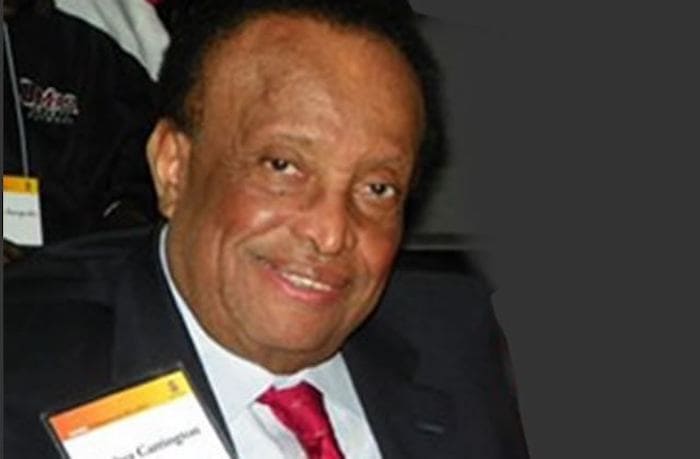
Eighteen days after his 90th birthday, former United States Ambassador to Nigeria, Walter ‘Omowale’ Carrington, has passed.
The much-beloved and highly respected American whose second home was Nigeria, passed on Tuesday, August 11 in the US.


His wife, Arese, a medical doctor from Benin City, Edo State, announced his passing in a brief message titled ‘Press Release – Ambassador Walter C. Carrington, former US Ambassador to Nigeria and Senegal.’


It read: “It is with a heavy and broken heart but with gratitude to God for his life of selfless humanity that I announce the passing of my beloved husband Walter Carrington, former US Ambassador to Nigeria and Senegal.
“He passed away peacefully, surrounded by loved ones at the age of 90 years old on Tuesday, August 11, 2020. Further announcements will be made shortly. Walter was a loving husband, father, grandfather, cousin, uncle, friend and in-law.”
The US Ambassador to Nigeria from 1993 to 1997 had clocked 90 on July 24. Though he was in the US, Nigerians, especially those of the progressive hue, had celebrated him.
Former Governor of Osun State and Minister of Interior, Ogbeni Rauf Aregbesola in a tribute titled ‘Toast to Ambassador Carrington at 90’ highlighted his contributions to the enthronement of democracy in the country, despite the threat to his life.
He said: “Ambassador Carrington went beyond diplomatic limits in the engagement of the Abacha regime and the struggle for military disengagement and enthronement of democratic government. This, alarmingly, at diplomatic and personal risks.
“He rallied the diplomatic corps against the regime’s abuse of human rights and brutalisation of Nigerians, especially critics and pro-democracy activists. He was unrelenting in his call for the release of Chief Abiola from illegal and unjust detention…
“Ambassador Carrington projected the United States as our greatest ally in the quest for democracy, human rights and social justice in a way never seen before and after his departure. No doubt, his place in the history of democratic struggles in Nigeria is assured.”
Former Senator, Shehu Sani, had also acknowledged his contributions, tweeting: “Many young Nigerians may not know Walter Carrington. He was the US Ambassador in the 90s who sided with the forces of freedom & democracy during Nigeria’s era of military rule. A man of courage, principles and conviction. This is to wish him a happy 90th birthday.”
Even President Muhammadu Buhari was not left out. He felicitated with Carrington through a statement signed by, his spokesperson, Garba Shehu.
“The President wishes to use this opportunity to put on record his appreciation and that of the Federal Republic of Nigeria for the extraordinary support of the Ambassador for democratic causes in Nigeria and around the globe.
“The President notes in particular, the support of Ambassador Carrington and those of other patriots including the National Democratic Coalition (NADECO) for the June 12 political cause in Nigeria,” the statement read.
Carrington’s affair with Africa and Nigeria began in 1952. He came to Dakar, Senegal as a delegate of the NAACP ((National Association for the Advancement of Colored People) Youth Council. His sustained relationship with Nigeria, however, began in 1959, the eve of the country’s independence.
He led a group of students on a program called The Experiment in International Living. They spent a summer living with Nigerian families in Lagos, Ibadan, Enugu, Port Harcourt, Kano and Kaduna. On that occasion and subsequent visits when he was an official of the Peace Corps, he met many of the country’s leading lights.
All these happened after he had graduated from both Harvard College (1952) and Harvard Law School (1955) and practising Law in Massachusetts. He had also served on the three-member Massachusetts Commission Against Discrimination becoming, at the age of 27, the youngest person to be appointed a commissioner in the state’s history.
Carrington returned to Africa in 1961 as one of the first overseas Directors of the Peace Corps. In 1967, he evacuated young Americans as Biafran troops advanced towards Benin City.
After the Peace Corps, Carrington’s professional career continued to revolve around Africa. He became a highly respected American specialist on Africa and America’s policy toward the Continent. In the 1970s, as Executive Vice President of the African-American Institute in New York, he oversaw programs that provided scholarships to hundreds of Nigerians for study in the United States.
He served as publisher of the Institute’s magazine, Africa Report, which was then the leading publication on African affairs in the United States. He reported on Nigeria’s post-war efforts of reconstruction and rehabilitation. He later taught African Politics and American Foreign Policy at several universities in the United States. He has written and lectured widely on Africa and the status of African-Americans in the United States and hosted a television series, The African World. He has worked on African issues as a top staff aid in the US Congress and at the leading African-American think-tank, the Joint Centre for Political and Economic Studies in Washington, DC.
In 1980, President Jimmy Carter appointed Carrington as Ambassador to Senegal. 1n 1993, President Bill Clinton appointed him Ambassador to Nigeria. He arrived in Lagos a few months after the annulment of the June 12, 1993 elections presumed won by the late Chief MKO Abiola. The invalidation caused massive social unrest, finally leading to Babaginda handing power over to an interim civilian president, Chief Ernest Shonekan. Carrington was the last diplomat to present his credentials to the new president because two weeks later, General Sani Abacha sent Shonekan packing in a bloodless coup.
In the four years, he served as Ambassador of the United States to Nigeria; the diplomat was an outspoken champion of human rights and Nigeria’s return to democracy and civilian rule. Despite threats to his person and family, which included assassination attempts, Carrington continued to call for the end of military rule throughout his tour in Nigeria and after returning to the United States.
He was an uncommon diplomat who openly identified with Nigerians such that they fondly named him Omowale – “the child who has returned.” After his tour of duty in Nigeria ended, Carrington continued to remain involved, doing his best to enable the country to return to democratic rule.
After the return to civilian rule in 1999, the area in Lagos on which the American and a dozen other diplomatic missions are located was renamed “Walter Carrington Crescent.” In 2003, President Olusegun Obasanjo conferred upon him the national honour award of “Officer of the Federal Republic (OFR).”
In 2010 Governor Babatunde Fashola of Lagos hosted a State banquet in honour of Carrington’s 80th birthday. A collection of his Nigerian speeches, ‘A Duty to Speak: Refusing to Remain Silent in a Time of Tyranny’, was published in Nigeria that same year. It was launched as part of his birthday celebrations.
Three years ago, Governor Akinwumi Ambode’s administration also hosted the public presentation of Arese’s book, ‘Defend the Defenseless’. Though billed as a book event, it was more a celebration of the Carringtons for their role in Nigeria’s recent history.
He graciously wrote the foreword to a landmark book by the Lagos State Ministry of Tourism, Arts & Culture in May 2019 titled ‘The Coolest City on Earth’. The publication documents the experiences of leading non-Nigerian artists, scholars, culture managers and tourists who have had intimate encounters with Lagos as a vibrant culture and entertainment hub.
The culture community and civil society will sorely miss him.