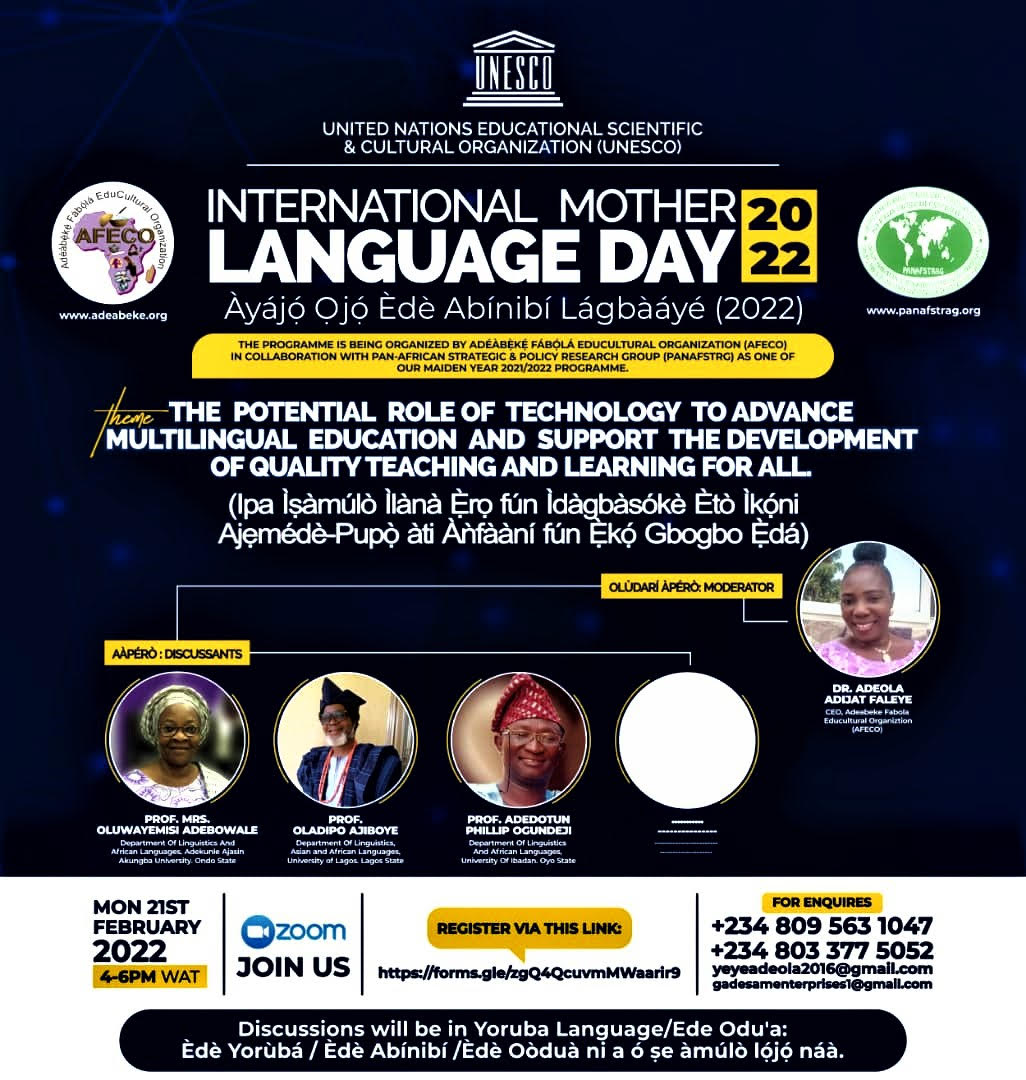
Come Monday February 21, 2022, the United Nations Educational, Scientific, and Cultural Organization, UNESCO will observe the 2022 International Mother Language Day.
Themed 2022 International Mother Language Day, “Using technology for multilingual learning: Challenges and opportunities”, the event will discuss the potential role of technology in advancing multilingual education and support the development of quality teaching and learning for all.


The virtual event will explore two main themes: Enhancing the role of teachers in the promotion of quality multilingual teaching and learning and; Reflecting on technologies and their potential to support multilingual teaching and learning.


To mark the global event in Nigeria, Dr. Adeola Faleye; CEO, Adeabeke Fabola Educultural Organisation (AFECO) will moderate a virtual event to discuss the theme of the event in the Yoruba Language.
The event is organized by AFECO and in collaboration with Pan-African Strategic and Policy Research Group.
She will be joined by a panel consisting of Prof Oluwayemisi Adebowale, Department of Linguistics and African Languages, Adekunle Ajasin University, Akungba, Ondo State, Prof Oladipo Ajiboye, Department of Linguistics, Asian and African Languages, University of Lagos, Lagos State and Prof Adedotun Phillip Ogundeji, Department of Linguistics and African Languages, University of Ibadan, Oyo State.
According to UNESCO, technology has the potential to address some of the greatest challenges in education today. It can accelerate efforts towards ensuring equitable and inclusive lifelong learning opportunities for all if it is guided by the core principles of inclusion and equity. Multilingual education based on mother tongue is a key component of inclusion in education.
“During COVID-19 school closures, many countries around the world employed technology-based solutions to maintain continuity of learning. A recent UNESCO, UNICEF, World Bank, and The Organisation for Economic Co-operation and Development, OECD survey on national education responses to COVID-19 school closures of 143 countries showed that 96 percent of high-income countries provided remote learning through online platforms for at least one education level compared to only 58 percent of low-income countries. In low-income contexts, the majority of countries reported using broadcast media such as television (83%) and radio (85%) to support continuity of learning.
Obviously, teachers lacked skills and readiness for using distance teaching. Many learners lacked the necessary equipment, internet access, accessible materials, adapted content, and human support that would have allowed them to follow distance learning. Moreover, distance teaching and learning tools, programs and content are not always able to reflect language diversity” UNESCO stated.
The idea to celebrate International Mother Language Day was the initiative of Bangladesh. It was approved at the 1999 UNESCO General Conference and has been observed throughout the world since 2000.
“UNESCO believes in the importance of cultural and linguistic diversity for sustainable societies. It is within its mandate for peace that it works to preserve the differences in cultures and languages that foster tolerance and respect for others” a statement from UNESCO highlighted.