
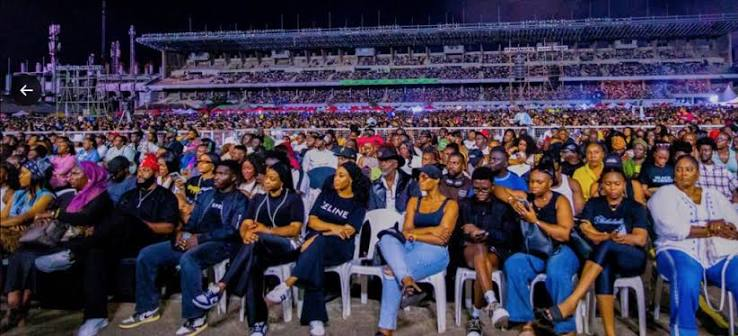
On Saturday, September 26, 2026, Pastor Jerry Eze held the NSPPD UK Prayer Conference at Old Trafford, home of Manchester United.
Old Trafford holds about 74,000 people. Registration was fully booked. Admission was free, so this was not about ticket revenue.
Watching that crowd brought back a question I keep returning to.
Who exactly fills these venues when successful Nigerians take their ministries, music, businesses and products abroad?
This is my observation, and I am stating it plainly.
A significant proportion of the people supporting Nigerian pastors, musicians, comedians and businesses abroad are NIGERIANS, and more broadly, Africans in the diaspora.

Look at our musicians.
Davido has headlined The O2 in London several times, including January 2024
Wizkid sold out three nights at The O2 in 2021
Burna Boy sold out London Stadium in 2023, the first African artist to headline a UK stadium.
I should be fair to the facts here. Music is the category that has travelled furthest.
Afrobeats now fills arenas with crowds well beyond the Nigerian and African diaspora, and streaming numbers, festival bookings and mainstream collaborations back that up.
Of everything I am describing in this post, music is closest to genuine global market penetration rather than diaspora demand alone.
But the same cannot yet be said with confidence for our ministries, our food, our cosmetics or our fashion. That is where the harder question still applies.
How much of the initial economic engine behind these international successes is still Nigerian?
And it is not only music.
Nigerian churches and ministries draw large gatherings in London, Houston, Toronto and beyond.
Nigerian comedians tour abroad.
Nigerian films are watched by Nigerians across the world.
Move beyond entertainment.
Nigerian food: egusi, ogbono, garri, palm oil, spices, snacks and processed products.
Nigerian fashion: ankara, adire, traditional wear, Nigerian designers.
Nigerian beauty: creams, black soap, shea butter, hair products, cosmetics.
Nigerian entrepreneurs have found a ready market for these in London, Manchester, Toronto, Houston and Atlanta.
This is where something important is happening, and I will say it directly.
We describe these businesses, artists, pastors and brands as having gone international because they operate outside Nigeria.
But international location and international customer base are NOT THE SAME THING.
A Nigerian pastor can fill a Manchester venue with a Nigerian congregation.
A Nigerian cosmetics company can export to the UK while most of its buyers are Nigerians living there.
NONE of that is a lesser achievement.
It is a different achievement, and one still earlier on the curve than music has reached.



Nigeria did not only export people. We exported a market.
Millions of Nigerians have relocated to the UK, the United States, Canada and Europe. They now earn pounds, dollars and euros.
But migration does not erase taste, culture, religion, entertainment preference or emotional connection.
The person left Nigeria. Nigeria did not leave the person.
And this does not apply only to first generation migrants.
In many families, Nigerian identity, food, music, faith, fashion and consumption patterns are being passed to children who were born abroad.
So the market can reproduce itself outside Nigeria.
They still listen to Nigerian music.
Still watch Nigerian films.
Still attend Nigerian churches.
Still buy Nigerian food, beauty products and clothing.
Still follow Nigerian personalities.
And now they are doing it with far stronger currencies and far greater purchasing power.
This changes the economics completely.
Someone who would struggle to spend the naira equivalent of £100 on entertainment in Lagos can spend £100 on a concert ticket after earning income in London.
The cultural preference stayed Nigerian. The purchasing power did not.
The money is not coming from Nigeria.
It is being earned in Britain, America and Canada.
But the consumer making the decision to spend it is Nigerian.
The income has become foreign
Part of the consumption remains Nigerian.
This raises questions I think we need to sit with.
We likely underestimate the true size of the Nigerian market by counting only people living inside Nigeria.
There is another NIGERIAN CONSUMER ECONOMY scattered across the world.
Our diaspora may be one of the greatest distribution channels Nigerian business has, if we stop viewing Nigerians abroad only through the lens of remittances and start seeing them as customers, distributors, promoters and gateways into foreign markets.
And there is a REAL DIFFERENCE between diaspora success and full global market penetration:
50,000 Nigerians and Africans filling a London concert is a major achievement. 50,000 people with no prior connection to Nigeria doing the same is a different one.
Music has already made that leap in large part.
Ministry, food, fashion and cosmetics have not, yet.
Our diaspora is the bridge. It should not be the final destination.
In fact, diaspora demand may be exactly how global penetration starts.
Nigerians abroad create the first concentrated customer base.
They sustain the restaurants, stores, concerts and brands.
Those businesses then become visible to non Nigerians.
What begins as an ethnic market can gradually become a mainstream market. We have already seen something close to this trajectory with Afrobeats.
Here is the uncomfortable question I keep coming back to.
What does it say about Nigeria that some Nigerians become more valuable consumers of Nigerian products only after leaving Nigeria?
The talent is still Nigerian.
The music, the food, the ministry, the brand are still Nigerian.
But much of the purchasing power that makes the transaction work was created outside Nigeria.
That should force a serious conversation about wages, disposable income, productivity, currency strength and the economic environment at home.
The people migrated
The purchasing power changed
But much of the culture travelled with them
The Nigerian market did not disappear.
It relocated, and in some cases, became richer.
And this is before we even talk about remittances
According to World Bank data, personal remittances received by Nigeria were equivalent to about 8.4% of GDP in 2024.
With Nigeria’s 2024 GDP at roughly US$252.3 billion, that puts remittance inflows at close to US$21 billion.
Sit with that figure.
Nigerians abroad are not only attending our concerts, supporting our ministries and buying our food, fashion and cosmetics.
They are also sending tens of billions of dollars home every year.
So the diaspora contributes in at least 2 distinct ways:
1. Money sent back through remittances.
2. An external market for Nigerian culture, entertainment, ministry and business that never needs to touch Nigerian soil to count as Nigerian economic activity.
Remittances bring diaspora purchasing power back to Nigeria.
Diaspora consumption takes Nigerian economic opportunity to where the purchasing power already is.
Remittances measure money sent into Nigeria.
What I am describing here is wider than that.
It is money Nigerians earn and spend abroad on Nigerian products, services and institutions, money that may never physically enter the country and yet is unmistakably part of the Nigerian economic story.
– Adetula, a Business Execution Strategist is the CEO at Acceltage Consulting