
This fall, two New York City museums that have helped shape contemporary culture are finally reopening to the public. One is the New Museum, the pioneering non-collecting institution on Bowery, which closed last year to build an expansion, designed by OMA/Shohei Shigematsu and Rem Koolhaas, that will nearly double its exhibition space.
The other is the Studio Museum in Harlem, the influential center for work by Black and African diaspora artists, which is opening a long-awaited new home on 125th Street, designed by Adjaye Associates in collaboration with Cooper Robertson, after closing its old building for demolition in 2018.
While both museums have stayed active through off-site and virtual programs, the opening of their new spaces will return New York’s museum landscape to its welcome density.
The Studio Museum, founded in 1968, and the New Museum, born in 1977, have expanded the scope and audiences for contemporary art for decades, in the process evolving from alternative roots that challenged the hierarchy to power players in their own right.
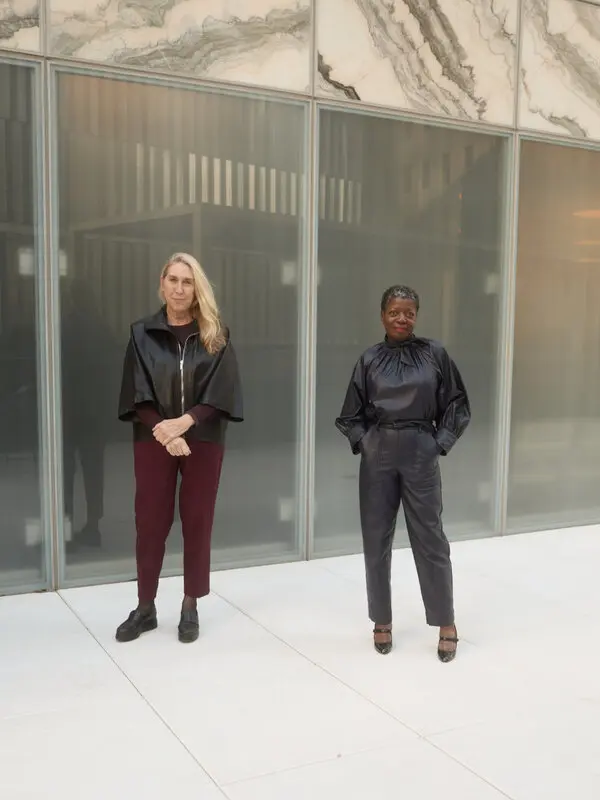
For Lisa Phillips, director of the New Museum since 1999, and Thelma Golden, director and chief curator of the Studio Museum since 2005, the connections are personal too. The two are good friends — they talk several times a week — and have shared experiences as female leaders whose influence in the museum field is felt not only in exhibitions and programs, but also through the many curators and other professionals who came through their institutions early in their careers.
Tempering the excitement, however, is the current fraught atmosphere for cultural organizations. This new reality has brought — so far — deep cuts in staffing and grantmaking by the National Endowment for the Humanities, efforts to dismantle the Institute of Museum and Library Services, and ultimatums by President Trump to end diversity programs and remove what he describes as “corrosive” and “anti-American” ideology from the Smithsonian Institution. Recently, the incoming director of the Museum of Fine Arts, Boston, described the overall climate around museums under the Trump administration as “volatile.”
When we met in early March in downtown Manhattan, Phillips and Golden were guarded in addressing the current atmosphere, but they said they were drawing on historical lessons to reinforce their sense of mission.
This conversation, reflecting a joint interview and follow-up questions by telephone, has been edited for length and clarity.
How do you plan to reintroduce your museums to New Yorkers and visitors?
LISA PHILLIPS With the doubling of our space, we have an opportunity to do broader outreach than we’ve ever done. We’re mobilizing our whole staff to go into the neighborhood and have personal interactions with both our partners and beyond. There are so many organizations around us. Shopkeepers, residents in NYCHA housing, we have an opportunity to go out and to invite people in. And there is going to be so much to experience in the architecture, in addition to the art program.
THELMA GOLDEN I know that both the designs of our institutions took in a thoughtful approach to create deeper experiences, not just for artists but for audiences. We’ll be welcoming people who had never come to the Studio Museum, to have this be the occasion to invite them to the museum and to Harlem.
Thelma, in these seven years, a huge amount has happened that connects to the museum’s core mission of presenting the work of artists of African descent — from the Black Lives Matter upsurge in 2020 to the surging market and its impact on artists. Was it frustrating to not be open during that time?
GOLDEN Absolutely. Frustrating because we were made for this moment, our history in some ways ushered in this moment. But there was something profound in being able to witness it as we were working to build this next life for this institution. The energy around artists of African descent lives as proof of concept to what our founders imagined when they took a little loft on 125th Street and Fifth Avenue. They were imagining a future for Black artists in the world that at that time did not exist, but they knew that they could see it and they could work to make it happen.
PHILLIPS There was also a tremendous acknowledgment in the field of the history and legacy of the Studio Museum and its impact on all of us during this time. So in a way, it was constantly alive.
Are there lessons from the last few years that you each carry into programs as you reopen?
PHILLIPS It’s been a period of profound disruptions — not just the last year and a half, but the last decade. The pandemic made us think about our programs differently, because we had to be remote, find ways to engage our audience outside of the norm. We realized that virtual platforms are as important as bricks and mortar. I know we believe similarly in that.
GOLDEN This building project has meant rooting deeply in legacy — to project into the next idea of what we will be as a museum. For our founders the canon could not be complete without the voices and visions of Black artists, so they were going to reimagine and open that canon. They were trying to think of a museum as studio, this museum in Harlem as a new type. That’s what we can be doing in this moment — imagining a new form of museum as we make a future.
Credit: New York Times